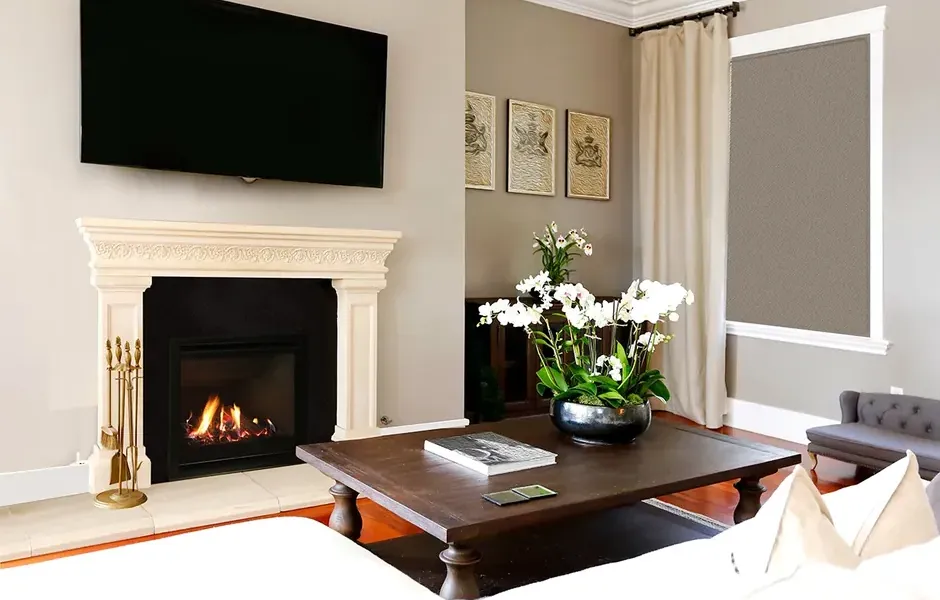
That beautiful brick fireplace or stunning stone accent wall seems like the perfect spot for your TV. But before you grab a drill, you need to answer a critical question: Is it solid masonry or decorative veneer?
The answer determines whether your installation will be rock-solid for decades-or result in cracked material, a failed mount, and potentially a destroyed TV.
This guide explains how to identify what you’re working with, the safe drilling techniques for each material type, and when you should absolutely not drill without professional assessment.
Solid Masonry vs. Veneer: Understanding the Difference
Solid Brick
What it is: Full-dimension clay or concrete bricks (typically 3.5” thick) stacked and mortared to create structural walls.
Where you’ll find it:
- Older Atlanta homes (pre-1960s)
- Load-bearing exterior walls
- Some interior fireplace chimneys
- Historic buildings and renovations
Characteristics:
- Each brick is 3.5” or more thick
- Bricks are structural (supporting weight)
- Can directly support heavy loads
- Drill depth can exceed 2-3 inches safely
Brick Veneer
What it is: A single layer of brick (3.5” or thinner) attached to a backing structure, usually wood framing or concrete block.
Where you’ll find it:
- Most homes built after 1960
- Decorative exterior cladding
- Interior accent walls
- Fireplace surrounds
Characteristics:
- Single brick thickness (3.5” or less)
- Brick provides appearance, not structure
- Backing material varies (wood frame, metal studs, concrete)
- Heavy loads must anchor to backing, not brick alone
Thin Brick Veneer (Brick Tile)
What it is: Ultra-thin brick slices (½” to 1”) adhered to wall surfaces like tile.
Where you’ll find it:
- Modern accent walls
- Kitchen backsplashes with “brick” appearance
- Fireplace refacing
- Commercial interiors
Characteristics:
- Less than 1” thick
- Cannot support any mounting loads
- Purely decorative
- Must drill through to backing material
Natural Stone Veneer
What it is: Real stone cut thin (1” to 2”) and applied to wall surfaces.
Where you’ll find it:
- Fireplace surrounds
- Accent walls
- Exterior cladding
- High-end interior finishes
Characteristics:
- Beautiful but fragile when thin
- Cracking risk during drilling
- Must anchor to backing structure
- Stone provides appearance, not strength
Manufactured Stone Veneer
What it is: Concrete-based material molded and colored to look like natural stone.
Where you’ll find it:
- Fireplace surrounds
- Interior accent walls
- Exterior cladding
- Budget-friendly stone appearance
Characteristics:
- Typically 1.5” to 2” thick
- Lighter weight than real stone
- Cannot support heavy loads alone
- Must anchor through to backing
How to Identify What You Have
Method 1: Wall Thickness Assessment
For fireplaces and accent walls:
- Find an edge or corner where material meets another surface
- Measure the visible thickness of brick/stone
- Look at any exposed edges or gaps
What you’re looking for:
- Full brick (3.5”+) suggests solid masonry
- Single brick thickness (3.5”) suggests veneer on backing
- Thin material (½” - 2”) is definitely veneer
Method 2: The “Knock Test”
Tap on various areas of the wall and listen:
Solid masonry: Dull, dead thud with no hollow resonance
Veneer on wood frame: Slightly hollow sound, possible vibration
Veneer on concrete: Solid sound but may feel different than deep masonry
This test is not definitive but provides clues.
Method 3: Check Visible Construction Details
Look for:
- Metal ties or straps (indicate veneer system)
- Weep holes at wall base (veneer)
- Building age (newer homes almost always use veneer)
- Consistency of brick/stone depth
Method 4: Test Drill (Carefully)
Last resort verification:
- Choose an inconspicuous spot
- Drill a small pilot hole (3/16”)
- Note depth before breaking through to different material
- Less than 3.5” to air/cavity = veneer
Caution: This creates a hole you’ll need to address.
Safe Drilling Techniques by Material Type
Drilling into Solid Brick
Required tools:
- Hammer drill (not regular drill)
- Carbide-tipped masonry bit
- Safety glasses
- Dust mask
Technique:
- Mark your drill point on brick face, not mortar
- Start at slow speed without hammer function to establish hole
- Engage hammer function and increase speed
- Apply steady pressure-let the drill do the work
- Periodically withdraw to clear dust
- Continue to desired depth (typically 2-2.5” for anchors)
Anchor options:
- Sleeve anchors
- Wedge anchors
- Tapcon screws
- Lead shields with lag bolts
What can go wrong:
- Drilling at angle (use guide if needed)
- Overheating bit (take breaks)
- Hitting air pockets in old brick
- Cracking brittle or weathered brick
Drilling into Brick Veneer
Key difference: You’re drilling through brick and into the backing material.
Assessment first:
- What’s behind the brick? (Wood frame, metal studs, concrete block?)
- Is the brick in good condition or deteriorating?
- Can you reach backing material with anchors?
Technique:
- Drill through brick using masonry bit
- When you break through, note what’s behind
- If wood: Continue with appropriate wood bit, use lag bolts
- If metal studs: Use toggle bolt system
- If concrete: Continue with masonry bit and use concrete anchors
Critical consideration: If brick is thin or cracked, the act of drilling may:
- Crack or shatter the brick
- Dislodge the brick from its adhesive
- Create visible damage
When to stop:
- If brick shows any cracking during drilling
- If brick feels loose or hollow
- If you can’t reach solid backing
Drilling into Stone Veneer (Natural or Manufactured)
High risk material: Stone veneer cracks easily during drilling.
Before drilling:
- Assess stone thickness and condition
- Determine backing material
- Consider whether drilling is the best approach
If proceeding:
- Use diamond-tipped bit for natural stone, carbide for manufactured
- Start without hammer function
- Keep speed moderate to reduce heat
- Apply very light pressure
- Drill slowly and patiently
- Stop immediately if cracking begins
Alternative approaches:
- Mount to backing structure only (drill between stones)
- Use surface-mounted systems that avoid drilling
- Consider mortar joint routing instead of stone drilling
When NOT to Drill
Absolutely Do Not Drill When:
Material is too thin:
- Thin brick veneer (under 1”)
- Cultured stone under 1.5”
- Any material that can’t accommodate anchor depth
Material is damaged or deteriorating:
- Cracked or spalling brick
- Stones with visible fracture lines
- Mortar that’s crumbling
- Material showing efflorescence (white mineral deposits)
You can’t identify the backing:
- Unknown construction behind veneer
- Potential for hitting utilities
- Air gaps with no solid backing
The risk isn’t worth it:
- Irreplaceable historic materials
- Extremely expensive stone
- Material that can’t be matched if damaged
Red Flags During Drilling
Stop immediately if:
- Material starts cracking around the hole
- Drill suddenly breaks through to open space
- Material feels like it’s moving or flexing
- Unexpected dust color (may indicate hitting something else)
- Drilling feels “crunchy” rather than solid
Alternative Mounting Methods for Veneer
When drilling into veneer is too risky:
Mortar Joint Mounting
Concept: Drill into mortar joints instead of brick/stone face
Advantages:
- Mortar is replaceable
- Less risk of damaging visible material
- Can be color-matched and repointed
Disadvantages:
- Mortar has less holding power than brick
- Joint alignment may not match bracket holes
- Requires more anchors for equivalent strength
Through-Backing Mounting
Concept: Use long anchors that pass through veneer and grip backing structure
Advantages:
- Load supported by backing, not veneer
- Works regardless of veneer type
- Most secure for heavy TVs
Technique:
- Carefully drill through veneer
- Continue into backing (wood, concrete, etc.)
- Use appropriate anchors for backing material
- Veneer acts as spacer only
Mounting Between Materials
Concept: Route bracket mounting to areas without veneer
Example: For fireplace surrounds, mount to drywall/studs adjacent to stone, with TV positioned over stone area
Advantages:
- No risk to decorative material
- Standard mounting techniques
- Easier cable concealment
Bracket Adapter Systems
Concept: Use adapter plates that distribute load across multiple points
Advantages:
- Spreads stress over larger area
- Reduces risk of point-source cracking
- Can bridge from solid points to veneer areas
Professional Assessment: When It’s Worth It
Consider professional evaluation before drilling when:
High-Value Materials
- Antique or reclaimed brick
- Rare or expensive stone
- Materials that can’t be replaced
- Historic preservation concerns
Uncertain Construction
- Can’t determine veneer vs. solid
- Unknown backing material
- Multiple layers of construction
- Recent renovations with unclear methods
Large/Heavy TVs
- TVs over 65”
- Weight exceeds 80 lbs
- Full-motion mounts with leverage forces
- Valuable TVs you can’t afford to damage
Complex Situations
- Fireplace surrounds with heat exposure
- Multiple mounting points on mixed materials
- Limited anchor point options
- Previous failed mounting attempts
Common Mistakes to Avoid
Mistake 1: Assuming All Brick is Solid
Reality: Most homes built after 1960 use brick veneer. Don’t assume structural capacity.
Mistake 2: Drilling into Mortar to “Be Safe”
Reality: Mortar is weaker than brick for anchoring. It’s sometimes the right choice, but not always “safer.”
Mistake 3: Using Standard Drywall Anchors
Reality: Drywall anchors provide zero support in brick or stone. Use proper masonry anchors.
Mistake 4: Over-Tightening Anchors
Reality: Excessive torque cracks brick and stone. Tighten until snug, then stop.
Mistake 5: Drilling Without Knowing What’s Behind
Reality: Hitting utilities, air gaps, or unexpected materials creates dangerous situations.
Summary: Decision Framework
| Material | Drill Directly? | Best Approach | Risk Level |
|---|---|---|---|
| Solid brick (3.5”+) | Yes | Standard masonry anchors | Low |
| Brick veneer on wood | Maybe | Through-bolt to studs | Medium |
| Brick veneer on steel | Careful | Toggles through to studs | Medium |
| Thin brick (<1”) | No | Mount to backing only | High |
| Natural stone veneer | Careful | Through-bolt to backing | High |
| Manufactured stone | Careful | Through-bolt to backing | Medium |
| Damaged/old material | No | Professional assessment | High |
Need Help with Brick or Stone Mounting?
Brick and stone installations are among the most challenging-and most rewarding when done right. Express Mounting brings:
✅ Material assessment expertise to identify exactly what you’re working with
✅ Proper tools including diamond bits and hammer drills
✅ Proven techniques for safe masonry installation
✅ Experience with Atlanta’s diverse construction styles
✅ Insurance coverage if something goes wrong
Don’t risk cracking irreplaceable material or a failed installation.
👉 Visit ExpressMounting.com to schedule a professional assessment for your brick or stone TV mounting project.
📍 Express Mounting - Safe, professional TV mounting on brick, stone, and masonry surfaces throughout Atlanta.