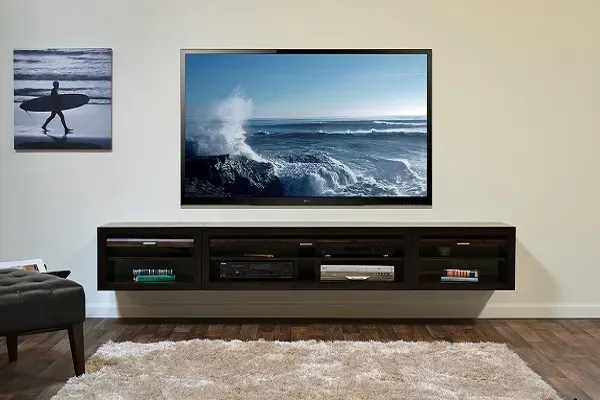
You’ve got your TV, you’ve got your mount, and you’re ready to install. But before you drill, there’s a critical question: How high should the TV go?
Mount it too high and you’ll spend every movie rubbing your neck. Too low and you’ll feel like you’re watching from the floor. The “right” height depends on your room, your seating, and how you actually use the TV.
This guide provides room-specific calculations and rules of thumb to help you find the perfect TV height for comfortable viewing in any space.
The Golden Rule: Eye Level Viewing
Why Eye Level Matters
When you look straight ahead from your normal seated position, that’s where your TV screen’s center should be-roughly 42 to 48 inches from the floor for most people.
Benefits of eye-level mounting:
- No neck strain during extended viewing
- Natural viewing posture maintained
- Optimal picture quality (most TVs are designed for direct viewing)
- Comfortable for movie marathons
Problems with too-high mounting:
- Neck tilted back, causing strain
- Eye fatigue from looking up
- Reduced picture quality on some TVs
- Uncomfortable for long viewing sessions
The Basic Formula
Ideal TV center height = seated eye level
For most people seated on standard furniture:
- Seated eye level: 38-42 inches from floor (depending on seat height and individual height)
- Common target: 42 inches for screen center
Simple calculation:
- Measure from floor to your eyes while seated normally
- That measurement = ideal center of your TV screen
- Calculate mounting point based on TV dimensions
Room-by-Room Height Guidelines
Living Room TV Height
Typical setup: Sofa or sectional viewing, primary family entertainment
Recommended center height: 42-48 inches from floor
Variables to consider:
- Sofa seat height (typically 17-19 inches)
- Distance from TV to seating
- Multiple viewing positions (standing, sitting, floor)
Calculation:
For an average sofa (18” seat height) and average adult (5’6” - 5’10”):
- Seated eye level: approximately 40-44 inches
- Target screen center: 42 inches
For your specific setup:
- Sit on your couch normally
- Measure from floor to your eyes
- That’s your ideal screen center height
Example with 65” TV:
- 65” diagonal = approximately 32” tall
- Screen center at 42” means:
- Bottom of TV at 26” from floor (42” - 16”)
- Top of TV at 58” from floor (42” + 16”)
- Mount installation point: Check your mount’s offset from TV center
Bedroom TV Height
Typical setup: Viewing from bed, often reclined
Recommended center height: 42-50 inches from floor (varies significantly)
The bedroom complication:
Bedroom TV viewing is different because:
- Viewer is often reclined (not sitting upright)
- Bed height varies (platform beds vs. traditional)
- Viewing angle naturally shifts higher when lying down
Calculation for bedroom:
Option 1: Sitting up in bed (watching before sleep)
- Sit against headboard in normal watching position
- Measure eye level
- Mount screen center at that height
Option 2: Reclining (lying down watching)
- Recline at your typical viewing angle
- Note where your eyes naturally point (usually 10-15° above horizontal)
- TV can be mounted higher-center at 48-55”
- Consider tilting mount to angle screen downward
Example with bedroom setup:
- Standard bed: mattress top at 24-26” from floor
- Sitting against headboard adds ~24” to eye position
- Seated eye level: ~48-50” from floor
- Reclining shifts view upward: TV center can go to 50-55”
- Consider a tilting mount to angle screen toward bed
Kitchen TV Height
Typical setup: Viewing while cooking, standing at counter
Recommended center height: 54-60 inches from floor
Why higher in kitchens:
- Primarily viewed while standing
- Needs to clear countertop items
- Often mounted on wall above counter level
Calculation:
- Average standing eye level: 60-66 inches
- Counter height: typically 36 inches
- Mount above counter with center at ~54-60”
- Consider viewing angle from multiple kitchen positions
Home Office TV Height
Typical setup: Viewing from desk chair
Recommended center height: 38-45 inches from floor
Considerations:
- Desk chair typically lower than sofa
- Closer viewing distance than living room
- May be used as secondary monitor
Calculation:
- Sit in your desk chair
- Measure eye level (typically 38-42” for standard desk setup)
- Mount screen center at that height
Above Fireplace: The Special Case
The Problem with Fireplace Mounting
Fireplaces are typically too high for comfortable TV viewing:
| Fireplace Type | Typical Mounting Height | Comfortable Viewing Height | Difference |
|---|---|---|---|
| Low mantel | 50-54” center | 42-44” center | 6-12” too high |
| Standard mantel | 56-62” center | 42-44” center | 14-20” too high |
| High/formal mantel | 62-70” center | 42-44” center | 20-28” too high |
When Fireplace Mounting Works
Acceptable scenarios:
- Low mantel that allows TV center below 50”
- Very deep room with distant seating (reduces angle)
- Tilting mount that angles screen downward
- MantelMount or pull-down system that lowers TV
Challenging scenarios:
- High formal mantels
- Small rooms with close seating
- Extended viewing sessions planned
Solutions for High Fireplace Placement
Option 1: Accept the compromise
- Mount as low as safely possible above fireplace
- Use tilting mount to angle screen down
- Best for occasional viewing, not daily use
Option 2: MantelMount or pull-down mount
- TV raises to aesthetic position when off
- Lowers to comfortable height when in use
- Best of both worlds, but higher cost
Option 3: Offset mounting
- Mount to side of fireplace instead of above
- TV at proper height, fireplace still focal point
- Requires appropriate wall space
Option 4: Don’t mount above fireplace
- Choose different wall for TV
- Use fireplace for art or mirror
- Optimal for comfort, may require room rearrangement
TV Height by TV Size
Larger TVs need adjusted calculations because screen height increases:
TV Height Reference Chart
| TV Size (diagonal) | Approximate Screen Height | Center at 42” = Bottom Edge |
|---|---|---|
| 43” | ~21” | 31.5” from floor |
| 50” | ~24.5” | 29.75” from floor |
| 55” | ~27” | 28.5” from floor |
| 65” | ~32” | 26” from floor |
| 75” | ~37” | 23.5” from floor |
| 85” | ~42” | 21” from floor |
Key insight: As TVs get larger, they need to be mounted lower on the wall to maintain the same center height.
The “Too Close to Floor” Problem
For very large TVs (75”+), maintaining 42” center height puts the bottom edge uncomfortably close to the floor-potentially behind furniture or at an awkward visual position.
Solutions:
- Accept slightly higher mounting (44-46” center)
- Use lower-profile furniture below TV
- Consider raised platform for seating
- Balance aesthetics with ergonomics
Distance from TV: The Other Variable
Viewing distance affects how much height matters:
Viewing Distance Guidelines
| TV Size | Minimum Distance | Optimal Distance | Maximum Distance |
|---|---|---|---|
| 43” | 3.5 feet | 5.5-7 feet | 9 feet |
| 50” | 4 feet | 6.5-8.5 feet | 10.5 feet |
| 55” | 4.5 feet | 7-9.5 feet | 11.5 feet |
| 65” | 5.5 feet | 8-11 feet | 13.5 feet |
| 75” | 6.5 feet | 9.5-12.5 feet | 15.5 feet |
| 85” | 7 feet | 10.5-14.5 feet | 18 feet |
How Distance Affects Height Tolerance
Closer seating:
- Viewing angle to screen edges is wider
- Height errors more noticeable
- Neck strain more pronounced
Farther seating:
- Viewing angle is narrower
- Height variations less significant
- Some flexibility in mounting position
Example:
- At 8 feet from a 65” TV, a 4” height error is uncomfortable
- At 14 feet from an 85” TV, a 4” height error is barely noticeable
How to Calculate Your Perfect Height
Method 1: The Measurement Method
You’ll need: Tape measure, someone to help
Steps:
- Sit in your primary viewing position normally
- Have someone measure from floor to your eye level
- Note that measurement (your “eye height”)
- Calculate TV mounting position:
- Mount center = eye height
- Mount top = eye height + (TV height ÷ 2)
- Mount bottom = eye height - (TV height ÷ 2)
Example:
- Your eye height: 44 inches
- Your TV: 65” (32” tall)
- TV center: 44 inches from floor
- TV top: 44 + 16 = 60 inches from floor
- TV bottom: 44 - 16 = 28 inches from floor
Method 2: The Tape-on-Wall Method
More visual approach:
- Cut a piece of paper or cardboard the exact size of your TV
- Tape it to the wall at various heights
- Sit in your viewing position
- Adjust until the center feels natural
- Mark that position
Method 3: The Trigonometry Method (For Enthusiasts)
For optimal viewing angle (0° horizontal):
Optimal center height = (Eye height from floor) + (Horizontal distance to TV × tan(0°))Since tan(0°) = 0, optimal center = eye height. Simple!
For acceptable viewing angle (up to 15° upward):
Maximum center height = Eye height + (Distance × tan(15°))Example:
- Eye height: 42 inches
- Viewing distance: 120 inches (10 feet)
- tan(15°) = 0.27
- Maximum center = 42 + (120 × 0.27) = 42 + 32 = 74 inches
This shows why distant seating tolerates higher mounting.
Common Height Mistakes
Mistake 1: “Above the Furniture” Placement
The thinking: “TV should float above the console.”
The problem: If console is 24” tall and you leave 6” gap, TV bottom is at 30”-fine. But many people leave huge gaps, pushing TV too high.
The fix: Measure based on eye level, not furniture clearance.
Mistake 2: Matching the Neighbor’s Setup
The thinking: “Their TV looks good, I’ll mount mine the same.”
The problem: Different ceilings, furniture, and viewer heights mean different optimal positions.
The fix: Measure YOUR eye level in YOUR seating.
Mistake 3: “Center of the Wall” Aesthetic
The thinking: “It looks balanced centered on the wall.”
The problem: Wall center has nothing to do with viewing comfort.
The fix: Prioritize ergonomics; work aesthetics around comfort.
Mistake 4: Forgetting About Tilt
The thinking: “I’ll tilt it down to compensate for height.”
The problem: Tilting improves angle slightly but doesn’t eliminate neck strain. Significant tilt also affects picture quality on some TVs.
The fix: Mount at proper height; use tilt for fine adjustment only.
Quick Reference: Height by Room Type
| Room | Primary Posture | Typical Eye Height | Recommended TV Center |
|---|---|---|---|
| Living room | Seated upright | 40-44” | 42-46” |
| Bedroom (upright) | Seated against headboard | 48-52” | 48-52” |
| Bedroom (reclined) | Lying at 30° angle | N/A | 50-56” + tilt |
| Kitchen | Standing | 60-66” | 54-60” |
| Home office | Seated in desk chair | 38-42” | 38-44” |
| Home theater | Reclined theater seating | 36-40” | 36-42” |
| Above fireplace | Seated upright | 40-44” | As low as safe, use tilt |
Professional Height Assessment
Not sure about your optimal height? Express Mounting helps Atlanta homeowners find the perfect position:
Our process:
- Evaluate your specific seating positions
- Measure actual eye levels for household members
- Consider room layout and furniture
- Recommend optimal mounting height
- Install at the perfect position
We account for:
- Multiple viewers with different heights
- Various seating positions in the room
- Aesthetic considerations alongside ergonomics
- Special situations (fireplaces, angled walls, etc.)
Frequently Asked Questions
Is there an industry-standard TV height?
No single standard exists. Professional installers typically target 42-48” center height for living rooms, adjusted for specific client measurements.
What if family members have very different heights?
Calculate based on the primary adult viewer or average the heights. Children adapt easily; adults get neck strain.
Should I mount higher if my ceilings are high?
No. Ceiling height doesn’t change your eye level. Mount based on eye level regardless of ceiling.
Can a tilting mount fix a too-high installation?
It helps slightly by improving viewing angle, but doesn’t eliminate neck strain from looking up. Tilt is for fine-tuning, not correcting major height errors.
What about standing desk viewing?
For dual sitting/standing use, consider motorized mounts or compromise between the two heights. Standing eye level is typically 58-66”.
Ready to Mount at the Perfect Height?
Getting height right is one of the most important aspects of TV mounting. Express Mounting ensures your TV is positioned for perfect viewing:
✅ Precise measurements for your specific setup
✅ Professional leveling for perfect alignment
✅ Height optimization based on your seating and viewers
✅ Expert installation that gets it right the first time
👉 Visit ExpressMounting.com to schedule your TV mounting with height optimization included.
📍 Express Mounting - Perfect TV placement throughout Atlanta.