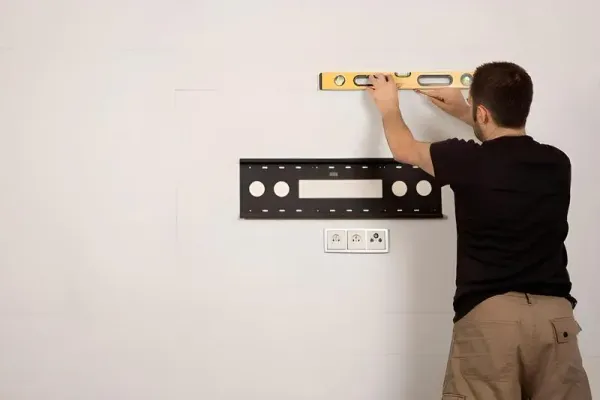
Drill with a hammer drill and use Tapcon masonry screws: 3/16 x 2-3/4 inch for most TVs under 75 inches, 1/4 x 3-1/4 inch from 75 up, and wedge anchors for 85-inch-plus TVs or full-motion arms on poured concrete. On brick, drill the face or the mortar joint, whichever lines up with the mount holes.
Quick note: This page contains Amazon affiliate links. We may earn a small commission at no extra cost to you if you buy through them.
A solid concrete or brick wall is one of the strongest places you can hang a TV. It is also the least forgiving: a hole in the wrong place can’t be patched with a dab of spackle. This guide covers the tools, the anchor for each wall and TV size, and the steps, so the holes go in once.
Two checks before you start. If the brick or stone might be a thin facing rather than structural masonry, read drilling into brick vs stone veneer first. For the general workflow on any wall, see our complete how-to-mount-a-TV guide.
Can you mount a TV on concrete or brick?
Yes, and once the anchors are in it’s more secure than drywall. A solid concrete or brick wall doesn’t depend on finding a stud, and it carries large TVs and heavy full-motion arms without complaint, as long as you use masonry hardware.
It does ask for three things:
- a hammer drill and carbide masonry bits, because an ordinary drill won’t cut cured concrete
- the right anchor for the wall and the TV (the table below)
- careful layout, because you can’t easily move a hole in concrete
Can you do it without drilling? Not on the wall itself. Adhesive strips, hooks and suction mounts aren’t rated for a TV at any size, so a concrete or brick wall means drilling. If you can’t drill, a floor stand or a floor-to-ceiling tension pole holds the TV without touching the wall; our no-drill guide compares them.
You’ll run into masonry walls around brick and stone fireplaces, in lofts and condos with exposed concrete, in older homes with block or brick interior walls, in basements, and on patios and garages.
Tools and hardware you’ll need
Tools
- Hammer drill. For poured concrete, an SDS-plus rotary hammer such as the Bosch GBH2-28L is the tool we use; it cuts cured concrete without bogging down. For brick and softer block, a corded hammer drill works. If you don’t own either, a tool rental counter will have one for the day.
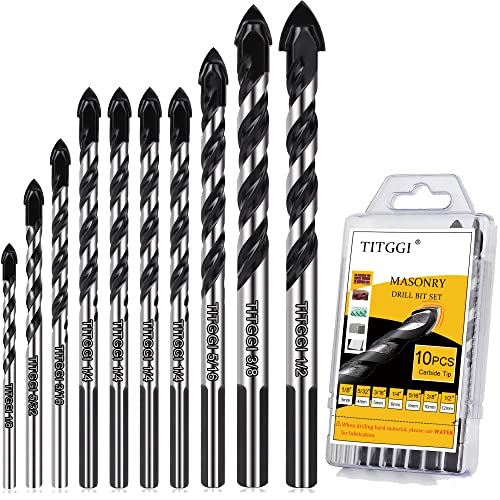
- Masonry bits sized to the anchor. A box of Tapcons comes with its matching bit. Sleeve and wedge anchors need a 3/8 inch bit, which a masonry bit set from 1/8 to 1/2 inch covers.
- Level. One degree off reads crooked forever on a big screen.
- Tape measure, pencil and painter’s tape for marking on rough brick.
- Shop vacuum or a dust blower to clear every hole.
- Socket wrench or impact driver to drive the screws and snug the nuts.
Hardware
- Tapcon masonry screws for solid concrete and brick. 3/16 x 2-3/4 inch Tapcons cover most TVs under 75 inches; step up to 1/4 x 3-1/4 inch from 75 inches. The ICC-ES evaluation reports list the verified load ratings.
- Wedge anchors for oversized TVs (85-inch and up) or full-motion arms on poured concrete: a 3/8 inch wedge anchor kit gives serious pull-out resistance.
- Sleeve anchors for brick and block, such as 3/8 x 3 inch Hillman sleeve anchors, long enough to reach through a facing into the block behind it.
- Toggle bolts or epoxy anchors for hollow block or crumbling masonry.
- A wall bracket rated above your TV’s weight and matched to its VESA pattern.
Anchor quick-reference
| Situation | Anchor | Spec |
|---|---|---|
| TVs under 75”, solid concrete or brick | Tapcon masonry screws | 3/16” x 2-3/4” |
| 75” and up, solid concrete or brick | Tapcon masonry screws | 1/4” x 3-1/4” |
| 85”+ or full-motion on poured concrete | Wedge anchors | 3/8” heavy-duty, tightened per the maker’s instructions |
| Brick | Tapcons or sleeve anchors | Face or mortar joint, whichever lines up with the mount holes |
| Hollow block | Toggle bolts or sleeve anchors | Spans the void behind the face |
| Crumbling or soft masonry | Epoxy anchors | Bonds instead of expanding |
Step-by-step: how to mount a TV on concrete
1. Mark the bracket position
Hold the bracket where it will go, level it, and mark every hole. Settle the height before you drill: our TV height chart gives the center and bottom-edge marks by TV size. A new hole in concrete means a patch job, so check the marks twice.
Pro tip: On rough brick or stone, stick painter’s tape where the holes go and mark on the tape.
2. Drill the pilot holes
Use the hammer drill and the bit that matches your anchor. Start slowly so the bit doesn’t walk, then let the drill do the work.
- Keep the drill at 90 degrees to the wall.
- Drill at least 1/4 inch deeper than the screw or anchor will reach, so dust has somewhere to go.
- On hollow block or old brick, ease off the pressure so the face doesn’t crack.
Pro tip: Vacuum or blow out every hole. Packed dust is the most common reason masonry anchors lose their grip.
3. Set the anchors
Tapcons need no separate anchor: they go through the bracket straight into the pilot hole in step 4. Sleeve and wedge anchors tap into the hole until flush, then expand inside the concrete as the nut tightens. On hollow block, use toggle bolts in the cells or epoxy anchors.
4. Attach the bracket
Hold the bracket over the holes and drive the Tapcons through it, or thread the nuts onto the sleeve or wedge anchors. Tighten evenly with a socket wrench or impact driver and stop when the bracket is firm against the wall; overtightening can crack brick or strip the hole.
Check for even pressure all round, a level bracket and no flex before the TV goes on.
5. Hang and secure the TV
Fit the mounting arms to the TV with the screws and spacers the mount supplied, lift the TV onto the bracket (two people for anything big) and engage the locks. Check that the safety screws are tight, the TV is level and it feels solid when you gently rock it. On a tilting or full-motion mount, test the motion and set the tension screws now.
Common mistakes to avoid
- Using wood screws, lag bolts or drywall anchors in masonry
- Drilling too shallow for the screw or anchor
- Overtightening until the brick or the anchor sleeve cracks
- Moving the bracket to chase solid brick or to dodge mortar lines. Drill the brick face or the mortar joint, whichever lines up with the mount holes
- Leaving dust in the holes
- Drilling before the height is settled
When to call a professional
Masonry isn’t a casual DIY job, especially when:
- the wall is stone, hollow block or crumbling brick
- you don’t own a hammer drill or masonry bits
- you want the wires hidden. A concrete wall has no cavity, so the clean options are a surface raceway or an in-wall power kit routed below the baseboard
- the TV is heavy or oversized: 65 inches and up, and especially 85-inch-plus TVs
What it costs to have it done
Concrete and brick installs use the standard size-tier labor plus a flat masonry surcharge for the drilling time and carbide bit wear. Base labor is $129 for TVs up to 54 inches, $159 for 55-69 inches, $209 for 70-79 inches, $299 for 80-99 inches, and $399 for 100 inches and up. Concrete, brick, stone and block walls add a $99 masonry surcharge, so a 50-inch TV on concrete is $129 + $99 = $228.
The bracket is separate: bring your own, or buy one from us (flat $49 or $69, full-motion $59 or $79). Wires on a concrete wall usually go in a paintable raceway on the surface, $79 per TV, because there’s no cavity to run them through.
Frequently asked questions
Can you mount a TV on concrete or brick without drilling?
Not on the wall. No adhesive, hook or suction product is rated to hold a TV, so a masonry wall means drilling. Without holes, use a floor stand or a floor-to-ceiling tension pole; our no-drill guide covers both.
What size Tapcon for a TV mount in brick?
3/16 x 2-3/4 inch Tapcons for most TVs under 75 inches, 1/4 x 3-1/4 inch from 75 inches up. Drill the brick face or the mortar joint, whichever lines up with the mount holes, with the bit that comes in the Tapcon box.
Can I use regular drywall anchors on concrete?
No. Drywall anchors rely on a hollow cavity or on soft gypsum to grip. In solid concrete they spin in the hole or shear off under load. Use Tapcon screws, sleeve anchors or wedge anchors.
Do I need a hammer drill for concrete walls?
Yes. An ordinary drill spinning a masonry bit glazes the bit and overheats the motor long before it gets through cured concrete. A hammer drill adds rapid blows that break up the concrete ahead of the bit; an SDS-plus rotary hammer is fastest. For brick and softer block, a corded hammer drill on hammer mode usually works. If you don’t own one, rent one for the day rather than fight the wall with a regular drill.
What size masonry bit for a Tapcon?
Match the bit to the screw: a 3/16 inch Tapcon takes a 5/32 inch carbide bit and a 1/4 inch Tapcon takes a 3/16 inch bit. The wrong bit is the most common cause of stripped or loose anchors, which is why Tapcon packs the right one in the box.
How deep should I drill into concrete for a TV mount?
At least 1/4 inch deeper than the screw will reach, so the dust has somewhere to go. For a 2-3/4 inch Tapcon, drill 3 inches; for a 3-1/4 inch Tapcon, drill 3-1/2 inches. Vacuum each hole before driving the screw.
Is mounting a TV on concrete safer than drywall?
Once the right anchors are in, yes. A masonry anchor in solid concrete holds at least as well as a lag bolt in a wood stud, and there’s no stud to miss. The trade-off is that concrete is less forgiving: a misplaced hole can’t be hidden with spackle.
Can I mount a TV on a concrete basement wall?
Yes, and poured basement walls are some of the strongest surfaces in a house. Watch for moisture and for parging, a thin cement coat sometimes troweled over the foundation. Use a 2-3/4 inch or longer Tapcon so it seats in the structural concrete behind the parge coat. If the wall shows efflorescence (white powder) or damp patches, seal the holes with masonry sealer before driving the screws.
Will the concrete crack when I drill?
Properly drilled holes don’t crack solid concrete. Cracks come from a dull bit, an overtightened anchor, a hole too close to an edge (stay at least 4 inches from corners and edges) or hollow block with thin face shells. Use a sharp carbide bit, drill at 90 degrees and tighten only until the bracket is firm.
Ready to mount your TV on concrete?
We bring the hammer drill, the anchors and the dust control, and every install carries a 3-year workmanship warranty.
Request a quote for flat-rate labor from $129 plus $99 for masonry, anywhere in the 13 metros we serve, or call (470) 777-4077. Fireplace wall? See our fireplace TV mounting service.