There are three NEC-compliant ways to hide HDMI and power cables behind a wall-mounted TV: an in-wall power bridge kit (cleanest, requires drywall cuts), a surface raceway (renter-safe, no drilling), or routing through a fireplace chase or behind built-in furniture. The non-negotiable rule under National Electrical Code (NEC) Article 400: standard TV power cords cannot be run through the wall - only UL-listed in-wall power kits qualify. On an ordinary drywall wall in a home you own, the in-wall power bridge is usually the right answer.
Quick note: This page contains Amazon affiliate links. We may earn a small commission at no extra cost to you if you buy through them. Our picks are the hardware our crews install on real customer walls, not spec-sheet guesses.
You mounted the TV. It looks sleek. Then you plug everything in and there’s a tangle of cables hanging below it like a wedding veil. We get called to “finish” plenty of installs like this: the mount went up, the cables didn’t get hidden, and now the whole thing looks unfinished.
The good news: this is the easiest part of a TV install to fix. The hard part is doing it without violating code or creating a fire hazard. We also get called to undo the other mistake: a standard power cord pushed straight through the drywall, which is a code violation and genuinely dangerous.
This guide is the same playbook our crews use on cable concealment jobs.
The three methods that work
| Method | Cost | Best for | Code-safe? |
|---|---|---|---|
| In-wall power bridge kit | $50-90 + 2hr DIY | Owner-occupied, drywall installs | Yes (UL-listed) |
| Cable raceway (surface mount) | $20-40 + 30min DIY | Renters, brick, stone, masonry | Yes (low-voltage routing) |
| Fireplace/built-in chase | $0-50 + carpentry skill | Fireplace mounts, built-ins | Yes (existing chase) |
For deeper coverage on surface-mount raceway installation specifically - sizing, paintable types, code rules - see our complete raceway guide. The raceway guide is the post to read if you can’t or won’t cut drywall.
In-wall power bridge kit
This is the method we use most on drywall. It’s the cleanest finish, completely hidden, and code-compliant.
How it works:
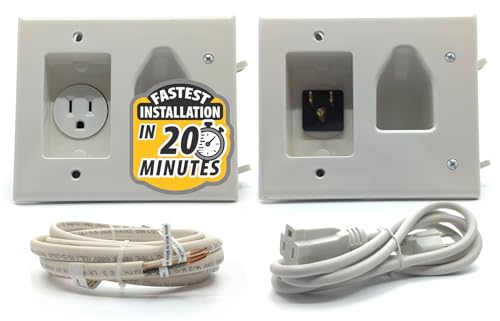
- A power bridge kit installs an electrical outlet behind the TV and runs a UL-listed extension cord through the wall down to an existing outlet near the floor.
- Low-voltage cables (HDMI, audio, ethernet, coax) run through separate grommets in the same wall opening.
- Result: no visible cables, the TV’s power cord plugs in behind the panel, every other cable disappears.
Hardware:
- In-wall power bridge kit (Echogear, PowerBridge, or Sanus) - all three brands are good
- Drywall saw or oscillating tool
- Stud finder
Process:
- Locate studs - the kit goes between studs, never through one.
- Mark and cut two rectangular openings: one behind the TV mount position, one near the floor outlet.
- Run the UL-listed extension cord through the wall cavity.
- Install both wall plates.
- Plug everything in: TV power cord into the upper wall plate, kit’s male plug into the floor outlet.
Time: 1.5-2 hours including cleanup. Difficulty: moderate - basic drywall cutting and fishing cables through stud bays.
One catch: if your TV mounts directly over a stud, the kit won’t fit. Plan the mount location BEFORE buying the kit.
Cable raceway
The right answer when you can’t or don’t want to cut into the wall. Three big use cases: rentals, brick or stone walls (no cavity to route through), and fireplace surrounds where there’s no chase.
Hardware:
- Paintable plastic cable raceway - D-Line, Cable Matters, Wiremold CordMate all work
- Sized to your cable count (rule of thumb: pick a raceway 2× wider than the actual bundle so you have room for future cables)
Process:
- Measure the path from the TV down to the outlet.
- Cut the raceway to length (plastic, use a fine-tooth saw or sharp utility knife).
- Peel the adhesive backing OR screw it into the wall depending on type.
- Run cables inside, snap the cover on.
- Paint to match the wall if desired.
Time: 30-45 minutes. Difficulty: easy.
Code rule: you can route HDMI, audio, ethernet, and coax through the raceway freely. The TV’s power cord can also go through the raceway as long as the raceway is rated for power and the cord isn’t crossing fire-rated walls. For the full code breakdown, our complete raceway guide covers it.
Fireplace chase routing
If you’re mounting above a fireplace, your wall almost always has a chase (vertical cavity) running up the chimney. This is where the gas line, vents, and existing wiring already run - and it’s the cleanest cable route for a fireplace TV install.
Process:
- Access the chase from the bottom (often behind a built-in or via an access panel below the firebox).
- Use a fish tape to run the cables up through the chase to the TV mount position.
- Install grommets at top and bottom for finishing.
For specifics on the whole fireplace install, see our fireplace TV mounting guide and the MantelMount installation walkthrough for tall fireplaces.
Which cables can go where
| Cable | In-wall kit | Raceway | Notes |
|---|---|---|---|
| TV power cord | UL-listed kit only | Yes | Never run standard power cords loose through walls |
| HDMI | Yes | Yes | Use in-wall rated HDMI for long runs |
| Optical audio | Yes | Yes | No restrictions |
| Ethernet (Cat6) | Yes | Yes | No restrictions |
| Coax (cable/satellite) | Yes | Yes | No restrictions |
| Speaker wire | Yes | Yes | Use CL2/CL3 rated for in-wall |
The pattern: low-voltage cables go anywhere. Power cords must be in a UL-listed in-wall kit OR a code-rated raceway OR surface-routed (visible).
What does the NEC code actually say?
National Electrical Code (NEC) Article 400 prohibits standard appliance power cords from being routed through walls, ceilings, or floors. A regular TV power cord stapled or run loose through a wall cavity is a code violation - and a real fire risk.
The two compliant options:
- UL-listed in-wall power kit - has a UL listing for in-wall use, includes both the male and female receptacles.
- Conduit-rated power cable - electrician-installed, hardwired, not user-serviceable.
If you see an article online telling you to drill a 1-inch hole and just pass your TV power cord through it - close that tab. That’s a code violation that won’t pass inspection and creates an actual hazard.
DIY vs. professional
DIY this job if:
- You’re comfortable cutting drywall and fishing cables.
- The TV is owner-occupied (not a rental) and the install is permanent.
- You’re using a kit, not freelancing the cable routing.
Call a professional if:
- You’re routing through brick, stone, or masonry walls.
- The TV is going above a fireplace and you don’t know the chase layout.
- You’re in a multi-unit condo where wall openings may affect shared structure.
- You don’t have a stud finder, drywall saw, or fishing tape.
Express Mounting handles in-wall cable concealment as a standalone $99 service in all 13 metros we serve. Most jobs take 1-1.5 hours and include the in-wall power kit, the two openings (covered by the wall plates) and the fish-tape routing. Get a quote at expressmounting.com or call (470) 777-4077.
Wall age often decides the method. Original 1920s plaster-and-lath, common in Inman Park, rules out a clean drywall-saw cut, so a paintable raceway color-matched to the trim is usually the better finish there. The open stud bays in a newer build take an in-wall power kit with no patching at all.
Express Mounting cable concealment pricing (Metro Atlanta)
If you’d rather skip the DIY: Express Mounting flat-rates cable concealment in Metro Atlanta - $99 per TV for a UL-listed in-wall power bridge kit installed end-to-end (kit, two drywall openings, fish-tape routing, both wall plates, drywall dust cleanup). Add-ons: masonry surcharge +$99 for brick, stone, or concrete walls. A surface raceway with no cutting is $79 per TV. The bracket is yours, or add ours (flat $49 or $69, full-motion $59 or $79). New TV mount + concealment combo: basic mount $129 (up to 54”), $159 (55-69”), $209 (70-79”), $299 (80-99”), $399 (100”+). Call (470) 777-4077 or book online.
Frequently asked questions
Can I run my TV power cord through the wall?
No - not unless it’s a UL-listed in-wall power kit. Standard TV power cords are not rated for in-wall use under NEC Article 400.
What’s the difference between an in-wall power kit and a regular extension cord?
The in-wall kit is rated and listed for in-wall installation. It uses heavier insulation, includes flush-mount receptacles at both ends, and is sold as a complete system. A regular extension cord is none of those things and is a code violation if used the same way.
Can I paint over a cable raceway?
Yes - paintable raceways from D-Line, Wiremold, and Cable Matters take latex paint cleanly. Use 220-grit sandpaper to scuff the plastic first for better adhesion.
How do I hide cables on a brick or stone wall?
A cable raceway is usually the only realistic option - there’s no cavity to route through. Match the raceway color to the mortar joints, or paint it to blend with the wall. See our complete raceway guide for sizing and routing across masonry.
Will an in-wall kit work in a brick veneer wall?
Sometimes - depends on whether the veneer has a cavity behind it. Many Atlanta homes have brick veneer over wood-stud framing with a cavity. Our brick vs. veneer guide covers how to tell the difference before drilling.
Can I route cables through a fireplace chase if the fireplace is gas?
Yes, but stay away from the gas line and any flue venting. A licensed professional should verify the chase routing on a gas fireplace before you cut openings.
What if my TV mount sits directly over a stud?
The in-wall power kit won’t fit. Options: reposition the TV mount slightly to clear the stud, or switch to a surface-mount raceway.
Is it expensive to have HDMI cables hidden professionally?
Express Mounting charges a flat $99 per TV for a UL-listed in-wall kit on standard drywall, or $79 for a surface raceway, and brick or masonry adds $99. Handyman and contractor quotes vary widely, so compare what each one includes. Ours covers the kit, two openings covered by the wall plates, fishing the cables through the cavity and basic dust cleanup; painting is not part of the job.
How long does cable concealment take?
A standard drywall in-wall power bridge install runs 60-90 minutes for an experienced installer (sometimes 45 minutes if the studs cooperate and there’s clear line-of-sight from upper to lower opening). Plaster-and-lath walls typical of pre-1950 Atlanta homes (Inman Park, Druid Hills, Virginia-Highland) add 30 minutes. Brick or masonry routing requiring a hammer drill and surface raceway adds 30-45 minutes. DIY first-timers should plan 2-3 hours.
Do I need an electrician for in-wall power?
Not for a UL-listed in-wall power bridge kit (Echogear, PowerBridge, Sanus). These kits are specifically designed as user-installable, code-compliant solutions under NEC Article 400 - the male plug at the bottom plugs into your existing receptacle, no electrical work required. You DO need a licensed electrician if you’re: adding a new dedicated outlet behind the TV (not just relocating one), running a new circuit, or hardwiring conduit. Most homes already have a baseboard outlet near the planned TV position, which is all the kit needs.
About the author: I’m Alex Crabinsky. I founded Express Mounting in 2015, and our crews have completed 9,747+ installs since. Full bio here.