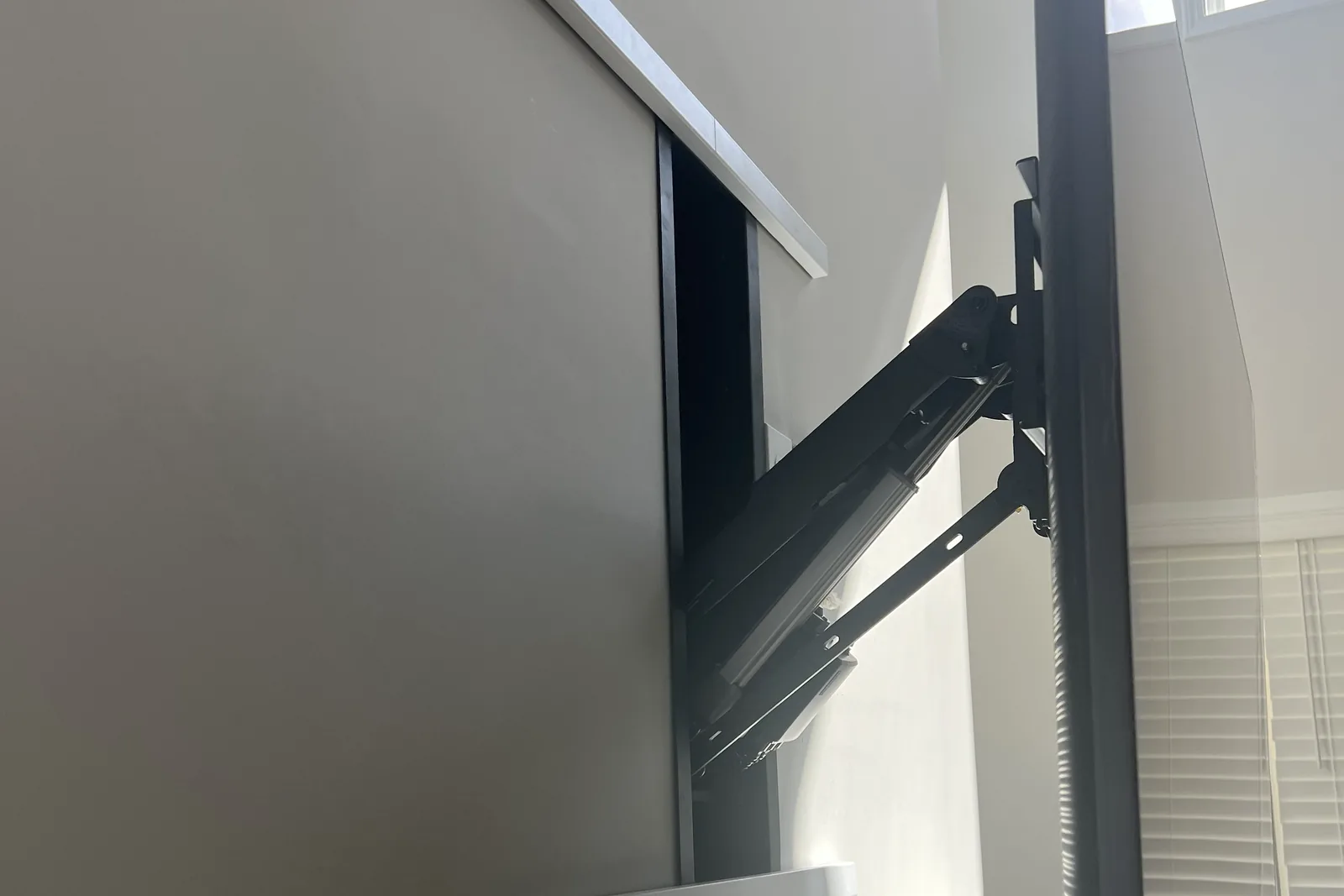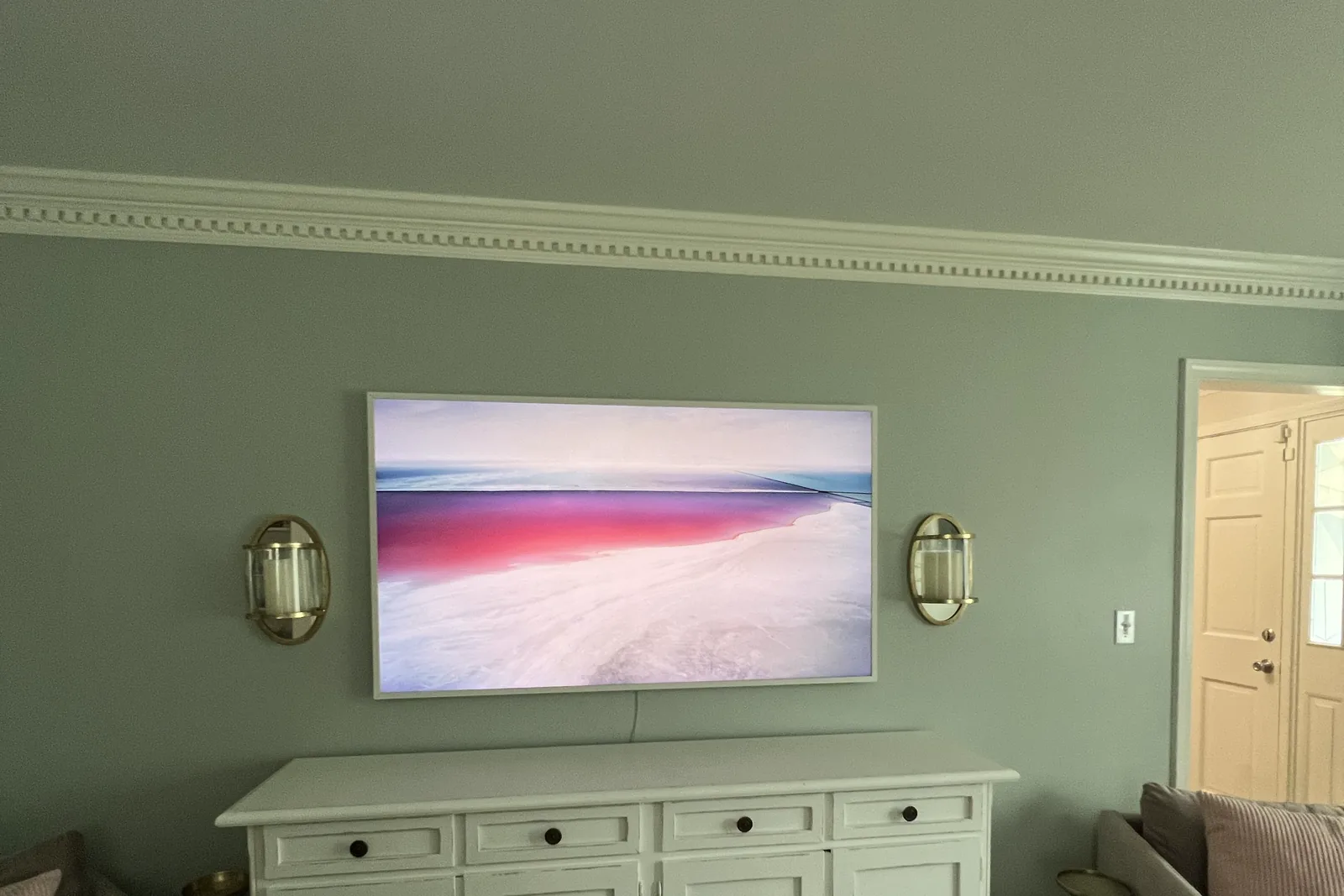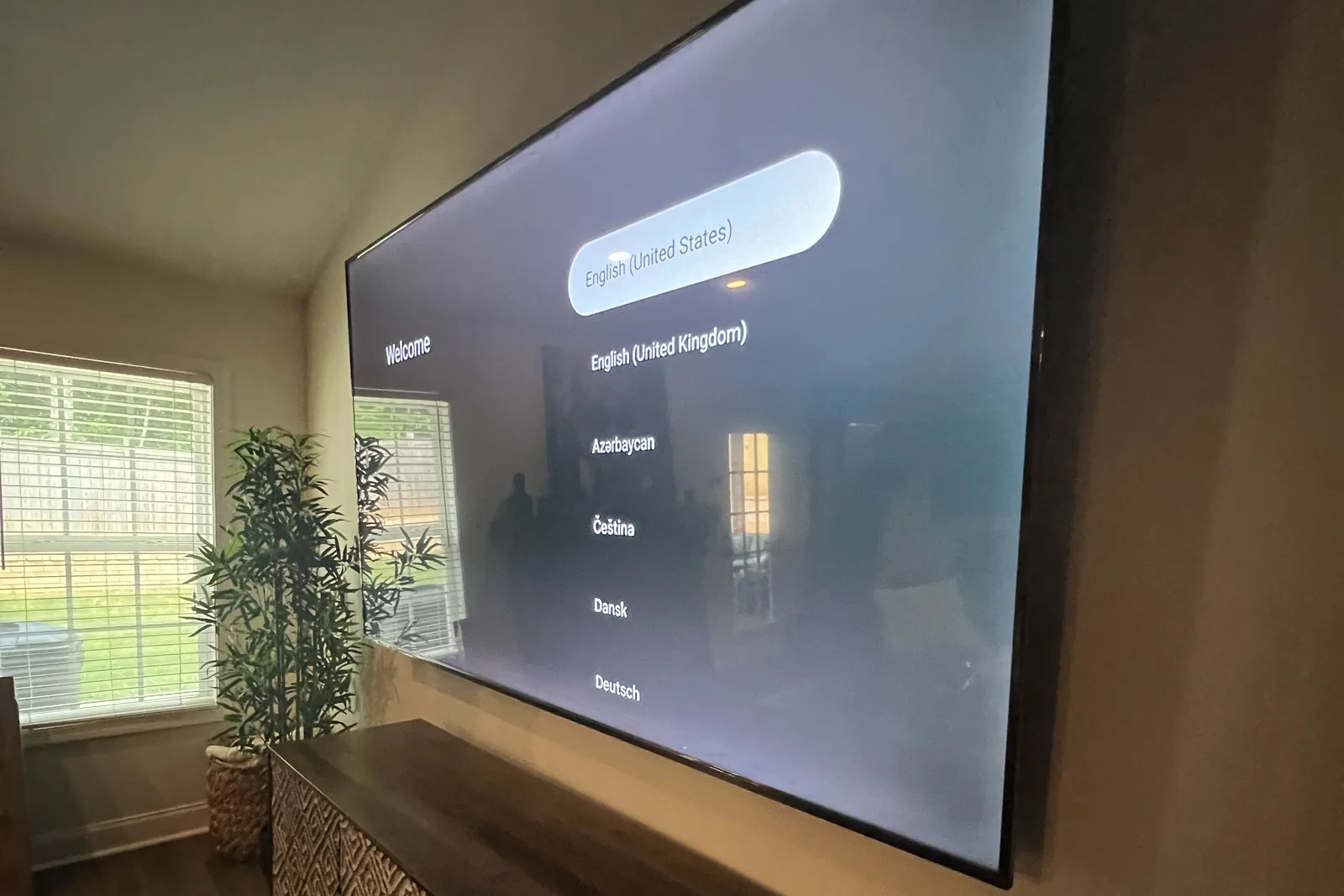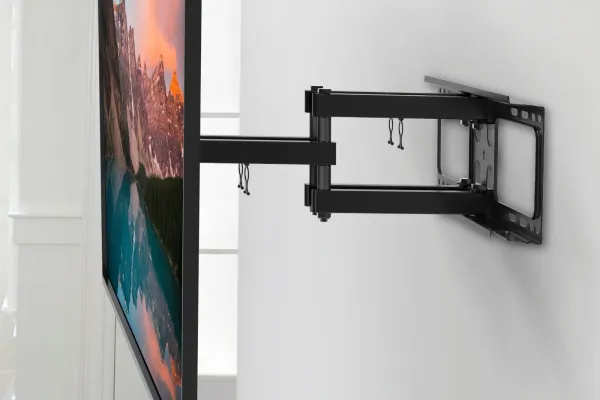
Without drilling, a TV has three safe homes: a floor stand with a weighted base, a floor-to-ceiling tension pole, or a stand base that sits on a sturdy TV console. Floor stands are the easy pick for 55-75 inch TVs. Adhesive strips, hooks and suction mounts aren’t rated for a TV at any size.
Quick note: This page contains Amazon affiliate links. We may earn a small commission at no extra cost to you if you buy through them.
Renting, or just don’t want holes in the wall? You can still get a TV up at mounted height. The three methods below hold a real TV. The stick-on products sold as “no-drill TV mounts” don’t, and we explain why further down.
Best ways to mount a TV without drilling
Ranked by how well they hold a full-size TV:
1. A floor stand with a weighted base
A floor stand is a steel pole on a wide, heavy base with a VESA bracket that holds the TV at mounted height. Nothing touches the wall, and it moves with you.
For most living rooms, pick one that covers your TV’s size with room to spare. The FITUEYES swivel floor stand takes 50-85 inch TVs, the WALI floor stand takes 32-75 inch TVs up to 110 lb and has a power outlet built in, and the Rfiver swivel floor stand covers 32-70 inch sets. Our TV floor stand roundup for renters lines up more of them by listed size range and weight rating.
Best for:
- 55-75 inch TVs, and larger with a stand rated for them
- Living rooms and bedrooms in rentals
- Anyone who moves often
Pros:
- No wall contact at all
- Height and swivel adjust after it’s set up
- Many hide the cables inside the pole
Cons:
- Takes floor space
- May mean rearranging furniture
- Costs more than a basic wall bracket
Tip: Check two numbers before you buy: the stand’s rated weight must be above your TV’s weight without its stand, and its VESA range must include your TV’s pattern. With kids or pets, pick a wide, anti-tip base.
2. A floor-to-ceiling tension pole
A tension-pole TV mount is a steel pole compressed between the floor and the ceiling, with a bracket at whatever height you set. It takes up less floor space than a stand and still never touches the wall.
Best for:
- Rooms with a solid floor and a solid ceiling
- Tight spaces where a floor stand’s base won’t fit
- Corners and room dividers
Pros:
- No wall contact, nothing to patch
- Small footprint
- Breaks down for a move
Cons:
- Needs a solid ceiling; a drop ceiling or a soft ceiling rules it out
- The ceiling height has to fall inside the pole’s range
- Weight and TV size limits vary widely by model, so check the rating on the one you buy
Tip: Measure the ceiling before you order, and tighten the pole fully against the ceiling. A pole that was never compressed properly is the usual way these fail.
3. A stand base on your TV console
If you already have a sturdy console, a stand base sits on top of it and lifts the TV to a mounted-looking height with a pole and bracket. The Perlegear universal swivel stand base takes 32-70 inch TVs up to 88 lb.
Best for:
- Living rooms with existing furniture
- TVs up to about 70 inches
- A clean look with no floor stand
Pros:
- No wall contact
- Holds the TV higher and steadier than its own feet
- Easy to take with you
Cons:
- The console has to be solid and wide enough
- Less height adjustment than a floor stand
What about adhesive strips, hooks and suction mounts?
They are not a TV mounting method, and this article used to say otherwise for small screens. Command picture-hanging strips top out at about 20 lbs for a full set of the largest strips, and they are sold and tested for pictures and frames that hang flat against the wall. A TV does not hang flat: it sits out from the wall on a bracket, which levers the top of the mount away from the wall. No adhesive strip, hook, Velcro product or suction mount is rated by its maker for that load, and the ones marketed as “no-drill TV mounts” fail slowly rather than never. We do not install a TV on any of them, at any size. If a 32-inch has to go up without a hole, use a tabletop stand, a console stand base or a small floor stand.
Why you might want a no-drill TV mount
The usual reasons:
- the lease forbids holes, or charges for them at move-out
- the wall is tile, glass or brick you don’t want to drill
- you move often and want the TV setup to move with you
- the studs aren’t where the TV needs to go
For renters in particular, a stand or pole keeps both the deposit and the TV safe. If you can put a few small holes in the wall, a proper wall mount is still the most solid option, and the four lag-bolt holes patch with spackle when you leave.
Can you mount a TV without studs?
Only a small one, and it still takes drilling. Drywall alone is safe only for a TV up to about 32 inches and 30 pounds, on a fixed mount with at least four rated toggle anchors. Anything bigger needs a stud or a backer board. The full reasoning is in our guide to whether you need studs to mount a TV.
For a truly no-drill setup, use a floor stand, a tension pole or a console stand base.
Quick comparison: no-drill mounting options
| Mount type | TV size range | Tools needed | Pros | Cons |
|---|---|---|---|---|
| Floor stand, weighted base | 32-85” depending on model | None | Adjustable, moves with you | Takes floor space |
| Tension pole | Varies by model | None | Small footprint, no wall contact | Needs a solid floor and ceiling |
| Stand base on a console | up to about 70” | None | Clean look, easy to move | Limited height, needs a sturdy console |
| Adhesive, hooks, suction | Not for TVs | None | None for a television | No maker rates them for a TV |
What we recommend for renters
- 55-85 inch TV: a weighted floor stand rated for your size, such as the FITUEYES 50-85 inch stand.
- 32-70 inch TV on an existing console: a console stand base.
- Small room, solid ceiling: a tension pole, if the ceiling height sits inside its range.
For the cables, a paintable surface raceway hides them without cutting the wall: see our raceway cable hiding tutorial and our apartment-friendly wire concealment guide.
Prices if you can put a few holes in the wall
Plenty of leases allow a few small holes, and a wall mount into the studs is the most solid option there is. Our labor is a flat $129 (up to 54”), $159 (55-69”), $209 (70-79”), $299 (80-99”), or $399 (100”+). The bracket is extra: bring your own, or buy one from us (flat $49 or $69, full-motion $59 or $79). A paintable raceway for the wires is $79 per TV, and an exposed brick wall adds $99. Every install carries a 3-year workmanship warranty.
The four lag-bolt holes a stud mount leaves are small and patch with spackle and a dab of paint at move-out. Call (470) 777-4077 or request a quote.
Frequently asked questions
Will 3M Command strips hold a TV?
No. Command picture-hanging strips top out at about 20 lbs for a full set of the largest strips, and they are tested for pictures and frames that hang flat against the wall. A television sits out from the wall on a bracket, which levers the top of the mount away from the wall, and no adhesive product is rated for that. We do not install a TV on strips or hooks at any size. For a small TV with no holes, use a tabletop stand, a console stand base or a small floor stand.
Can I mount a 55-inch TV without drilling?
Yes. A 55-inch TV typically weighs 30-50 lbs. A weighted floor stand rated for 55 inches and above that weight is the simplest option; a tension pole rated for the TV, or a stand base on a sturdy console, also work. Adhesive options are not appropriate at any size.
Are tension-pole TV mounts safe?
When the pole is rated for your TV and properly compressed between a solid floor and a solid ceiling, yes. The keys are measuring the ceiling height first, tightening the pole fully, and checking the rated weight and size range of the specific model.
How can I hide cables without drilling?
Use a surface-mount cable raceway (a paintable plastic channel), adhesive-backed cord covers, or a floor stand that runs the cables inside its pole. See our raceway cable hiding tutorial and apartment-friendly wire concealment guide for renter-safe methods. For the complete renter playbook, see how to mount a TV in an apartment.
Will a no-drill TV mount damage my walls?
Floor stands, tension poles and console stand bases never touch the wall, so they can’t damage it. Adhesive strips and hooks are not a TV mounting option, but if you use them for a cable raceway or a remote holder, they can pull paint on textured or poorly primed walls, so test in a hidden spot first.
Are no-drill mounts safe for TVs over 50 inches?
Floor stands and tension poles are, when they’re rated for the TV. Floor stands go up to 85 inches, such as the FITUEYES 50-85 inch stand. Adhesive mounts, Command strips and suction systems are not a TV mounting method at any size, whatever the advertised weight rating: the bracket levers the load away from the wall, which is not what those bonds are tested for.
Can I use Command strips for a 32-inch TV?
No, and the same goes for Velcro, adhesive hooks and suction mounts. A 32-inch TV is light, but it is not a picture: it hangs on a bracket that levers away from the wall, and no adhesive product is rated for that. Put a 32-inch on its own tabletop stand, a console stand base or a small floor stand and you keep both the lease and the TV.
Can I mount a TV on a brick or concrete wall without drilling?
Not on the wall itself; masonry means drilling. A floor stand or a tension pole holds the TV in front of the brick instead. If you can drill, our concrete and brick guide has the anchor sizes.
What’s the best no-drill mount for renters?
For most renters with a 55-75 inch TV, a weighted floor stand rated for the TV’s size and weight. It moves with you, needs no ceiling fit, and damages nothing. A tension pole suits tight rooms with a solid ceiling. Avoid suction-based and adhesive systems for any TV.
Get your TV mounted without the holes
A stand, a pole or a console base will get your TV up at the right height with zero damage to the walls. If you’d rather have it on the wall and your lease allows a few small holes, we mount into the studs in any of our 15 metros. The full drilled walkthrough is in our how to mount a TV guide, and the right height for any room is in our TV height chart.
Written by Alex Crabinsky, founder of Express Mounting, which has completed 9,747+ TV installs since 2015.