TV size by viewing distance
Find your seating distance on the left and read across. Most people should buy the balanced column; go to
the immersive column if the room is mainly for films and gaming.
| You sit | Relaxed (30°) | Balanced (36°) | Immersive (40°) |
| 5 ft | 32" | 43" | 50" |
| 6 ft | 43" | 55" | 65" |
| 7 ft | 50" | 65" | 70" |
| 8 ft | 55" | 70" | 83" |
| 9 ft | 65" | 83" | 90" |
| 10 ft | 75" | 90" | 100" |
| 12 ft | 90" | 100" | 100" |
| 14 ft | 100" | 100" | 100" |
| 16 ft | 100" | 100" | 100" |
Or start from the TV you want
If you have already picked a size, this is the seating distance it wants, plus the two numbers that matter
once it is on the wall: how wide it is, and what it weighs.
| Size | Screen width | Typical weight | Comfortable range | At 10 ft |
| 43" | 37" | 20 lb | 4.3–5.8 ft
| 18° |
| 55" | 48" | 33 lb | 5.5–7.5 ft
| 23° |
| 65" | 57" | 47 lb | 6.5–8.8 ft
| 27° |
| 75" | 65" | 62 lb | 7.5–10.2 ft
| 30° |
| 85" | 74" | 92 lb | 8.5–11.5 ft
| 34° |
| 98" | 85" | 155 lb | 9.8–13.3 ft
| 39° |
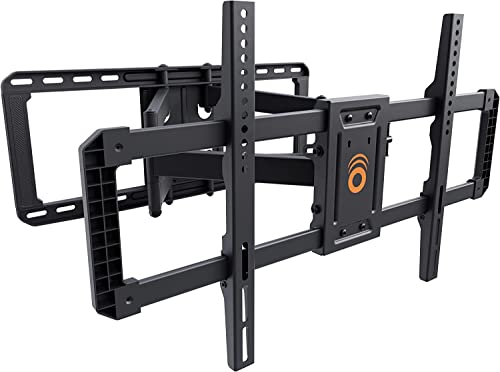
The weight column is the one that catches people. An 85-inch panel is around 92 pounds, and that
is the number your mount has to be rated above, for the screen alone, with no stand. Plenty of brackets sold
as fitting "up to 85 inches" are rated well below it.
Why viewing angle, not a multiplier
Older advice told you to sit some multiple of the screen size away, 1.5x, 2x, 2.5x depending on who you
asked. Those rules were really about resolution: sit too close to a 1080p panel and you start resolving
individual pixels. On a 4K screen that limit has moved past any sensible seating position, so it no longer
decides anything.
What still decides is field of view, how much of your vision the picture occupies. SMPTE, the body behind
cinema standards, recommends a 30-degree angle for reference viewing. THX recommends up to 40 degrees
as the best seat in a cinema. Those two figures bracket the range worth using at home, and because they are
angles they scale correctly with any distance and any screen size.
The wall constraint nobody checks
Viewing geometry will happily tell you to buy a 90-inch. Your wall might disagree. As a rule of thumb, a
screen wider than about 60 per cent of the wall it hangs on starts to read as oversized, it
crowds the room visually even when the viewing distance supports it, and it leaves nowhere for the mount
plate to land if the studs are awkward.
Measure the wall before you order. If the number the calculator gives you does not fit, the usual fix is to
move the seating back rather than to squeeze in a screen the wall cannot carry visually.
Frequently asked questions
What size TV do I need for a 10 foot viewing distance?
At 10 feet the sensible range runs from about 75 inches to about 100 inches, with 85 to 90 inches as the general-purpose middle. The 75-inch end fills roughly 30 degrees of your vision, the relaxed setting SMPTE recommends for reference viewing; the 100-inch end fills 40 degrees, the cinema-immersive maximum THX uses. That is larger than most people expect. If you are torn between two sizes at this distance, the larger one usually suits the room better.
Is a 65 inch TV too big for a small room?
Almost certainly not. A 65-inch is at its most immersive from about 6 feet 6 inches back, balanced at around 7 feet 3, and still comfortable out to 8 feet 9. If your sofa is 8 feet from the wall, a 65-inch is squarely in range and a 75-inch would also work. The real constraint in a small room is usually the width of the wall rather than the viewing distance, a screen wider than about 60 per cent of the wall it sits on starts to dominate the room visually, however the viewing maths works out.
How far should you sit from a 75 inch TV?
Between about 7 feet 6 inches and 10 feet 2 inches, with roughly 8 feet 5 as the balanced middle. Closer than 7 feet 6 and the screen fills more than 40 degrees of your vision, which is immersive for a film but tiring for a news broadcast where your eyes track across the frame. Beyond about 10 feet you stop getting the benefit of the size you paid for, and a larger screen would suit the room better.
Does 4K let you sit closer to a TV?
Yes, but not for the reason most people think. The old viewing-distance rules existed partly to stop you seeing the pixel structure of a 1080p panel. At 4K, that limit has effectively moved past any sensible seating position, so it is no longer the binding constraint. What still binds is field of view: how much of your vision the picture fills, and how much your eyes have to move to follow the action. That is why the recommendations here are expressed as viewing angles rather than as a multiple of screen size.
Should I buy the biggest TV that fits?
For films and gaming, lean large. That is where immersion comes from and it is the most common regret when people go smaller. For a room that is mostly news, sport and daytime television, a slightly smaller screen is genuinely easier to watch for long stretches, because your eyes are tracking across the frame rather than resting in the middle of it. And check the wall: a screen much wider than 60 per cent of the wall reads as oversized regardless of the numbers.
How much does a 75 inch TV weigh?
About 62 pounds is typical, and the 2024-2026 75-inch models in our VESA finder run from 39 to 111 pounds without the stand. This matters because it is the number your wall mount has to be rated above, and the rating is for the panel alone. The VESA finder shows the published weight for your brand and size, or your exact model.
Buying the TV? We will hang it.
Same-day mounting across all 13 US metros we serve. Bring your own bracket or have us supply
one, from $49. Flat-rate pricing from $129.
Get a free estimate →