Mounting a TV in a Miami condo costs the same flat rate as anywhere else we work ($129 to $399 by TV size), but the building adds steps a single-family install never sees: contractor rules at the management office, front-desk scheduling, sometimes a freight-elevator reservation, and walls that are either metal stud or solid concrete. The two things you control that keep the visit on schedule: check your building’s contractor rules and give it a day’s notice, and tell dispatch what’s behind your drywall.
Miami is a tower market, and in a tower the building shapes the job more than the TV does. This guide walks through the approval steps, the wall types you’ll actually find in Miami condos, what they mean for hardware and weight limits, and where the flat-rate pricing does and doesn’t move.
What your building will ask for
Most Miami towers treat a TV installer like any other contractor. Before anyone drills, building management typically wants:
- Contractor paperwork on file. Many towers want documents from any contractor before work starts. Ask your management office exactly what it needs before you book.
- Front-desk or portal scheduling. Many buildings only allow contractor work Monday through Friday, roughly 9 am to 5 pm. Weekend installs are genuinely restricted in a lot of Brickell and Sunny Isles towers, so plan around it.
- A freight-elevator reservation in some buildings, even for a job where the only equipment is a drill bag and a mount box.
- Board approval for anything in-wall. Surface mounting rarely needs board sign-off. Cutting drywall for in-wall cable routing sometimes does, and that approval can take one to three weeks.
None of this is a problem. It is only a delay if nobody told the building. Give your management office a day of notice and the install happens on the first visit instead of being turned around at the security desk.
The one rule that surprises people: the association controls the demising walls and the slab, not just the lobby. Your unit’s interior partition walls are usually yours to drill. The concrete wall you share with the neighbor, and the ceiling slab, are common elements in most Miami condo documents. A wall mount on a demising wall is normal and allowed nearly everywhere; coring through one is not.
Metal studs: how big a TV they carry
The steel-framed towers along Brickell, Edgewater, Aventura, and Sunny Isles use light-gauge metal studs for interior partitions. Metal studs hold a TV fine with the right hardware and an honest weight limit.
Lag bolts are wrong for metal studs. The threads have nothing to bite. The correct hardware is a snap-toggle style anchor that opens behind the stud face and clamps the load across the channel. A 1/4-inch SnapToggle is rated around 265-300 lbs through the steel, and we pull-test every install to twice the TV’s hanging weight.
The planning limit: four 1/4-inch SnapToggles through the steel carry a TV up to about 100 lbs, and six carry about 150 lbs. A toggle that misses the stud is only a drywall anchor, good for about a 32-inch, 30-lb TV. Our metal stud mounting guide covers the engineering, and the brackets and steel-stud anchor kits that fit are compared in best TV mount for metal studs.
What that means in practice for a Miami condo:
- 55-65 inch TV, fixed or tilting mount: routine on metal studs, no surcharge.
- 70 inches and up: fine on the steel when the TV sits inside the toggle limit; a typical 75-inch set weighs 60-80 lbs. Past about 100 lbs we look for a concrete wall in the unit or add a backer board across the studs.
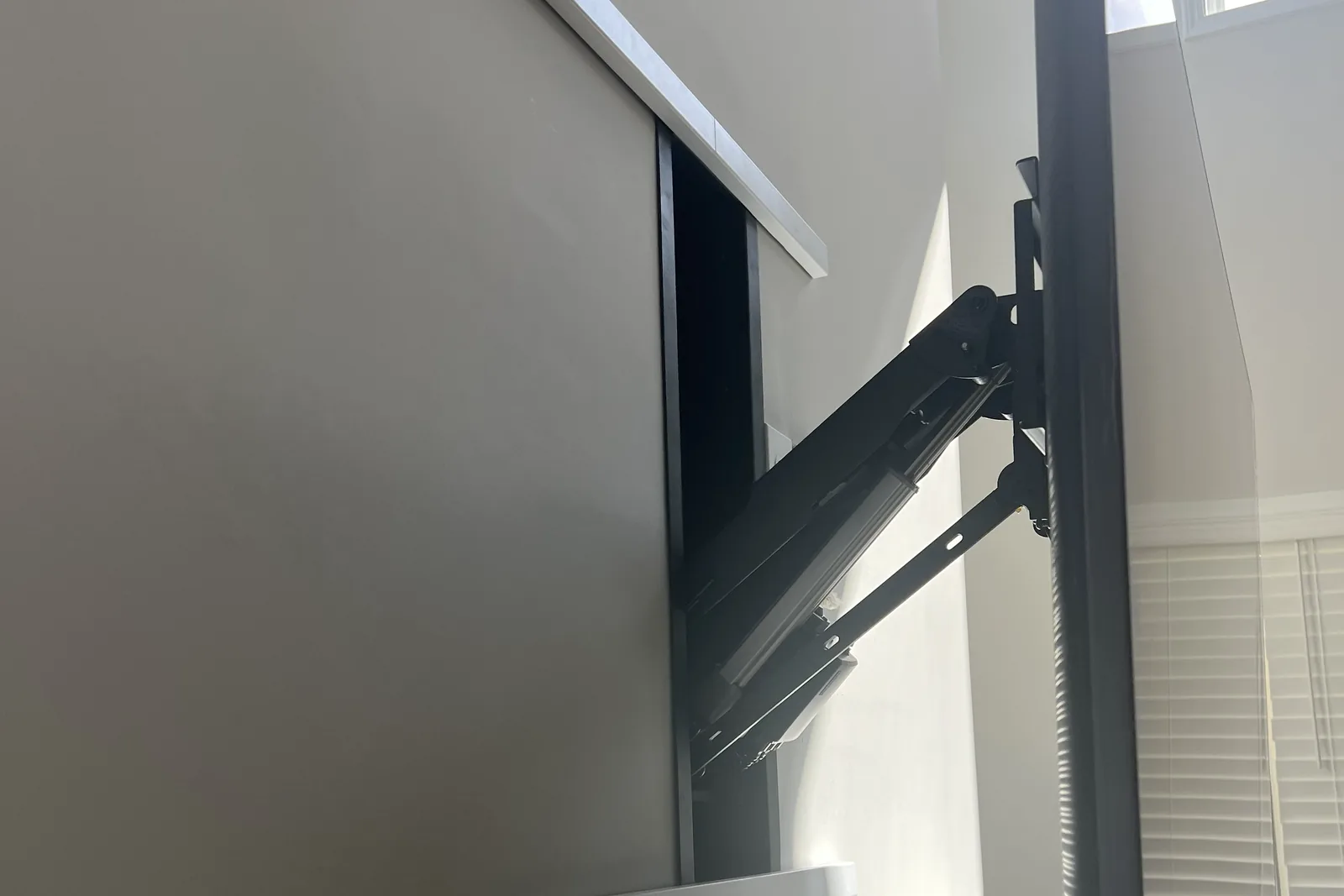
- Full-motion arms on metal studs: six toggles through the steel and a TV well inside the limit, because an extended arm multiplies the pull on the anchors.
If your heart is set on an 85-inch screen, the concrete demising wall is usually the easier answer, and that wall is the next section.
Concrete demising walls
The other Miami condo wall is poured concrete or CBS block, and it’s the best mounting surface in the building. Properly anchored concrete holds far more than any residential TV weighs. The work is just different:
- We confirm it’s solid concrete, not furring strips over block with an air gap.
- An SDS hammer drill with carbide bits makes the holes. It’s loud for about ten minutes - another reason buildings restrict work hours.
- Tapcon-style masonry screws or sleeve anchors carry the mount. Our concrete mounting guide lists the exact sizes we use.
- Dust control matters in a furnished condo, so the drill rides with a HEPA vacuum attachment.
Concrete work carries the $99 masonry surcharge, the same as a CBS single-family wall in Kendall or a stucco exterior in Doral. Older buildings drill slower: Miami Beach’s Art Deco and MiMo buildings from the 1920s to 1950s have thick poured walls that eat carbide bits, and older towers can be slower going than newer CBS construction. The flat fee still covers it; the installer just arrives with longer bits when you mention the building’s age.
One caution that applies to ceilings, not walls: many Miami towers are post-tension construction. Drilling a post-tension slab can sever a tensioned cable, which is dangerous and expensive. We don’t drill condo ceiling slabs without the building’s documentation, which is why ceiling-hung TVs are rare in towers and wall mounts are the default.
Cable concealment in a condo
In-wall cable concealment - our standard $99 add-on - assumes a hollow wall cavity. Miami condos split two ways:
| Wall type | Concealment option | What it looks like |
|---|---|---|
| Metal-stud partition | Full in-wall concealment | Power bridge + HDMI behind drywall, NEC-compliant |
| Furred drywall over concrete | Usually yes, shallow cavity | Depends on furring depth; assessed on site |
| Solid concrete / CBS | No in-wall without conduit | Low-profile surface raceway ($79), painted to match |
The in-wall method uses a code-compliant power bridge kit - the same three NEC-approved approaches from our cable hiding guide. On solid concrete, a paintable raceway is the honest answer, and a clean raceway run looks far better than a draped cable. A paintable raceway kit is also the renter-safe DIY route if you’re not ready for an installer visit.
Quick note: This page contains Amazon affiliate links. We may earn a small commission at no extra cost to you if you buy through them. Our picks are the hardware our crews install on real customer walls, not spec-sheet guesses.
Buildings sometimes require board approval before any drywall is opened. If your association is one of them, the surface raceway gets your TV mounted today and the in-wall run can happen after the paperwork clears.
Renting your condo? Read this first
Many Brickell and Edgewater units are rentals, which stacks landlord permission on top of building rules. Two notes:
- Get the landlord’s okay in writing, even a text. Standard drywall anchor holes are a patch-and-paint fix at move-out, and our apartment mounting guide covers deposit-safe approaches end to end.
- If drilling is off the table entirely, a heavy console stand with an anti-tip strap beats a wobbly no-drill gadget. Our no-stud mounting myth guide explains which no-drill solutions are real and which are marketing.
Dismounting at lease-end and patching are quoted when you book, and the remount at the new place is the same flat rate. The process is the one in our dismounting and relocation guide.
Pricing for Miami condo installs
Condo installs use the standard flat-rate card. The building steps don’t change the price; the wall might:
- Base install: $129 (up to 54”), $159 (55-69”), $209 (70-79”), $299 (80-99”), $399 (100”+)
- Bracket: bring your own, or add our flat mount at $49 (up to 54”) or $69 (55” and up)
- Masonry surcharge: $99 when we’re drilling concrete or CBS
- Metal studs: no surcharge; the hardware changes, the price doesn’t
- In-wall concealment: $99 per TV where the wall allows it
- Surface raceway: $79 per TV on solid concrete
- Full-motion arm: ours is $59 (up to 54”) or $79 (55” and up), subject to the metal-stud weight conversation
- Soundbar: $79 mounted and aligned
Full market context is in our Miami TV mounting cost guide, and the price estimator produces a real number from your TV size, wall type, and add-ons before anyone is dispatched.
Booking a tower install
Express Mounting is Atlanta-based and dispatches vetted local installers across Miami-Dade, Broward, and Palm Beach counties - the metro overview lives on our Miami service page, with per-city detail for Brickell-adjacent Miami, Aventura, Sunny Isles Beach, and Miami Beach.
For a tower job, the booking call covers four things: TV size, wall type if you know it, your building’s contractor rules, and whether cable concealment is wanted. Bookings placed before noon get same-day scheduling, building hours permitting, and the installer arrives within 2-4 hours of confirmation. Call (470) 777-4077 or get a free estimate.
Frequently asked questions
Do I need HOA approval to mount a TV in my Miami condo?
Usually not for the mount itself - surface mounting on your unit’s walls is routine in nearly every association. What sometimes needs approval is in-wall cable routing, since it opens drywall. Either way, ask your management office about its contractor rules before you book.
Can you mount a 75-inch TV on metal studs in a high-rise?
Yes, with 1/4-inch SnapToggles through the steel. A typical 75-inch TV weighs 60-80 lbs, inside the four-toggle limit of about 100 lbs; six toggles carry about 150. A toggle that misses the stud is only a drywall anchor. A concrete demising wall is the other option, with Tapcon anchors and the $99 masonry surcharge.
How much does condo TV mounting cost in Miami?
The same flat rate as everywhere we work: $129 for TVs up to 54 inches, $159 for 55-69, $209 for 70-79, $299 for 80-99, and $399 for 100 and up. Concrete walls add the $99 masonry surcharge, and the bracket is extra unless you bring your own. Building scheduling steps add no cost.
Can you hide TV cables inside a concrete condo wall?
Not inside solid concrete - there’s no cavity. On metal-stud and furred drywall walls, standard $99 in-wall concealment works. On solid concrete the clean answer is a low-profile paintable raceway ($79), installed straight and tight so it reads as trim rather than cable.
What do I need to arrange with my building?
The things only a resident can do: checking the contractor rules with your management office, telling the front desk, reserving the freight elevator if your building requires it, and filing any board form for in-wall work. Tell us the building’s work hours when you book so the slot fits.