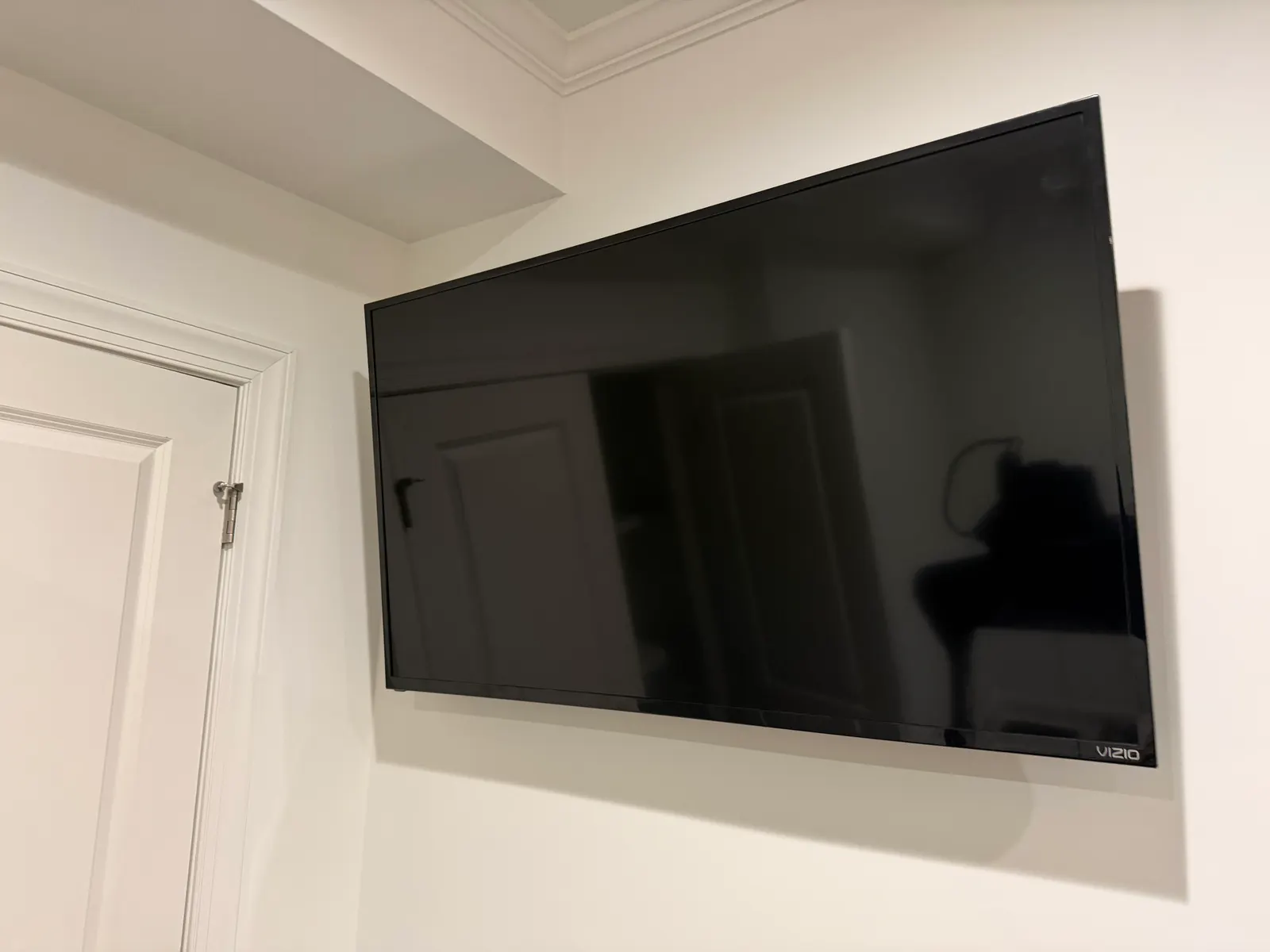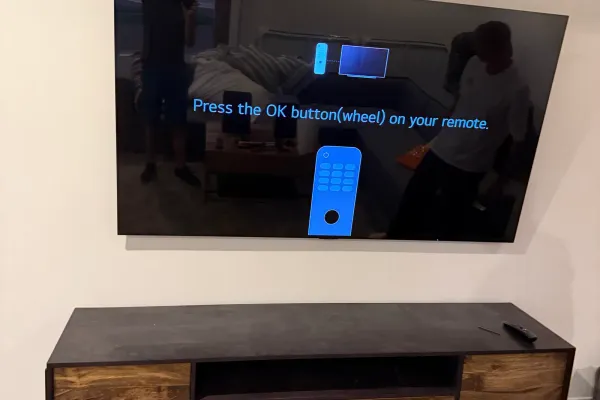
Mounting a TV in an LA apartment costs the standard $129-$399 flat rate by size, and the bracket is yours or ours (flat $49/$69, full-motion $59/$79). The two questions that decide your job: what your lease says, and what decade your building was framed. Post-1960 stucco buildings with drywall interiors are the easy case. Pre-1940 lath-and-plaster in Hollywood, Koreatown, or Pasadena needs longer lags and a slower drill. And LA is earthquake country, so every install anchors into studs or masonry wherever they exist: we treat a mounted TV here as something that has to stay on the wall while the wall is moving.
Most of Los Angeles rents. That means most LA TV mounting happens inside someone else’s walls, under a lease, in a building that has felt real ground motion before and will again. Here’s how we handle landlord rules, deposit-safe exits, LA’s odd wall mix, and the earthquake part, plus what’s honestly fine to DIY and what isn’t.
What your lease and landlord actually allow
California leases handle wall mounting three ways: silence, a “no alterations” clause, or an explicit policy. In practice:
- Get permission in writing - a text or email reply counts. Most LA landlords approve a professionally mounted TV when you commit to patching at move-out, because anchor holes are a routine patch-and-paint item.
- “No holes” clauses are usually negotiable when you offer professional install plus professional dismount-and-patch. Property managers care about the exit condition, not the months in between.
- Buildings with corporate management (the big Mid-Wilshire and DTLA portfolios) often have a standing contractor policy, like a condo tower: paperwork on file, set work hours, sometimes an approved-vendor list. Ask the management office what it requires before you book.
The national renter playbook is in our apartment mounting guide; everything below is the LA-specific layer.
LA walls by building era
Los Angeles housing spans 110 years of framing styles, and the era predicts the wall better than the neighborhood does:
| Era | Typical building | Wall behind your TV | Our approach |
|---|---|---|---|
| Pre-1940 | Craftsman, Spanish Revival fourplexes - Hollywood, Hancock Park, Pasadena, West Adams | Lath-and-plaster, brittle | Slow drill, 4-inch lags seated into the stud behind the lath |
| 1950s-70s | Dingbats and stucco walk-ups - the Valley, Palms, Long Beach | Drywall over wood studs | The easy case: standard lags, no surcharge |
| 1980s-2000s | Mid-rise stucco boxes - Koreatown, NoHo | Drywall, sometimes metal studs | Stud-finder confirms; snap-toggles if steel |
| 2010s+ | Podium buildings: DTLA, Culver City, Playa Vista | Metal studs almost always | Snap-toggles through the steel: about 100 lb on four, 150 lb on six |
Two of these deserve a word. Lath-and-plaster cracks if you treat it like drywall - the fix is patience, pilot holes, and lag bolts long enough to pass through plaster and lath and seat deep in the stud, the method from our plaster stud-finding guide. Metal studs in new podium buildings can’t take lag bolts at all; rated snap-toggles work, with the same practical 65-inch cap we apply in high-rise condo work, because thin steel shouldn’t carry a big cantilevered load - especially not in a building that moves.
The earthquake part: anchoring for motion
A mounted TV in Los Angeles has a different job description than one in Atlanta: hold the static weight, and hold it while the wall accelerates. What matters in a quake is how the mount is anchored and locked, not a special bracket. Concretely:
- Into-stud anchoring beats cavity anchors wherever studs exist. Ground motion is exactly the load case where bargain drywall anchors let go. Lags into wood framing are the gold standard.
- Pull-testing to twice the TV’s hanging weight before we hand back the remote - our standard everywhere, and the margin that motion eats into here.
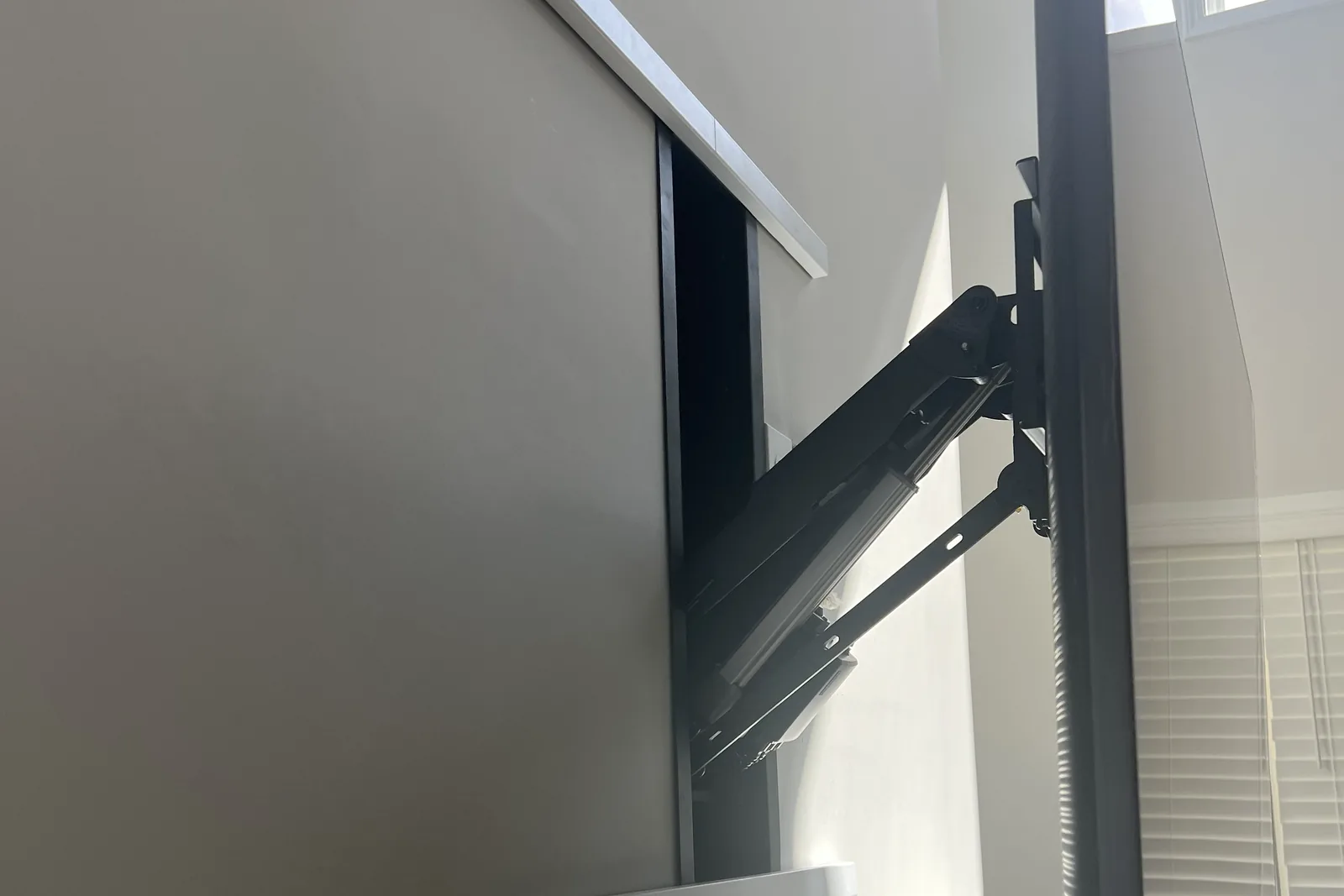
- Full-motion arms get locked. An articulating arm is a pendulum in a quake. We position arms retracted against the wall and use mounts with positive retention, so the panel can’t walk off its hooks. Safety screws on the wall plate, always - the tilting vs swivel guide covers which mount families have real retention.
- TVs on furniture need straps more than mounted TVs need anything. If you’re not mounting, anti-tip straps on the stand are the single best earthquake purchase a renter can make: a rated anti-tip strap kit costs less than dinner.
Quick note: This page contains Amazon affiliate links. We may earn a small commission at no extra cost to you if you buy through them. Our picks are the hardware our crews install on real customer walls, not spec-sheet guesses.
We don’t cite building-code chapters at you, and you should be suspicious of TV installers who do. The honest version: residential TV mounting isn’t a permitted structural alteration; it’s hardware selection done by people who assume the ground moves.
Deposit-safe: drilling vs no-drill, honestly
The deposit math favors drilling more than renters expect:
- A professional mount leaves 4-6 lag holes in known stud locations. Patched and painted at move-out, that’s invisible - and patching is a standard part of our dismount service.
- No-drill alternatives carry real trade-offs. Rail-hung and tension-pole systems hold smaller TVs adequately; adhesive solutions don’t hold TVs at all, whatever the packaging says. Our no-stud mounting myth guide and mounting without drilling guide separate the workable from the wishful.
- In a quake-prone market, a heavy TV on a cheap no-drill gadget is the worst of both worlds - no landlord paperwork, but the failure mode is your TV on the floor mid-shake. If the lease truly forbids holes, use a quality stand plus anti-tip straps and skip the gadget tier.
Cable management has a renter tier too: a paintable surface raceway ($79) hides the cord drop with zero wall cuts and removes clean, per our renter wire-concealment guide. In-wall concealment ($99) is for owners or with written landlord approval.
Move-out: dismount, patch, remount
Moves happen year-round in LA. The exit job: TV off the wall, mount down, holes filled and sanded flush, paint-ready or painted if you have the building’s touch-up can. The dismount and patch are quoted when you book. At the new place the same TV goes up at the same flat rate, and we’ll tell you if your existing mount survives the move (most do; the dismounting and relocation guide covers what transfers). Book both ends together and the scheduling lines up with your truck day.
Apartment pricing in LA
Renting changes the paperwork, not the price:
- Base install: $129 (up to 54”), $159 (55-69”), $209 (70-79”), $299 (80-99”), $399 (100”+)
- Bracket: bring your own, or add our flat mount at $49 (up to 54”) or $69 (55” and up)
- Lath-and-plaster: no automatic surcharge; it’s a slower, more careful version of the standard job
- Metal studs: no surcharge; snap-toggle hardware with the 65-inch cap conversation
- Full-motion arm: our arm is $59 (up to 54”) or $79 (55” and up), where the wall supports it
- Brick, block or concrete: +$99
- Surface raceway: $79; in-wall concealment $99 with landlord approval
- Soundbar: $79
The broader market context is in our LA TV mounting cost guide. Dispatch covers LA County, Orange County, and the Inland Empire - per-city pages include Santa Monica, Hollywood-adjacent central LA, Pasadena, and the full Los Angeles metro page. Run your numbers on the price estimator, check the pricing page, or call (470) 777-4077. Bookings before noon get same-day service, subject to the day’s schedule, and the installer arrives within 2-4 hours of confirmation.
Frequently asked questions
Can my landlord stop me from mounting a TV in Los Angeles?
A lease can prohibit alterations, so read yours and ask. In practice most LA landlords approve a professional mount when you commit to professional dismount-and-patch at move-out, since lag holes in studs are a routine patch-and-paint repair. Get the approval in writing; corporate-managed buildings may have their own contractor rules, so ask the management office what it needs before you book.
Is it safe to mount a TV in an earthquake zone?
Yes - properly anchored, a wall-mounted TV is one of the safer places a TV can be during ground motion, far safer than unstrapped on a stand. Every LA install we dispatch anchors into studs or masonry wherever they exist, is pull-tested to twice the TV’s weight, and uses mounts with positive retention so the panel can’t walk off its hooks mid-shake.
How do you mount a TV on lath-and-plaster walls in older LA buildings?
Slowly and into the studs. Pre-1940 plaster cracks under hammer-drill impatience, so we use pilot holes and 4-inch lag bolts that pass through the plaster and lath and seat deep into the stud behind. No surcharge applies; it’s a more careful version of the standard install at the same flat rate.
How much does apartment TV mounting cost in LA?
The standard flat rate: $129 for TVs up to 54 inches, $159 for 55-69, $209 for 70-79, $299 for 80-99, $399 for 100 and up, and the bracket is extra unless you bring your own. A renter-friendly surface raceway is $79, and in-wall concealment is $99 with landlord approval. Dismount-and-patch at move-out is quoted when you book, and the remount at your next place is the same flat rate.
Are no-drill TV mounts good enough for a rental?
For small TVs, some rail and tension-pole systems work. For a typical 55-inch-plus panel in an earthquake-prone market, no - adhesive and friction solutions fail exactly when the ground moves. If your lease truly forbids holes, the honest setup is a quality stand with rated anti-tip straps rather than a no-drill gadget carrying weight it was never going to hold.