
Sanus In Stock
SANUS Extendable Tilting TV Wall Mount for 46-90” TVs up to 150lbs | Universal wall mount TV bracket with 5.7” extension for max tilt range, easy DIY w/ included hardware & drill template
$109.99 View on Amazon
Tell it your screen size, how far back you sit and what is underneath. It returns the floor-to-centre height, the bottom edge, the angle you will be looking up, and whether you need to tilt.
Updated September 22, 2026 · Based on seated eye-height and viewing-angle guidelines
Express Mounting, "TV Mounting Height Calculator", updated September 22, 2026, https://expressmounting.com/tools/tv-height-calculator/
Screen size is the diagonal, corner to corner, not the width of the cabinet.
A tilt mount for when the screen has to sit above eye level, plus what you need to find the studs.
As an Amazon Associate, we earn from qualifying purchases. Prices as of Oct 15, 2026, 10:00 AM EDT. Product prices and availability are accurate as of the date/time indicated and are subject to change. Any price and availability information displayed on Amazon.com at the time of purchase will apply to the purchase of this product.

Mount the TV so the centre of the screen sits at your eye level when you are seated, about 42 inches from the floor for a standard sofa. That single rule covers every screen size: a 55-inch and an 85-inch both centre at 42 inches, the bigger panel simply reaches further above and below it. In a bedroom the centre goes 42 to 50 inches from the floor. Where a mantel or a console forces the screen higher, mount as low as the obstruction allows and tilt the screen down to recover the viewing angle.
These are the numbers for a standard sofa on an open wall, with nothing underneath forcing the screen up. Every row centres the screen at 42 inches, because that is seated eye height, what changes down the table is only where the edges of the panel land.
| Screen size | Floor to centre | Bottom edge | Screen height |
|---|---|---|---|
| 32" | 42" (3' 6") | 34" | 16" |
| 43" | 42" (3' 6") | 31" | 21" |
| 50" | 42" (3' 6") | 30" | 25" |
| 55" | 42" (3' 6") | 29" | 27" |
| 65" | 42" (3' 6") | 26" | 32" |
| 70" | 42" (3' 6") | 25" | 34" |
| 75" | 42" (3' 6") | 24" | 37" |
| 77" | 42" (3' 6") | 23" | 38" |
| 83" | 42" (3' 6") | 22" | 41" |
| 85" | 42" (3' 6") | 21" | 42" |
| 98" | 42" (3' 6") | 18" | 48" |
Notice that the bottom edge drops as the screen grows. On a 98-inch panel the bottom edge lands about 18 inches from the floor, which is below the top of most media consoles, worth checking before you buy the TV, not after.
Your eyes are comfortable looking straight ahead and slightly down. Looking up is the position that causes strain, because it holds the neck in extension and stops you blinking fully. The further the screen sits above your sight line, the more of that you accumulate over a two-hour film. So the target is not a number off a chart. It is your own eye height in the seat you actually use.
That is also why a bigger TV does not go higher. People reason that a large panel is imposing and should be lifted, but the centre of the image is where your eyes rest, and that belongs at eye level regardless of how far the corners reach. Mounting an 85-inch TV as if it were a 55-inch, bottom edge at the same height, pushes its centre nearly a foot above where it should be.
Seated eye height is the only input that really changes between rooms, and it changes more than people expect. There is a foot of difference between a recliner and a bar stool. For a bedroom, open the calculator with bed seating.
| Room and seating | Screen centre | Why |
|---|---|---|
| Living room, sofa | 42" | The default. Centre at 42 inches suits almost every sofa. |
| Living room, low sectional | 40" | Modern deep-seat sectionals sit you lower than a traditional sofa. |
| Home theatre, recliners | 38" | Reclined viewing drops the eye and tips the head back: mount lower, not higher. |
| Bedroom, watching from bed | 42-50" | Sitting up in bed puts your eye higher than a sofa, but the centre stays inside this band. A tilt mount covers watching lying back. |
| Kitchen or bar seating | 52" | Stools are the one case where a genuinely high mount is correct. |
| Office desk | 45" | Treat it like a monitor: top of screen at or just below eye level. |
A mantel sets a floor under the TV, and once you add the clearance a working firebox needs, the screen ends up well above eye level. Here is what that costs you, worked out for a sofa 10 feet back with the bottom of the screen at 60 inches, a 48-inch mantel plus 12 inches of heat clearance.
| Screen size | Forced centre height | You look up | Verdict |
|---|---|---|---|
| 55" | 73" | 15° | Comfortable with a tilt mount |
| 65" | 76" | 16° | Tilt mount essential |
| 75" | 78" | 17° | Tilt mount essential |
| 85" | 81" | 18° | Tilt mount essential |
A bigger screen makes it worse, not better. The mantel fixes the bottom edge, so every extra inch of screen height pushes the centre up by half an inch: on the same 60-inch line an 85-inch sits about 7 inches higher at the centre than a 55-inch, and from 10 feet that is roughly 18 degrees of upward angle instead of 15. Size is not the lever. Seating distance and the mount hardware are.
Two hardware answers exist. An advanced tilt mount pulls the panel a few inches off the wall and angles it down, which recovers most of the comfort. A pull-down mount drops the TV to eye level while you watch and lifts it back above the mantel when you are done. The fireplace planner works through the heat and clearance side of it properly.
The number this calculator gives you is where the centre of the screen goes. The bracket does not go there. The VESA holes on the back of a TV usually sit above the panel's vertical centre, sometimes by several inches, and the wall plate hangs from those.
If your mount is a full-motion arm, add one more check: extend it mentally to where the TV will sit when swung out, and make sure it still clears the mantel, the window trim and the light fitting.
For a 65-inch TV on an open wall with normal sofa seating, put the centre of the screen 42 inches from the floor. That puts the bottom edge at about 26 inches and the top at about 58 inches. The rule behind the number is simple: the middle of the screen belongs at your eye level when you are sitting down, and seated eye height on a standard sofa is 42 inches. Measure your own seated eye height if you want it exact, because a low sectional can put you 4 inches below that.
Centre of the screen at 42 inches from the floor, exactly as for a 65-inch. This surprises people, but the target is your eye level, not the screen size, a bigger TV simply extends further above and below that same centre line. A 75-inch mounted this way has its bottom edge around 24 inches from the floor and its top around 60 inches.
It is very common and it is usually a compromise. A typical mantel forces the centre of the screen to around 78 inches, which from 10 feet back means looking up at roughly 17 degrees, past the comfortable range for a full film, and enough to notice after an hour. Two things make it work: an advanced tilt mount that angles the screen down at you, or a pull-down mount that brings the TV to eye level when you watch and returns it above the mantel when you do not. Heat matters too. Check the wall temperature above the firebox during a real fire before committing.
Put the centre of the screen 42 to 50 inches from the floor. Sitting up in bed puts your eye higher than a sofa does, so the upper end of that band suits a standard bed and the lower end a low platform bed. Do not chase a higher mark than 50 inches: if you mostly watch lying back, keep the centre in the band and use a tilting mount to angle the screen toward the bed.
The centre of the screen goes at seated eye level. Every other rule is a shortcut to that one. It means measuring from the floor to your eye while you are sitting in the seat you actually watch from, around 42 inches on a typical sofa and 38 in a recliner, and putting the middle of the panel at that number. In a bedroom the centre goes 42 to 50 inches from the floor. Where something below the TV makes that impossible, mount as low as the obstruction allows and tilt the screen down to recover the angle.
No. Distance changes which screen size suits the room, not the height. Sitting further back does soften a bad angle, the same 78-inch centre is a 17 degree look up from 10 feet but only 12 degrees from 15 feet, so a large room is more forgiving of a high mount. But the ideal height is still eye level, and moving the TV up because the room is big only makes it worse.
Match the tilt to the angle you are looking up. If the calculator says you are looking up 15 degrees, about 15 degrees of downward tilt puts the screen square to your line of sight, which kills reflections off the ceiling lights and evens out the picture across the panel. Most tilting mounts offer between 5 and 15 degrees. If you need more than 15, the TV is mounted too high and a pull-down mount is the better answer.
Rather we set the height for you?
Express Mounting installs across all 13 US metros we serve. We set the height from your seat, not from a chart. Bring your own bracket or have us supply one. Flat-rate pricing from $129.
Get a free estimate →When the only workable wall spot rides high, a tilting mount recovers the angle. These fit a typical 65-inch panel; run the calculator above for your exact size.
Checked against the size, weight and pattern above
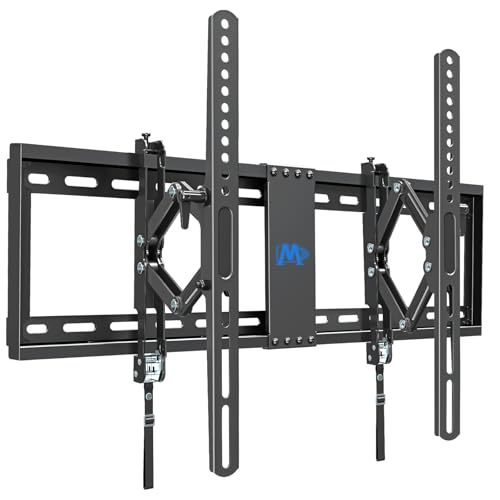
Mounting Dream UL Listed Advanced Tilt TV Wall Mount for Most 42-90 Inch TV
Advanced tilt: pulls 7 inches off the wall before it angles down, so you can reach the ports and get a real viewing angle from a high or above-fireplace position.
$50.49
See it on Amazon
Lowest current price of the mounts that fit
USX MOUNT Tilting TV Wall Mount for Most 37"-95" Flat Curved Screen Television
Covers almost every mainstream TV up to 95 inches and stays low-profile against the wall.
$19.94
See it on Amazon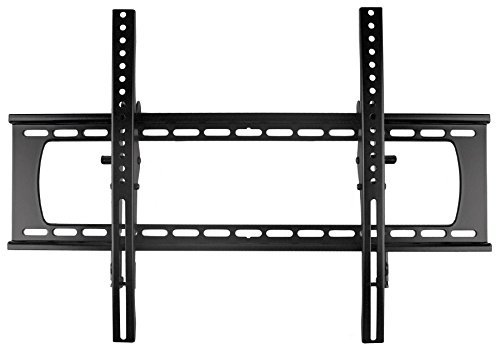
Same mount style, a step up in price
SunBriteTV Outdoor Weatherproof Tilt Mount for 37"
SunBrite build the outdoor TVs, so their mount hardware is the one that survives a real winter.
$159.10
See it on AmazonPrices as of Oct 15, 2026, 10:00 AM EDT. Product prices and availability are accurate as of the date/time indicated and are subject to change. Any price and availability information displayed on Amazon.com at the time of purchase will apply to the purchase of this product. As an Amazon Associate, Express Mounting earns from qualifying purchases.