What the viewing angle actually costs you
This is the number nobody quotes before the install and everybody notices after it. The table below assumes
a typical setup, a 48-inch mantel with 12 inches of clearance above it, putting the bottom of the screen
at 60 inches, and shows how steeply you would be looking up from a normal sofa.
| TV size | Screen centre | 8 ft back | 10 ft back | 12 ft back | 15 ft back |
| 55" | 6' 1" | 18°
| 15°
| 12°
| 10°
|
| 65" | 6' 4" | 19°
| 16°
| 13°
| 11°
|
| 75" | 6' 6" | 21°
| 17°
| 14°
| 11°
|
| 85" | 6' 9" | 22°
| 18°
| 15°
| 12°
|
Green is comfortable, amber needs a tilt mount, red needs a pull-down. Only one thing in the grid moves you
toward green: sitting further back. A bigger TV moves you the other way, because the mantel fixes the bottom
edge and a taller panel puts its centre higher.
Heat clearance by fireplace type
These are planning clearances: starting points for a conversation with a thermometer, not code citations.
The numbers your fireplace manufacturer and TV manufacturer state for your specific units always override
them.
| Fireplace | Deep mantel | Flush surround | Why |
| Wood burning | 12" | 24" | The most heat, and the least predictable. A real fire can run the wall above the firebox well past what a TV is specified for. |
| Gas, vented | 6" | 18" | Steadier than wood but still a genuine heat source. Vented units push most of the heat up the flue, not the wall. |
| Electric | 4" | 12" | Nearly all electric units vent forward at the top of the unit. Keep the screen out of that vent path and heat is rarely the issue. |
| Decorative only | None | None | If it is never lit, treat the wall as an ordinary wall. Only the viewing angle matters. |
The mantel itself is doing more work than the distance. A shelf projecting 6 inches or more throws
rising heat outward into the room, away from the wall, which is why a deep mantel earns you clearance and a
flush stone surround costs you it.
The thermometer test
Everything above is planning. This is the only measurement that settles it, and it takes an hour.
- Light a normal fire, the kind you would actually have on a winter evening, not a token one.
- Let it run for a full hour so the masonry and the surround have warmed through. Cold brick hides the problem.
-
Hold an infrared thermometer against the wall at the exact height and position where the back of the TV
will sit. Take readings at the bottom edge, the centre and the top.
-
Compare against your TV's specified maximum operating temperature, usually around 95 °F. If the
wall is above it, the answer is no, regardless of how good the mount is.
If it is marginal, a mantel hood is the cheapest effective fix. It sits at the top of the firebox opening
and deflects the rising column of heat forward into the room instead of straight up the wall. Take the
thermometer reading again with the hood in place before you decide.
Tilt or pull-down
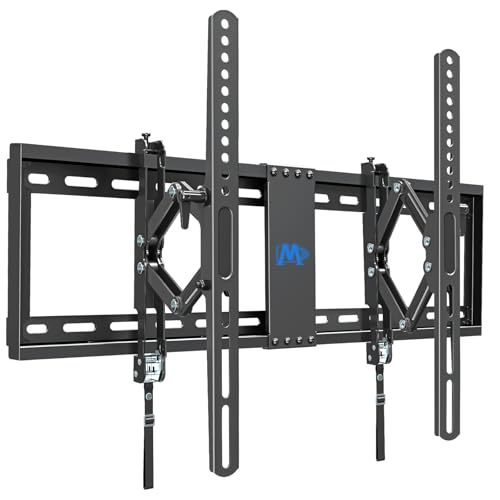
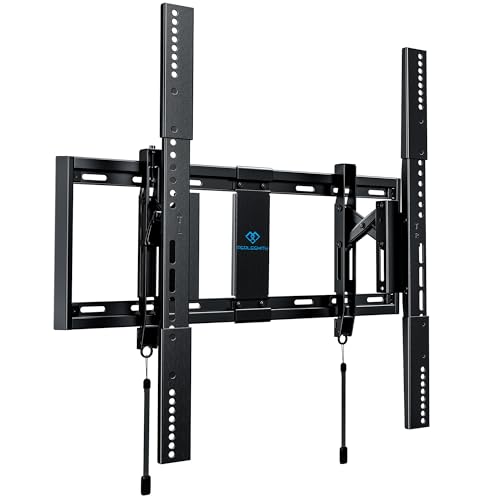
An advanced tilt mount pulls the panel a few inches off the wall before angling it down.
The extension matters as much as the tilt: it gets your hands behind the TV for cables, and it stops the
bottom edge fouling the mantel as the screen rotates. Under about 25 degrees of viewing angle, this is
all you need, at a fraction of the price of a pull-down.
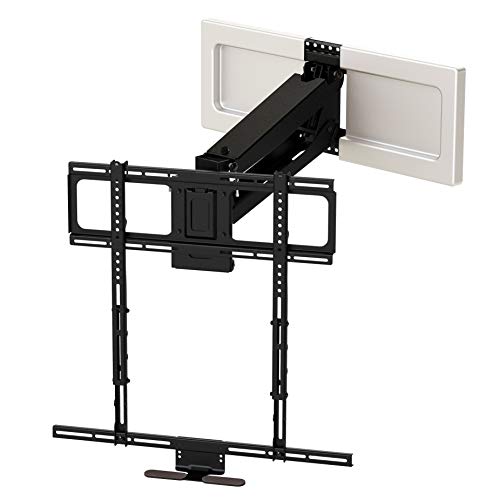
A pull-down mount is the answer when the angle is genuinely too steep. Counterbalanced arms
bring the screen down and out to eye level, and lift it back above the mantel when you are done. They are
heavier, more expensive and need headroom above the TV to travel, check that on an 8-foot ceiling before
committing. If you want us to fit one, a pull-down install is a $99 add-on to the size price.
There is a longer write-up on
pull-down mount installation
if you want the detail.
Frequently asked questions
Is it bad to mount a TV above a fireplace?
It is not automatically bad, but it is always a compromise, and two separate problems have to be solved. The first is viewing angle: a mantel forces the screen well above eye level, and from a sofa 10 feet back a typical 65-inch install has you looking up around 16 degrees, which is past the comfortable range for a long film. The second is heat. Most TVs are specified for ambient temperatures up to roughly 95 degrees Fahrenheit, and the wall above a working firebox can exceed that. Both are solvable, a pull-down mount fixes the angle, and a mantel hood plus adequate clearance manages the heat, but they need to be solved deliberately rather than assumed away.
How much clearance do I need above a fireplace?
It depends on the fireplace type and on how far the mantel projects from the wall. As a planning starting point we allow 12 inches above a mantel for a wood-burning fireplace, 6 for a vented gas unit and 4 for an electric one, all assuming a mantel that projects at least 6 inches to deflect rising heat outward. With a flush surround and no projecting mantel, double those numbers. Those are planning figures, not code: the clearances stated by your fireplace manufacturer and your TV manufacturer always take precedence.
How do I know if it is too hot for the TV?
Measure it. Light a normal fire, let it burn for an hour so the masonry has warmed through, then hold an infrared thermometer against the wall at the exact spot the TV will sit. Most televisions are specified for ambient operation up to around 95 degrees Fahrenheit. If the wall is running hotter than that during ordinary use, the TV does not belong there, and no mount changes that. This is a ten-dollar test that prevents a very expensive mistake.
Should I use a pull-down mount above a fireplace?
If the calculator puts your viewing angle above about 25 degrees, yes. A pull-down mount is the only hardware that actually solves a high mantel, because it brings the screen down to eye level while you watch and returns it above the mantel when you are done. Below 25 degrees an advanced tilt mount is usually enough and costs a fraction as much. Pull-downs also need headroom above the TV for the arm to travel, which is worth checking on an 8-foot ceiling.
Does a bigger TV help or hurt above a fireplace?
It hurts, a little. The mantel fixes the bottom edge of the screen, so a larger panel pushes its centre higher: hung off the same 60-inch line, an 85-inch sits about 7 inches higher at the centre than a 55-inch, and from 10 feet that is roughly 18 degrees of upward angle instead of 15. Size is not the lever. Seating distance, a tilt mount or a pull-down mount are, so choose the size for the room and fix the angle with hardware.
Can you mount a TV on a brick or stone fireplace?
Yes, and masonry is the strongest substrate there is once the anchors are in. It needs a rotary hammer with SDS-Plus bits, sleeve anchors drilled into the brick face or the mortar joint, whichever lines up with the mount's holes, and dust control if the room is finished. Stone veneer is the exception that catches people out: it is a facing, not a structure, so the anchor has to pass through it into the block or framing behind, which means knowing exactly how thick the veneer is before you start.
How do you hide the wires on a fireplace TV?
It depends on what the chimney breast is made of. On a framed and drywalled chimney breast you can usually run in-wall power and low-voltage cable exactly as you would on any wall. On solid masonry you cannot fish a cable, so the realistic options are a paintable surface raceway, or chasing a channel into the masonry and filling over it, which is a plastering job as much as a mounting one. Our wire-hiding tool builds the parts list for either route.
Fireplace installs are the ones worth handing over
Brick and stone need a rotary hammer, the right anchors and dust control, and the cable route above a
firebox is rarely obvious. We do these across all 13 US metros we serve. A pull-down mount install
is a $99 add-on to the size price; brick or stone adds $99.
Get a free estimate →