
On-Q In Stock
Legrand On-Q in-Wall TV Power Kit – Cable Management System with Recessed Outlet, Hides Wires for Wall-Mounted TVs, 6FT Power Cord, White, CPT306WV1
$79.99 View on Amazon
Answer four questions about your wall and get the parts list, both ways. The clean in-wall route, and the no-cutting surface route.
Updated September 22, 2026 · Parts matched from each product's listed specs; cable lengths include routing slack
Express Mounting, "TV Wire Hiding Kit Builder", updated September 22, 2026, https://expressmounting.com/tools/tv-wire-hiding-kit/
In-wall power done to code, or a surface cover when you cannot open the wall.
As an Amazon Associate, we earn from qualifying purchases. Prices as of Oct 15, 2026, 10:00 AM EDT. Product prices and availability are accurate as of the date/time indicated and are subject to change. Any price and availability information displayed on Amazon.com at the time of purchase will apply to the purchase of this product.

There are two ways to hide the cables behind a wall-mounted TV. Inside the wall gives an invisible finish and needs two cut-outs plus a UL-listed in-wall power kit, because a standard TV power cord must never be run inside a wall cavity. A paintable surface raceway needs no cutting at all, comes off cleanly, and is the right answer for renters and for masonry walls where fishing a cable is not possible. This builder gives you the complete parts list for whichever route fits your wall.
Everything else on this page is a preference. This one is not: a standard TV power cord may not be run inside a wall. Ordinary appliance cord is not rated for enclosure in a cavity: it cannot shed heat, it is not fire-rated, and it will fail a home inspection when you sell. People do it anyway because the hole is already cut and the cord already reaches, and then it has to be undone.
The fix is one kit. An in-wall power kit installs a properly rated cable between two boxes: a real outlet behind the TV, and a plug at the bottom that goes into your existing outlet. Nothing about it requires touching mains wiring, which is why these kits are sold for DIY installation. Low-voltage cables (HDMI, ethernet, optical, speaker wire) have no such restriction and can run freely in the cavity.
Never the length you measured. A cable pulled dead tight unseats itself when the mount moves, leaves nothing to work with if you need to re-dress it, and puts strain on the port. These are the lengths we would order for the four situations that cover most installs.
| Situation | Straight-line path | Buy | Type |
|---|---|---|---|
| TV to a console directly below | 3 ft | 6 ft | Certified copper |
| TV to a cabinet beside it | 6 ft | 15 ft | Certified copper |
| TV above a fireplace to a side cabinet | 9.5 ft | 15 ft | Certified copper |
| TV to equipment in another part of the room | 15.3 ft | 25 ft | Optical fibre |
The jump to optical fibre past 15 feet is not marketing. Certified 48 Gbps copper is dependable at short lengths, but on long runs 4K120 and 8K start dropping out intermittently: a black flash every few minutes, or a mode that will not lock at all. Diagnosing that after the wall is closed up is miserable. Fibre does not have the problem, and the price difference has narrowed to almost nothing.
There is no shame in the surface route, and in several situations it is simply correct: you are renting, the wall is solid masonry, the TV may move within a year, or there is a structural reason not to cut. A paintable raceway painted in the wall colour reads as a shadow line from a few feet away.
Two things separate a raceway that looks deliberate from one that looks stuck on. Buy a kit with proper corners and joiners rather than plain channel, and buy more length than the run needs. The fittings eat more than you expect. Then prime and paint it before you stick it down, not after.
There is a fuller walkthrough of the surface method in our raceway guide , and the in-wall method in how to hide TV wires in the wall .
No. A standard TV power cord is appliance cord, and it is not rated to be enclosed in a wall cavity. Burying one is a fire risk and it will fail a home inspection. The correct solution is an in-wall power kit, sometimes called a power bridge: it installs a proper in-wall rated cable between two code-compliant boxes, with a normal outlet behind the TV and a plug that reaches an existing outlet below. Kits from Legrand and similar brands are UL listed for exactly this. Low-voltage cables (HDMI, ethernet, optical, speaker wire) are fine to run in the cavity.
A paintable surface raceway. It is an adhesive channel that sticks to the wall, takes the cables inside it, and paints to match so it reads as a shadow line rather than a cable. It is inexpensive, takes about twenty minutes, comes off cleanly, and it is the correct answer for renters, for masonry walls where fishing a cable is impossible, and for anyone who does not want to open a wall. The finish is not quite as invisible as in-wall, but it is far better than a bundle of cables hanging down.
Longer than the distance you measured. Add roughly 15 per cent for routing that is never as straight as the tape measure, a foot for each bend, and two feet of service loop behind the panel so the cable does not unseat when a full-motion mount swings out. A TV with a console directly below it typically needs 10 feet even though the straight-line drop is only three. Past about 15 feet, switch from copper to optical fibre HDMI. Certified 48 Gbps copper starts dropping 4K120 and 8K intermittently on long runs, and that is the worst kind of fault to chase once the wall is closed up.
Not the way you would on drywall. There is no cavity to fish a cable through, so the options are a surface raceway, or chasing a channel into the masonry with an angle grinder and filling over it, which is a plastering job as much as a mounting one. On a framed and drywalled chimney breast, common even where the fireplace itself is masonry, the normal in-wall route usually works. Check by tapping: a hollow sound means framing behind the surface.
It is the plate that turns a hole in the drywall into a finished detail. Cables pass through the bristles, which flex around them and close up the gap, so the cut-out looks deliberate rather than like damage. You need two, one behind the TV and one behind the equipment. Pair them with low-voltage mounting brackets, the open-backed rings that hold a plate in drywall without needing an electrical box.
For a standard in-wall power kit, usually not: the kits are designed for DIY installation and neither end involves touching mains wiring. You are plugging into an existing outlet, not creating a circuit. If you want a new outlet installed behind the TV on its own circuit, then that is electrical work and it needs an electrician. If you are unsure which you are doing, that uncertainty is itself the answer.
Rather not cut into the wall yourself?
Rated in-wall power and no visible cable for $99 a TV, or a surface raceway for $79, alongside a mounting job across all 13 US metros we serve.
Get a free estimate →Both routes covered: in-wall power relocation and paint-ready raceway. Build your exact kit with the tool above.

Matched to this job
D-Line 157in Cord Cover Kit
D-Line's corners and joiners are what separate a raceway that looks deliberate from one that looks stuck on.
$26.99
See it on Amazon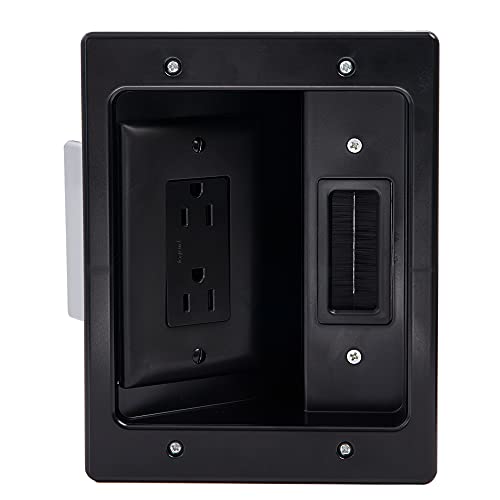
Strong alternative for the same job
Legrand
Legrand's UL-listed power bridge is the code-correct way to get an outlet behind the TV without running an extension cord inside the wall.
Different trade-off, same problem solved
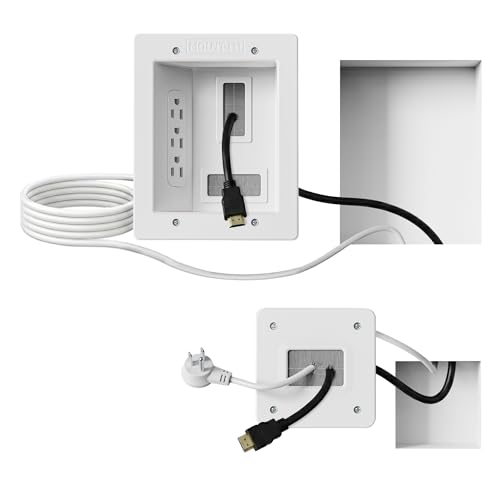
Mount-It! in-Wall TV Cable Concealer Kit with Recessed Power
Triple outlet, so the TV, soundbar and a streaming box all live behind the screen.
$66.99
See it on AmazonPrices as of Oct 15, 2026, 10:00 AM EDT. Product prices and availability are accurate as of the date/time indicated and are subject to change. Any price and availability information displayed on Amazon.com at the time of purchase will apply to the purchase of this product. As an Amazon Associate, Express Mounting earns from qualifying purchases.