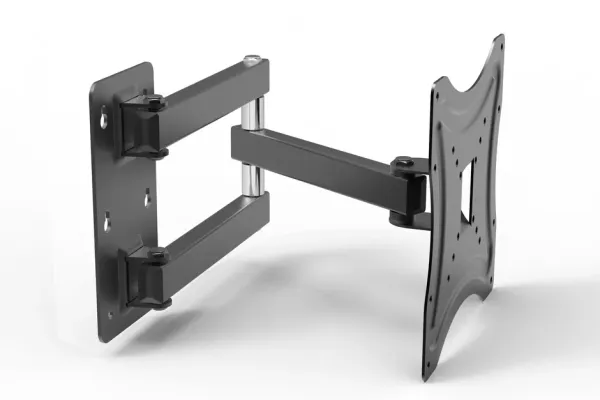
Most TV mounting quotes differ in four places: whether the price is flat or hourly, whether the bracket is included, what happens when the wall is not drywall, and what your building requires before anyone drills. Everything else is presentation. After 9,747+ installs since 2015, those are the four questions that predict how a job actually goes.
This guide is written from the installer side. It covers what a quote should contain, what the add-ons genuinely cost to perform, and which answers separate a company that mounts televisions every day from one that treats it as a side line.
Start with how the price is structured
A flat-rate quote states a number before anyone sees your wall. An hourly quote states a rate and discovers the number afterwards.
Flat rate is not automatically cheaper. It is more predictable, and predictability is what you are buying. Express Mounting publishes four tiers by screen size:
| Screen size | Flat rate |
|---|---|
| Up to 54 inches | $129 |
| 55 to 69 inches | $159 |
| 70 to 79 inches | $209 |
| 80-99 inches | $299 |
| 100 inches and up | $399 |
The reason size drives the tier is weight and handling, not difficulty of thought. An 85 inch panel is a two-person lift and needs a bracket rated far above what a 55 inch set needs.
When you compare two quotes, compare what each one covers rather than the headline figure. A $99 quote with the bracket billed on top can end up level with a $129 quote once the bracket is added. At Express Mounting the bracket is always a separate line: bring your own, or add ours (flat $49 or $69, full-motion $59 or $79).
Find out whether the bracket is included
This is the single line item that makes quotes look different when they are not.
A mount that fits your television has to satisfy three things at once: the hole pattern on the back of the panel, the weight of the panel, and the screen size range the bracket is built for. VESA publishes the Flat Display Mounting Interface standard that defines that hole pattern, and it varies by model and by screen size within the same model. A 65 inch set and a 75 inch set from the same product line often take different patterns.
UL 1678 is the standard covering carts, stands and entertainment centres used with audio and video equipment, and a bracket built to a recognised standard is a reasonable thing to ask about. What matters more in practice is the stated weight rating. Plenty of brackets advertised for 85 inch screens are rated below what an 85 inch screen weighs.
If the company supplies the bracket, ask which one and what it is rated to. If you are supplying it, ask them to confirm it fits before the appointment rather than on the day.
Ask what happens when the wall is not drywall
Drywall over wood studs is the easy case. The rest of the housing stock is not that.
Brick, stone and concrete need a hammer drill and masonry anchors, set into the brick face or the mortar joint, whichever lines up with the mount’s holes. That takes longer and burns through bits. Express Mounting publishes the masonry surcharge at $99 per TV, which means you know the number before the technician arrives.
Metal studs, plaster and lath, and tile each change the fixing method as well. What you are listening for is whether the company has a specific answer for your wall type or a general reassurance. A general reassurance usually means the price is going to move.
Check your building’s rules before you book
TV mounting is not a licensed trade in most jurisdictions, so asking for a contractor licence often produces a confused answer from a perfectly competent company.
The more useful homework is your building’s. Condo boards, high-rise management and many apartment complexes set their own rules for contractors: paperwork on file with the office, a service-lift reservation, set work hours. Ask your management office what it requires before you book, and tell the installer when you call.
If you live in a managed building, sort this out first. A missed building requirement is a common reason an appointment gets turned away at the door.
Cable concealment is where the code question appears
Running cables inside the wall is the part of the job with an actual rulebook behind it.
Low-voltage cables such as HDMI, Ethernet and speaker wire carry a CL2 or CL3 rating, and those ratings are what make them approved for in-wall use under the National Electrical Code, published as NFPA 70. Standard TV power cords are not rated for in-wall burial. The compliant way to get power behind a mounted television is a recessed in-wall power kit that puts a proper receptacle behind the screen.
An installer who answers “we just run everything up the wall” is describing something that will fail an inspection and may be flagged when you sell the house. It is a small technical question that reliably separates the trades from the hobbyists.
Questions that reveal experience quickly
- What VESA pattern does my model use, and what is the bracket rated to carry?
- What is the price if my wall turns out to be masonry?
- Is the bracket included in that figure?
- Is there a travel charge, and how long is the workmanship warranty?
- If cables go inside the wall, what rating are they and how does the power get there?
None of these are trick questions. A company that installs televisions daily answers them in a sentence each.
What a good appointment looks like
The technician locates framing with a stud finder or selects the right anchor for the substrate, sets the height, levels the bracket, load-checks it, and tidies the cabling at the back of the set. Most installs finish inside about 90 minutes. Express Mounting works 8am to 8pm, seven days a week, across 15 metros and 507 cities, and can usually quote accurately over the phone in around two minutes once it knows the screen size, the wall type and whether cables are going inside the wall.
If you want the number before you call, the price estimator runs the same flat-rate pricing the crew quotes from. If you already know your model, the mount finder looks up the VESA pattern and panel weight listed for your model.
Common questions
Should a TV mounting quote be flat rate or hourly?
Flat rate is the safer structure for the customer, because the number you are given does not move if the install runs long. Express Mounting publishes four flat tiers by screen size: $129 up to 54 inches, $159 for 55 to 69 inches, $209 for 70 to 79 inches, $299 for 80-99 inches, and $399 for 100 inches and up. Hourly quotes are not automatically worse, but they transfer the risk of a slow job onto you, and a hollow-wall or masonry surprise is exactly the kind of thing that makes a job slow.
What should be included in the base price of a TV installation?
At minimum: locating the framing, the mounting hardware itself, levelling, a load check, and basic cable tidying at the back of the set. Ask whether the bracket is included or billed separately, because that single line item is where quotes diverge most. Add-ons that are normally priced separately and should be stated up front include in-wall cable concealment, soundbar mounting, a full-motion bracket upgrade, and a masonry surcharge.
Does a TV mounting company need to be licensed?
TV mounting is not a licensed trade in most places, so a contractor licence is usually not the right question to ask. The more useful homework is your building’s: condo boards and managed buildings often set their own contractor rules, such as paperwork on file, a service-lift booking or set work hours. Ask your management office what it requires before you book, and tell the installer when you call.
Why do some companies charge extra for brick or concrete walls?
Because the work genuinely changes. Drywall over wood framing takes lag bolts into a stud. Brick, stone and concrete take a hammer drill and sleeve anchors rated well past the panel load, which is slower and consumes consumables. Express Mounting publishes that masonry surcharge at $99 per TV rather than discovering it on site. A company that has no masonry price at all has either not done much of it or intends to price it once the technician is standing in your living room.
How can you tell whether an installer actually knows the hardware?
Ask what VESA pattern your TV uses and what the bracket is rated to carry. VESA publishes the Flat Display Mounting Interface standard that defines the hole spacing on the back of the panel, and the pattern varies by model and by screen size within the same model, so a confident answer without your model number is a warning sign rather than a good one. A useful second question is whether the bracket is rated above your panel weight, not merely listed for your screen size.