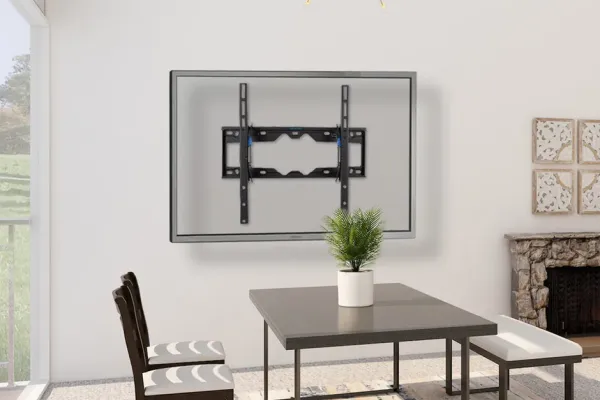
Five details decide what a TV mounting appointment costs and how long it takes: the screen size and model, what the wall is made of, whether cables go inside the wall, whether a bracket already exists, and what your building requires from contractors. Have those ready and a quote takes about two minutes on the phone, with the figure quoted matching the figure invoiced.
This is the preparation side rather than the vetting side. If you are still deciding which company to use, how to choose a TV mounting service covers that. This page assumes you have picked one and want the appointment to go cleanly.
1. Screen size and model number
Size sets the price tier. Model determines the bracket.
Express Mounting prices in four flat bands by screen size: $129 up to 54 inches, $159 for 55 to 69 inches, $209 for 70 to 79 inches, $299 for 80-99 inches, $399 for 100 inches and up. Size is the diagonal, corner to corner, not the width of the cabinet.
The model number matters for a different reason. The hole pattern on the back of your panel follows the VESA Flat Display Mounting Interface standard, and it changes by model and by screen size within the same model. Two sets from the same product line at different sizes frequently take different patterns. The mount finder looks up the pattern and panel weight listed for your model if you would rather not read it off the back.
2. What the wall is made of
This is the detail most likely to move a price, so it is worth thirty seconds.
| Wall | How to recognise it | Effect |
|---|---|---|
| Drywall over wood studs | Hollow between studs, firm on the stud line | Standard rate |
| Drywall over metal studs | A magnet sticks in a vertical line | Different anchors, no surcharge |
| Plaster and lath | Denser sound, common in pre-war homes | Slower, more dust |
| Brick, stone, concrete | Unmistakable when tapped | Published $99 surcharge |
| Tile over backer | Hard, hollow behind | Needs careful drilling |
You are not being asked to survey your house. A rough description is enough for the technician to load the correct anchors, and getting it roughly right is what stops the price changing when they arrive.
3. Where the cables are going
Two paths, and they cost differently.
Visible is fastest: the cables run down the wall, usually tidied into a channel. In-wall concealment means cutting, fishing the run and bringing power up to the screen properly. That last part has a rulebook behind it. Low-voltage cables such as HDMI and Ethernet carry a CL2 or CL3 rating, which is what makes them approved for in-wall use under the National Electrical Code, published as NFPA 70. A standard power cord is not rated for burial in a wall, so the compliant route is a recessed in-wall power kit placing a receptacle behind the set.
Decide which you want before booking. It changes both the price and the length of the appointment.
4. Who is supplying the bracket
Settle this before the van is loaded.
If the company supplies it, ask which model and what it is rated to carry. If you are supplying it, three things all have to be true at once: it matches your VESA pattern, its weight rating exceeds your panel weight, and its screen-size range includes your size. The mismatch we see most often is a bracket that lists the right screen size but is rated below the panel’s actual weight, which is a real failure risk rather than a technicality.
Also decide whether you want fixed, tilting or full motion, because that changes the bracket and sometimes the price. If you want ours, a flat mount is $49 or $69 and a full-motion mount $59 or $79, depending on screen size.
5. Building access rules
If you live in a condo, a high-rise or a managed apartment complex, this is the item most likely to cost you the appointment.
Many buildings set rules for contractors, such as paperwork on file with the management office, a service-lift booking or set work hours, and their approval process runs on its own schedule. Ask your management office what it needs before you book, not after, and tell us what they said when you call.
Confirm these when you book
- Is the quoted figure final, or an estimate that can change on site
- What the arrival window is, and whether you get a call when the technician is en route
- What the cancellation terms are
- Whether the bracket is included in the figure
- What happens if the wall turns out to be different from what you described
Express Mounting confirms appointments by text and email and the technician calls when on the way. Booking is open online around the clock, and the price estimator uses the same flat-rate pricing the crew quotes from if you want the number in front of you first.
A short pre-arrival checklist
Clear the floor in front of the wall. Move anything fragile. Take the TV out of the box if you can manage it safely, since an 80 inch panel is a two-person lift. Decide whether the furniture under the mounting position is staying, because that sets the screen height. Know where the nearest outlet is.
Most installs finish inside about 90 minutes once the technician is working.
Common questions
What information do I need before booking a TV installation?
Five things cover almost every quote: the screen size and model number, what the wall is built from, whether cables are going inside the wall or staying visible, whether a bracket already exists, and what your building requires from contractors. With those, Express Mounting can usually give an accurate price over the phone in about two minutes, and the figure quoted is the figure invoiced.
How do I find out what my wall is made of?
Knock it. Drywall sounds hollow between studs and firm where a stud runs. Plaster over lath sounds denser and is common in pre-war housing. Brick and concrete are unmistakable once you tap them, and a magnet that sticks in a vertical line usually means metal studs rather than wood. You do not need certainty, only a description good enough for the technician to load the right anchors before setting off.
Do I need to buy the TV mount before the appointment?
Not necessarily, but the answer has to be settled before the technician leaves. If the company supplies the bracket, confirm which one and what it is rated to carry. If you are supplying it, confirm it matches your VESA pattern, exceeds your panel weight and lists your screen size in its range. A bracket that satisfies the size range but not the weight rating is the most common mismatch we are called out to fix.
What should I ask about the appointment itself?
Ask for the arrival window rather than a single time, whether you will be contacted when the technician is on the way, and what the cancellation terms are. Express Mounting sends appointment confirmations by text and email, and the technician calls when they are en route. Ask also whether the quoted figure is final or an estimate that can move on site, because those are very different commitments.
Does the room need preparing before the installer arrives?
Clear a working area in front of the wall and move fragile items out of the way. If furniture sits under the mounting position, decide in advance whether it is staying, because that affects the height the screen ends up at. Have the TV out of its box if you can, and know where the nearest power outlet is, since that determines what an in-wall power kit would involve.