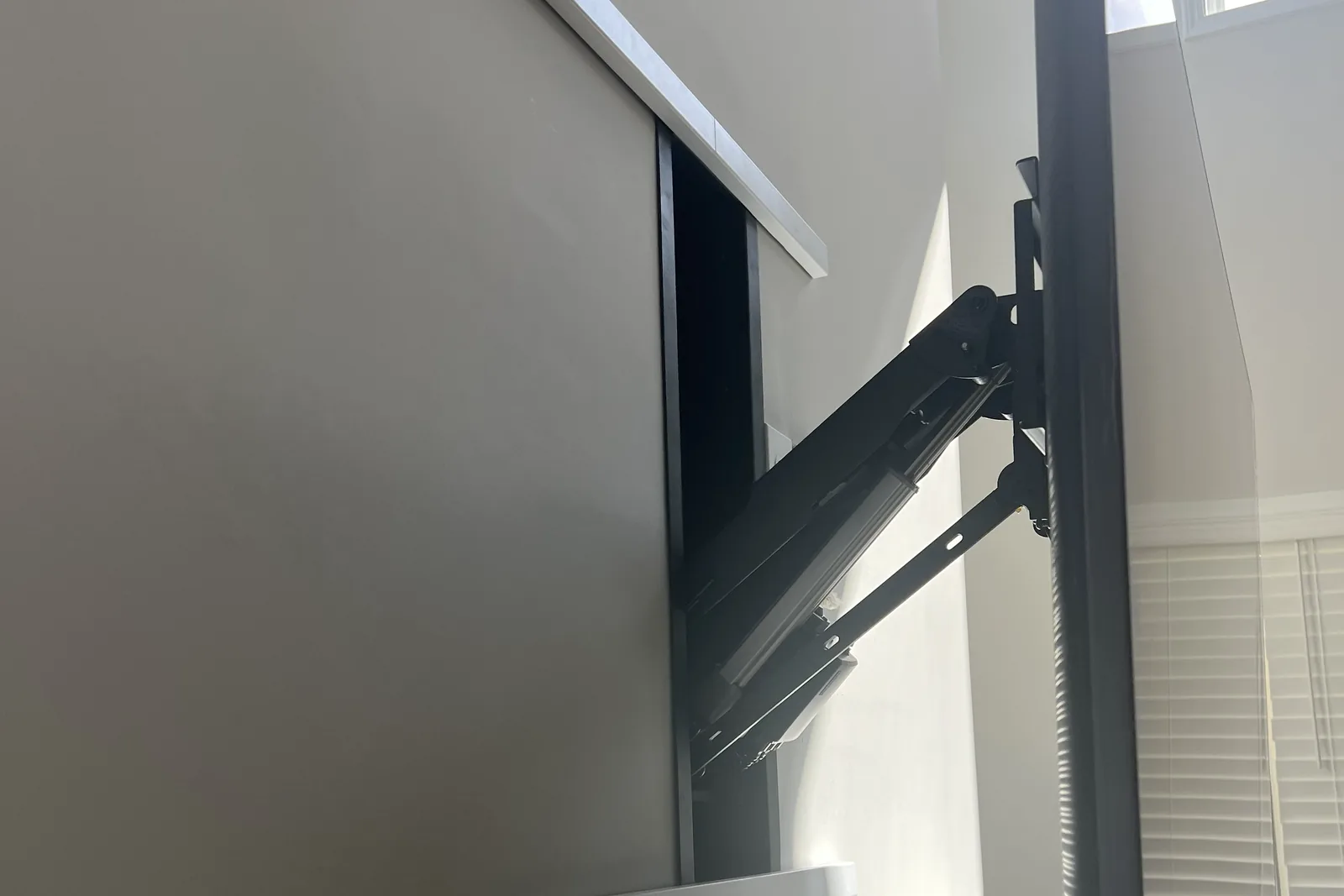
Pick a ceiling mount rated 25% over your TV’s weight with a VESA range that reaches its pattern, then lag the ceiling plate into a joist, or blocking between joists, never into ceiling drywall alone. On a vaulted ceiling, choose a plate that adjusts to the pitch. VIVO’s motorized flip-down suits flat ceilings and TVs up to 70 inches.
Quick note: This page contains Amazon affiliate links. We may earn a small commission at no extra cost to you if you buy through them.
A ceiling mount solves a room where no wall works: windows on every side, a bedroom where the only open wall is behind the headboard, an attic room under a steep roof, a garage gym. It also asks more of the structure than a wall mount does. On a wall, the lag bolts mostly carry the weight across their shanks. On a ceiling, the whole load hangs from the fasteners and pulls straight out of the wood, and a swinging arm adds to it every time someone turns the screen.
So the choice comes in two parts: the mount, sized to your TV and your ceiling, and the anchoring, which is where ceiling installs succeed or fail. How we picked: the specs below are quoted from each maker’s product page or Amazon listing. We name only mounts whose listings state enough to check the fit; where our catalog has a gap, we say so and link a search instead.
What makes a ceiling TV mount safe?
Four checks, in this order:
| Check | What to look for | Why it matters overhead |
|---|---|---|
| Weight rating | At least 25% over the TV’s weight without its stand | The mount carries the full load in tension |
| VESA range | Reaches your TV’s pattern | Same as any mount; big TVs need 600×400 or wider |
| Ceiling type | Flat, sloped, drop or concrete, as the listing states | A flat-ceiling plate on a sloped ceiling hangs the TV crooked |
| What it anchors into | A joist, blocking between joists, or concrete | Ceiling drywall can’t hold a TV at any size |
The 25% margin is the same one our VESA size guide uses for wall mounts. On a wall, drywall with rated toggles is acceptable for a TV up to about 32 inches and 30 pounds. Overhead there is no such exception: a ceiling mount goes into framing or concrete.
Best ceiling TV mounts by ceiling type
Flat drywall ceiling, TV up to 70 inches: VIVO’s motorized flip-down
The VIVO electric flip-down and swivel ceiling mount (MOUNT-E-FD75C-S) folds the TV flat against the ceiling and lowers it on a remote. VIVO’s own product page, checked September 23, 2026, lists:
| Spec | VIVO MOUNT-E-FD75C-S |
|---|---|
| Screen sizes | 37 to 70 inches |
| Weight capacity | 99 lb |
| VESA patterns | 200×100 up to 600×400 |
| Ceiling type | Flat surfaces |
| Folded profile | 7 inches |
| Swivel and tilt | Electric swivel 90° each way; manual tilt 0 to -75° |
| Power | Needs power at the ceiling (100-240V input) |
Two notes from the same page are worth reading before you buy. It’s for flat ceilings only, so it isn’t the answer for a vaulted room. And VIVO advises that on a TV over 65 inches the VESA holes should be centered on the back of the set, so the screen clears the ceiling when it folds. With the 25% margin, 99 lb suits a TV up to about 79 lb.
Flat ceiling, standard (non-motorized) mount
The most common ceiling mount is a steel pole hanging from a ceiling plate, with a tilting head for the TV. Our catalog doesn’t carry one with verified specs yet, so we won’t name a model; search ceiling TV mounts with an adjustable pole and hold each listing to the table above. Prefer a pole that adjusts in length, so you can set the screen’s height after the plate is up.
Vaulted or sloped ceiling
Look for a ceiling plate that states a pitch range and a pole that swivels at the top, so the TV hangs plumb under an angled ceiling. None of the mounts in our catalog list a pitch range, so search vaulted-ceiling TV mounts and confirm the listing’s pitch against your ceiling’s before buying. On a steep vault, check whether a short knee wall or a gable wall would take a normal wall mount instead; it’s often the simpler install.
Drop ceiling
The tile grid in a suspended ceiling can’t carry a TV. The mount has to reach through the grid to the structure above, usually with an extension pole, and the plate goes into the joists or the concrete deck overhead.
Poured-concrete ceiling
Common in high-rise condos. Concrete holds a ceiling mount well with masonry anchors set by a hammer drill, but drilling overhead into a slab is a job most people hand off: rebar can sit anywhere, and some towers have post-tension cables in the slab that must never be drilled. Ask the building’s management before anyone drills.
What if the TV has to hang between two joists?
Joists sit 16 or 24 inches apart, center to center, and they rarely fall exactly where the screen should go. There are two clean fixes:
- Bridge them with a plate. The VIVO extension adapter plate is sold for ceiling and wall mounts, lists 16 to 24-inch spacing and 154 lb, and lets you fasten to two joists and hang the mount between them.
- Add blocking from above. With attic access, a length of 2x lumber fastened between two joists gives the ceiling plate solid wood exactly where you need it.
Either way, lag into the center of the wood: 3/8-inch lag bolts at least 3 inches long, such as the Prime-Line 3/8 x 3 inch 50-pack, in every hole the plate provides. The sizes and pilot holes are in our toggle bolts vs lag bolts guide.
How do you find ceiling joists?
The same way you find studs, with a few ceiling-specific habits:
- Scan across the joists, not along them. A finder that reads the whole joist at once, like the Franklin ProSensor M210, which also lists live-wire detection, is useful overhead, where light fixtures bring wiring close to the drywall.
- Confirm with a thin nail where the plate will cover the holes, before any lag goes in.
- Look from the attic if you can. You’ll see the joist direction and anything in the way, such as ductwork or wiring.
How high should a ceiling-mounted TV hang?
A ceiling mount puts the screen high by design, so aim it with tilt. The most comfortable center is still seated eye level, about 42 inches from the floor from a sofa and 42-50 inches in a bedroom, and the highest comfortable center is eye height + 0.27 x seating distance, which holds the upward look to 15 degrees. From 10 feet (120 inches) back, that’s about 74 inches. A screen hanging higher than that needs enough downward tilt to face the seats, and it will still be work on the neck for a long movie. Our TV height calculator runs the numbers for your room.
Mounting a projector rather than a TV? That’s a different mount entirely; see our projector mounts.
Ceiling or wall: which should you choose?
A wall mount is simpler, cheaper and easier to hide cables for, so use a wall wherever one works, including a corner. Our guide to corner and ceiling mounts in Atlanta homes covers the corner options. Go to the ceiling when every wall is glass, doors or built-ins, when you watch lying down, or when the room is a vaulted space with no usable wall at viewing height.
Frequently asked questions
What is the best ceiling TV mount?
The one rated at least 25% over your TV’s weight, with a VESA range that reaches its pattern and a plate made for your ceiling type. For a flat ceiling and a TV up to 70 inches and about 79 lb, VIVO’s motorized flip-down (99 lb, 600×400) fits on paper. For a vaulted ceiling, choose a mount that states a pitch range.
Can a ceiling hold a TV?
Yes, when the mount is lagged into a joist, blocking between joists or concrete. Ceiling drywall alone can’t hold a TV at any size, because the whole load pulls straight out of it.
How much weight can a ceiling joist hold for a TV?
It depends on the joist’s size, span and condition, so there’s no single number. What you size in practice is the mount’s rating and the fasteners: 3/8-inch lags at least 3 inches long into the center of the joist, in every hole the plate provides. If the attic shows roof trusses, water damage or undersized lumber, have the framing checked before hanging a big TV.
Can you mount a TV on a vaulted ceiling?
Yes, with a ceiling plate made for sloped ceilings, which lets the pole hang plumb. A flat-ceiling mount on a slope hangs the TV at an angle. On a steep vault, a knee wall or gable wall is often an easier place for a normal wall mount.
Do motorized ceiling TV mounts need an outlet?
Yes. The motor needs power at the ceiling, so plan an outlet or have an electrician run one. VIVO lists a 100-240V input for its flip-down mount.
Can you mount a TV to a drop ceiling?
Not to the tiles or the grid. The mount has to reach the joists or the concrete deck above the suspended ceiling, usually with an extension pole.
Want it installed?
Ceiling mounts aren’t on our flat price list, because the job depends on the joists, the ceiling type and what’s above it. We quote them after a look; a photo of the ceiling and a note about attic access helps. For wall mounting, our labor is a flat rate by TV size, from $129 up to 54 inches, with the same rates in all 13 metros we serve and a 3-year workmanship warranty on every install. See the price list for wall rates, or send a photo of the ceiling for a quote.