Usually, if you stay at the same size. Across 2024-2026 TV lines, the VESA pattern carried over to the line’s next model in 171 of 206 cases (83%). One size up in the same model, it changed in 222 of 342 cases and the TV gained about 12 to 21 lb at the median. Check pattern, weight rating and screws first.
Quick note: This page contains Amazon affiliate links. We may earn a small commission at no extra cost to you if you buy through them.
If a Black Friday deal (November 27 this year) is about to put a new TV in front of an old wall mount, three numbers on the new TV’s spec sheet decide whether the mount can stay: the VESA pattern, the weight without the stand and the screw size. We compared all three across every 2024, 2025 and 2026 US model in Express Mounting’s research, compiled from each maker’s published specs: 745 listings, one per model and screen size, from Samsung, LG, Sony, TCL, Hisense, Vizio and Roku.
The result mostly turns on one decision. Keep the screen size and the old mount usually works. Go bigger and it often doesn’t.
Same size, newer model: does the old mount still fit?
Most of the time. Makers name their TVs in lines that run across model years: Samsung’s S90D, S90F and S90H are one line, and so are LG’s C4, C5 and C6. We compared each line at each screen size with the next model year the research has for it, for example Samsung’s 65-inch S90F (2025) with the S90H (2026). That gives 206 year-to-year cases, and in 171 of them the pattern stayed exactly the same.
| Brand | Lines compared | Year-to-year cases | Same pattern | New pattern | Depends on the variant |
|---|---|---|---|---|---|
| Samsung | 14 | 81 | 74 | 7 | 0 |
| LG | 5 | 39 | 39 | 0 | 0 |
| TCL | 4 | 24 | 18 | 6 | 0 |
| Hisense | 4 | 20 | 8 | 11 | 1 |
| Roku | 6 | 18 | 14 | 4 | 0 |
| Sony | 4 | 16 | 14 | 2 | 0 |
| Vizio | 2 | 8 | 4 | 1 | 3 |
| All seven | 39 | 206 | 171 | 31 | 4 |
LG is the steadiest. Its B, C and G-series OLEDs, the QNED85 and the 75-inch UT7000 kept the same pattern in all 39 cases. Hisense sits at the other end: its U6 and U7 switched patterns at 65 and 75 inches in 2025, then switched again in 2026, so 11 of its 20 cases ended on a new pattern and one more depends on the retail variant.
When the pattern stays, does the weight?
Mostly. In 161 of those 171 cases the newer TV was lighter or within a pound of the older one, so your mount keeps about the same margin it had over the old TV. The other 10 got heavier. The largest jumps were Roku’s 65-inch Plus Series, where the 2025 R6CX lists 39.7 lb against Roku’s approximate 33 lb for the 2024 R6AX (about 20%), and Samsung’s 65-inch QN900F, 8.6 lb (18%) heavier than the 2024 QN900D.
Even those jumps stay inside the margin our VESA guide recommends, a rating at least 25% above the TV’s weight without its stand. A mount that met that rule for the old TV is still rated above the new one’s weight, just with less to spare. If your new TV is one of the heavier ones, redo the math with the new weight.
Which TV lines changed their mounting pattern?
A new pattern showed up in 31 of the 206 cases, and in 4 more it depends on which variant you buy. The full list is below. A few are worth knowing by name:
- Samsung Crystal UHD: the 2025 U8000F uses a different pattern from the 2024 DU8000 at 65, 75 and 85 inches. The 85-inch went from 600×400 to 400×300 and dropped 28 lb.
- TCL QM7 and QM8: the 2025 QM7K and QM8K changed at five sizes between them (55 and 75 inches on the QM7; 65, 75 and 98 on the QM8). The 2026 QM7L and QM8L then kept the 2025 patterns.
- Samsung’s 2026 models: the 55-inch S95H and QN80H moved to 300×200, and the 75-inch QN80H to 400×300.
- TCL X11L: the 85-inch went from 400×400 on the X11K to 600×400.
- Sony Bravia 3: the 2026 Bravia 3 II (XR30M2) uses 300×300 at 50 inches and 400×400 at 75, where the 2024 S30 had 200×200 and 300×300.
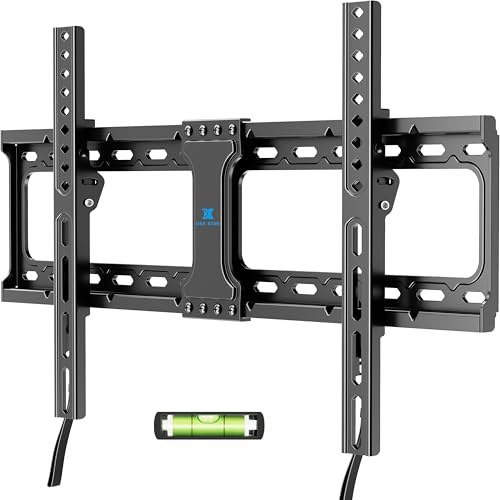
A new pattern doesn’t always mean a new mount. Many mounts list a range rather than a single pattern, and 26 of the 31 changes stay inside a 200×200 to 600×400 range, so a mount with that range only needs its TV brackets moved to the new holes. A bracket made for one pattern, or one whose range stops short of the new one, does need replacing.
| Brand | Size | Older model | Newer model | Pattern | Weight without stand |
|---|---|---|---|---|---|
| Samsung | 55” | 2025 QN80F | 2026 QN80H | 200×200 to 300×200 | 36.2 lb to 29.1 lb |
| Samsung | 75” | 2025 QN80F | 2026 QN80H | 400×400 to 400×300 | 71 lb to 50.7 lb |
| Samsung | 75” | 2024 QN900D | 2025 QN900F | 400×300 to 400×400 | 67.9 lb to 78.9 lb |
| Samsung | 55” | 2025 S95F | 2026 S95H | 400×300 to 300×200 | 30.4 lb to 35.9 lb |
| Samsung | 65” | 2024 DU8000 | 2025 U8000F | 400×300 to 200×200 | 46.1 lb to 31.3 lb |
| Samsung | 75” | 2024 DU8000 | 2025 U8000F | 400×400 to 400×300 | 69.2 lb to 49.4 lb |
| Samsung | 85” | 2024 DU8000 | 2025 U8000F | 600×400 to 400×300 | 91.5 lb to 63.3 lb |
| Sony | 50” | 2024 S30 | 2026 XR30M2 | 200×200 to 300×300 | 26.7 lb to 24.6 lb |
| Sony | 75” | 2024 S30 | 2026 XR30M2 | 300×300 to 400×400 | 69 lb to 68.8 lb |
| TCL | 55” | 2024 QM751G | 2025 QM7K | 400×300 to 300×300 | 28.9 lb to 29.3 lb |
| TCL | 75” | 2024 QM751G | 2025 QM7K | 400×400 to 300×300 | 63.1 lb to 54.2 lb |
| TCL | 65” | 2024 QM851G | 2025 QM8K | 400×400 to 300×300 | 51.2 lb to 46.5 lb |
| TCL | 75” | 2024 QM851G | 2025 QM8K | 500×400 to 400×400 | 72.8 lb to 62.6 lb |
| TCL | 98” | 2024 QM851G | 2025 QM8K | 600×600 to 600×500 | 147.3 lb to 121.3 lb |
| TCL | 85” | 2025 X11K | 2026 X11L | 400×400 to 600×400 | 104.5 lb to 112.9 lb |
| Hisense | 55” | 2025 U65QF | 2026 U6SF | 400×200 to 300×200 | 30.9 lb to 29.8 lb |
| Hisense | 65” | 2024 U6N | 2025 U65QF | 400×300 to 400×400 | 42.5 lb to 45 lb |
| Hisense | 65” | 2025 U65QF | 2026 U6SF | 400×400 to 400×300 | 45 lb to 40.8 lb |
| Hisense | 75” | 2024 U6N | 2025 U65QF | 400×400 to 600×400 | 60.6 lb to 63.9 lb |
| Hisense | 75” | 2025 U65QF | 2026 U6SF | 600×400 to 500×400 | 63.9 lb to 56.9 lb |
| Hisense | 55” | 2025 U75QG | 2026 U7SF/U7SG | 400×200 to 400×200 (U7SF) or 400×400 (U7SG) | 33.3 lb to 31.9 lb |
| Hisense | 65” | 2024 U75N/U7N | 2025 U75QG | 400×300 to 400×400 | 42.5 lb to 47 lb |
| Hisense | 65” | 2025 U75QG | 2026 U7SG | 400×400 to 400×300 | 47 lb to 43.2 lb |
| Hisense | 75” | 2024 U75N/U7N | 2025 U75QG | 400×400 to 600×400 | 60.2 lb to 63.9 lb |
| Hisense | 75” | 2025 U75QG | 2026 U7SG | 600×400 to 400×400 | 63.9 lb to 61.5 lb |
| Hisense | 100” | 2024 U70N/U76N | 2025 U75QG | 600×400 to 800×400 | 132.3 lb to 136.7 lb |
| Hisense | 55” | 2024 U8N | 2025 U8QG | 400×300 to 400×400 | 41.2 lb to 39.5 lb |
| Vizio | 50” | 2024 V4K-C-0809 and 4 other V4K variants | 2025 V4K-S-0810 | 200×200 or 400×300 (by variant) to 400×300 | 19 lb to 18.7 lb |
| Vizio | 65” | 2024 V4K-C-0804/V4K-M-0804 | 2025 V4K-X-0804/V4K-X-0810 | 400×300 to 300×200 (V4K-X-0804) or 400×300 (V4K-X-0810) | 37.8 lb to 32.5 lb |
| Vizio | 50” | 2025 VQD-M-0809 | 2026 VQD-R-1007 and 2 other VQD variants | 200×200 to 200×200 (VQD-R-1007) or 400×300 (VQD-R-1010/VQD-X-1010) | 18.8 lb to 18.9 lb |
| Vizio | 65” | 2025 VQD-M-0804 | 2026 VQD-R-1004/VQD-X-1004 | 400×300 to 300×200 | 30.5 lb to 28.6 lb |
| Roku | 32” | 2024 R2BX/R2CX | 2025 R2D5 | 100×100 to 200×200 | 8.3 lb to 7.7 lb |
| Roku | 32” | 2024 R3BX/R3CX | 2025 R3D5 | 100×100 to 200×200 | 8.3 lb to 7.6 lb |
| Roku | 40” | 2024 R3BX/R3CX | 2025 R3D5 | 100×100 to 300×200 | 11.6 lb to 11 lb |
| Roku | 55” | 2024 R6AX | 2025 R6CX | 400×300 to 300×300 | 30 lb to 27.4 lb |
65-inch TVs, 2024 to 2026, line by line
No screen size has more listings than 65 inches, so here is every line sold at that size in at least two of the three years. Each cell is the maker’s pattern and weight without the stand, and the model name links to the page that covers it.
| 65-inch line | 2024 | 2025 | 2026 | Mount carries over? |
|---|---|---|---|---|
| Samsung LS03D, LS03FA, LS03HE | LS03D: 400×300, 49.3 lb | LS03FA: 400×300, 49.4 lb | LS03HE: 400×300, 48.1 lb | Same pattern every year |
| Samsung LS03FW, LS03HW | no model at this size | LS03FW: 400×300, 48.1 lb | LS03HW: 400×300, 48.1 lb | Same pattern every year |
| Samsung QE1D, QEF1 | QE1D: 400×300, 46.1 lb | QEF1: 400×300, 36.8 lb | no model at this size | Same pattern every year |
| Samsung QN1EF, QN1EH | no model at this size | QN1EF: 400×300, 45.9 lb | QN1EH: 400×300, 45.9 lb | Same pattern every year |
| Samsung QN70F, QN70H | no model at this size | QN70F: 400×300, 45.9 lb | QN70H: 400×300, 45.9 lb | Same pattern every year |
| Samsung QN80D, QN80F, QN80H | QN80D: 400×300, 50 lb | QN80F: 400×300, 50 lb | QN80H: 400×300, 37.9 lb | Same pattern every year |
| Samsung QN90D, QN90F | QN90D: 400×300, 53.4 lb | QN90F: 400×300, 53.4 lb | no model at this size | Same pattern every year |
| Samsung QN900D, QN900F | QN900D: 400×300, 47.6 lb | QN900F: 400×300, 56.2 lb | no model at this size | Same pattern every year |
| Samsung S85D, S85F, S85H | S85D: 300×200, 38.4 lb | S85F: 300×200, 35.5 lb | S85H: 300×200, 38.4 lb | Same pattern every year |
| Samsung S90D, S90F, S90H | S90D: 300×200, 46.7 lb | S90F: 300×200, 46.7 lb | S90H: 300×200, 42.1 lb | Same pattern every year |
| Samsung S95D, S95F, S95H | S95D: 400×300, 41.7 lb | S95F: 400×300, 41.7 lb | S95H: 400×300, 46.1 lb | Same pattern every year |
| Samsung DU8000, U8000F, U8000H | DU8000: 400×300, 46.1 lb | U8000F: 200×200, 31.3 lb | U8000H: 200×200, 31.1 lb | Changed in 2025 |
| LG B4, B5, B6 | B4: 300×200, 37.7 lb | B5: 300×200, 37.7 lb | B6: 300×200, 37.7 lb | Same pattern every year |
| LG C4, C5, C6 | C4: 300×200, 36.6 lb | C5: 300×200, 36.6 lb | C6: 300×200, 36.6 lb | Same pattern every year |
| LG G4, G5, G6 | G4: 300×300, 52.5 lb | G5: 300×300, 48.5 lb | G6: 300×300, 48.5 lb | Same pattern every year |
| LG QNED85T, QNED85A, QNED85B | QNED85T: 300×300, 49.6 lb | QNED85A: 300×300, 49.6 lb | QNED85B: 300×300, 47.4 lb | Same pattern every year |
| Sony S30, XR30M2 | S30: 300×300, 47.2 lb | no model at this size | XR30M2: 300×300, 45.9 lb | Same pattern every year |
| Sony XR70, XR70M2 | XR70: 300×300, 59.7 lb | no model at this size | XR70M2: 300×300, 58.6 lb | Same pattern every year |
| Sony XR80, XR80M2, XR8B | XR80: 300×300, 49.2 lb | XR80M2/XR8B: 300×300, 50.5 lb / 49.2 lb | no model at this size | Same pattern every year |
| Sony XR90, XR90M2 | XR90: 300×300, 71.4 lb | no model at this size | XR90M2: 300×300, 58.6 lb | Same pattern every year |
| TCL Q651G, Q6L | Q651G: 400×300, 35.7 lb | no model at this size | Q6L: 400×300, 35.7 lb | Same pattern every year |
| TCL QM751G, QM7K, QM7L | QM751G: 300×300, 45.9 lb | QM7K: 300×300, 39.6 lb | QM7L: 300×300, 39.7 lb | Same pattern every year |
| TCL QM851G, QM8K, QM8L | QM851G: 400×400, 51.2 lb | QM8K: 300×300, 46.5 lb | QM8L: 300×300, 46.5 lb | Changed in 2025 |
| Hisense S7N, S7SG | S7N: 400×300, 61.7 lb | no model at this size | S7SG: 400×300, 47.4 lb | Same pattern every year |
| Hisense U6N, U65QF, U6SF | U6N: 400×300, 42.5 lb | U65QF: 400×400, 45 lb | U6SF: 400×300, 40.8 lb | Changed in 2025 and 2026 |
| Hisense U75N, U7N, U75QG, U7SG | U75N/U7N: 400×300, 42.5 lb | U75QG: 400×400, 47 lb | U7SG: 400×300, 43.2 lb | Changed in 2025 and 2026 |
| Vizio V4K | V4K-C-0804/V4K-M-0804: 400×300, 37.8 lb | V4K-X-0804/V4K-X-0810: 300×200 or 400×300, 29.7 lb / 35.2 lb | no model at this size | Depends on the variant |
| Vizio VQD | no model at this size | VQD-M-0804: 400×300, 30.5 lb | VQD-R-1004/VQD-X-1004: 300×200, 28.6 lb | Changed in 2026 |
| Roku R4AX, R4C5 | R4AX: 400×300, 33 lb | R4C5: 400×300, 31.1 lb | no model at this size | Same pattern every year |
| Roku R5CX, R5D5 | no model at this size | R5CX: 400×300, 31.1 lb | R5D5: 400×300, 30.2 lb | Same pattern every year |
| Roku R6AX, R6CX | R6AX: 400×300, 33 lb | R6CX: 400×300, 39.7 lb | no model at this size | Same pattern every year |
| Roku R8BX, R8CX | R8BX: 400×300, 64 lb | R8CX: 400×300, 63 lb | no model at this size | Same pattern every year |
Sony’s Bravia 3, 7, 8 and 9 used 300×300 at 65 inches in every year listed, and Samsung’s S85 and S90 OLEDs stayed on 300×200. Owners of those lines mostly need to check the weight and the screws.
Going bigger: 55 to 65, 75 or 85 inches
This is where old mounts run out. Within one model and year, stepping up one size changed the pattern in 222 of 342 cases, 65% of the time, and the share grows with the screen: every model sold at both 65 and 83 to 86 inches uses a different pattern at the larger size (101 of 101).
| Going from | Models with both sizes | Pattern changed | Median weight added | Weight added, range |
|---|---|---|---|---|
| 55 to 65 inches | 107 | 52 (49%) | 11.5 lb (40%) | 3 to 23 lb |
| 65 to 75/77 inches | 128 | 86 (67%) | 18.9 lb (43%) | 10.3 to 33.5 lb |
| 75/77 to 83/85/86 inches | 107 | 84 (79%) | 20.7 lb (32%) | 1.8 to 37.4 lb |
| 55 to 75/77 inches | 100 | 78 (78%) | 33.1 lb (107%) | 19 to 46.3 lb |
| 65 to 83/85/86 inches | 101 | 101 (100%) | 39.3 lb (92%) | 18.9 to 62.6 lb |
Weight climbs faster than the screen. Going from 55 to 75 or 77 inches in the same model adds a median 33.1 lb, about double, so a mount that was comfortably rated for the 55-inch set may not be for the bigger one.
Will your mount’s VESA range reach?
The range printed on your mount’s box decides whether the holes can line up at all. At 55 and 65 inches, every listing fits a mount listed 200×200 to 400×400 (141 of 141 at 65 inches). At 75 inches that range still covers 109 of 119, but at 85 inches it covers only 21 of 82. Stretch the range to 600×400 and it takes 78 of 82 at 85 inches; the four it misses are TCL’s QM8 and QM9K at 600×500.
| Screen size | Listings | Most common pattern | Fits a 200×200 to 400×400 mount | Fits a 200×200 to 600×400 mount | Median weight | Heaviest | Rating 25% over the heaviest |
|---|---|---|---|---|---|---|---|
| 55” | 113 | 300×200 (42) | 113 (100%) | 113 (100%) | 30.4 lb | 64.6 lb | 81 lb |
| 65” | 141 | 400×300 (65) | 141 (100%) | 141 (100%) | 45 lb | 85.8 lb | 108 lb |
| 75” | 119 | 400×400 (56) | 109 (92%) | 119 (100%) | 62.6 lb | 110.9 lb | 139 lb |
| 85” | 82 | 600×400 (55) | 21 (26%) | 78 (95%) | 85.8 lb | 115.5 lb | 145 lb |
The last column is the rating the 25% margin asks for on the heaviest TV at each size. At 55 to 75 inches that TV is Samsung’s outdoor Terrace, so the column runs high; the median is the better guide for an indoor set. The median 85-inch listing weighs 85.8 lb, which calls for a mount rated to about 107 lb, and the heaviest, Sony’s 2024 Bravia 9 at 115.5 lb, needs about 145 lb.
Bigger TVs ask more of the wall
A heavier panel changes the wall work too. Drywall alone is only safe for a TV up to about 32 inches and 30 pounds, so a 55-inch set or anything bigger belongs on studs or masonry, and a bigger TV may need a wall plate that reaches a second stud. Our 85-inch mounting guide covers lag bolts and backer boards for big panels, and the TV height calculator shows where a taller screen’s bottom edge lands.
Screws: what changes when the pattern doesn’t
The holes can line up and the screws still be wrong. In the same-pattern cases the thread changed in only 3 of 156 where both years list one. Screw depth moved more often, by more than 2 mm in 26 of the 83 cases where the maker lists a depth for both years. Samsung’s S95H lists 15-17 mm where the S95F listed 5-6 mm, the QN900F lists 13-15 mm against the QN900D’s 5-6 mm, and the 43 to 55-inch Crystal UHD U8000F lists 23-25 mm against the DU8000’s 11-13 mm.
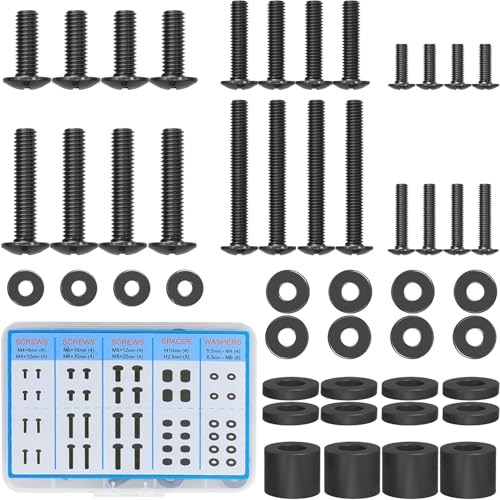
A screw that’s too short grabs only a few threads. One that’s too long can bottom out and press on the panel. Use the length the new TV’s manual gives and the mount’s spacers if the holes sit in a recess. If the hardware bag doesn’t have the right length, a TV screw kit with M4, M6 and M8 screws and spacers is worth having on hand before the new set arrives.
| Brand | Sizes | Older model | Newer model | What the maker lists |
|---|---|---|---|---|
| Samsung | 55”, 65” | 2025 LS03FA | 2026 LS03HE | screw depth 12 mm to 15 mm |
| Samsung | 75”, 85” | 2024 LS03D | 2026 LS03HE | screw depth 12 mm to 15 mm |
| Samsung | 55”, 65”, 75”, 85” | 2024 QE1D | 2025 QEF1 | screw depth 13 mm to 21 mm |
| Samsung | 65”, 85” | 2024 QN900D | 2025 QN900F | screw depth 6 mm to 15 mm |
| Samsung | 77” | 2024 S84D | 2025 S84F | screw depth 30 mm to 21 mm |
| Samsung | 77”, 83” | 2024 S85D | 2025 S85F | screw depth 30 mm to 21 mm |
| Samsung | 65”, 77”, 83” | 2025 S95F | 2026 S95H | screw depth 6 mm to 17 mm |
| Samsung | 43”, 50”, 55” | 2024 DU8000 | 2025 U8000F | screw depth 13 mm to 25 mm |
| Hisense | 85” | 2025 U65QF | 2026 U6SF | thread M8 to M6 |
| Vizio | 55” | 2025 VQD-M-0804 | 2026 VQD-R-1004 | screw depth 12 mm to 15 mm |
| Vizio | 75” | 2025 VQD-M-0804 | 2026 VQD-R-1004 and 2 other VQD variants | screw depth 12 mm to 15 mm |
| Roku | 24” | 2025 R2D5 | 2026 R2E5 | screw depth 5 mm to 10 mm |
| Roku | 32” | 2025 R2D5 | 2026 R2E5 | thread M4 to M6; screw depth 5 mm to 10 mm |
| Roku | 32” | 2025 R3D5 | 2026 R3E5 | thread M4 to M6; screw depth 5 mm to 10 mm |
| Roku | 55” | 2024 R4AX | 2025 R4C5 | screw depth 16 mm to 12 mm |
| Roku | 65” | 2025 R5CX | 2026 R5D5 | screw depth 16 mm to 12 mm |
Thread size tracks screen size loosely. M6 is the thread the makers list most often at 55, 65 and 75 inches, and at 85 inches, 65 of the 75 listings that name a thread use M8.
TVs that come with their own wall mount
For a few TVs the question is a different one, because the maker designed them around its own bracket.
| TV | Year | Sizes | The maker’s own mount | VESA holes for a standard mount? |
|---|---|---|---|---|
| Samsung LS03D | 2024 | 43”, 50”, 55”, 65”, 75”, 85” | Samsung Slim Fit Wall Mount WMN-B50EB | Yes |
| Samsung LS03FA | 2025 | 43”, 50”, 55”, 65” | Samsung Slim Fit Wall Mount | Yes |
| Samsung LS03FW | 2025 | 65”, 75”, 85” | Samsung Slim Fit Wall Mount | Yes |
| Samsung LS03HE | 2026 | 55”, 65”, 75”, 85”, 98” | Samsung Slim Fit Wall Mount | Yes |
| Samsung LS03HW | 2026 | 55”, 65”, 75”, 85” | Samsung Slim Fit Wall Mount | Yes |
| LG G4 | 2024 | 77”, 83”, 97” | LG wall mount | Yes |
| LG G5 | 2025 | 55”, 65”, 77”, 83”, 97” | LG wall mount | Yes |
| LG QNED9MA | 2025 | 65” | LG wall mount | Yes |
| LG G6 | 2026 | 55”, 65”, 77”, 83”, 97” | LG flush wall mount | Yes |
| LG LX7B | 2026 | 55”, 65” | LG flush wall mount | Yes |
| TCL A300W | 2024 | 55”, 65”, 75”, 85” | TCL flush wall mount | No, the maker lists none |
| TCL A300L | 2026 | 55”, 65”, 75”, 85” | TCL flush wall mount | No, the maker lists none |
| Hisense S7N | 2024 | 65” | Hisense wall mount assembly | Yes |
| Hisense S7SG | 2026 | 50”, 55”, 65” | Hisense wall mount assembly | Yes |
- TCL A300W and A300L: TCL lists them as not VESA compatible. They hang on the flush mount in the box, so no bracket you already own will fit.
- LG G5, G6, LX7B and QNED9MA, and the 77 to 97-inch G4: LG lists a wall mount in the box. The VESA holes are there as well, so a standard mount fits, but LG designed these TVs to hang on its own bracket. The G-series page has every year and size.
- Samsung The Frame and The Frame Pro: Samsung lists its Slim Fit Wall Mount for every size, and the VESA holes also take a standard mount. Our Frame guide covers the flush install and the One Connect box.
- Hisense CanvasTV (S7N and S7SG): Hisense puts a wall mount assembly in the box, and standard VESA brackets fit too.
Before you buy: a five-minute check
- Get the new TV’s model number. It’s on the retailer’s listing and on the box, and the maker’s code usually tells you the model year (Samsung’s S90F is a 2025 model, the S90H a 2026).
- Look up its pattern, weight and screws. The finder below answers by brand and size, and each model page lists the maker’s numbers with a link to the source.
- Read your mount’s limits. The VESA range and weight rating are printed on the box and in the manual. If those are long gone, look for a model sticker on the wall plate or one of the arms and look the mount up.
- Compare. The new pattern has to sit inside the mount’s range, and the rating should be at least 25% above the new TV’s weight without its stand.
- Plan the screws. Use the thread and length the new TV’s manual lists, with spacers where the holes are recessed.
- Check for a maker’s mount. The Frame, LG’s G series and TCL’s A300 change the plan (see above).
Browsing by pattern instead? The VESA research page links a page for each common pattern, such as 400×300 and 600×400, with every TV in the research that uses it and mounts that fit.
What it costs to have the new TV mounted
If you’d rather hand the swap to someone else, our labor is priced by screen size, and the mount is always a separate line: use yours if it fits, or buy one from us.
| What | Price |
|---|---|
| Mounting labor, TV up to 54” | $129 |
| Mounting labor, TV 55-69” | $159 |
| Mounting labor, TV 70-79” | $209 |
| Mounting labor, TV 80-99” | $299 |
| Mounting labor, TV 100” and up | $399 |
| Flat mount from us (up to 54” / 55” and up) | $49 / $69 |
| Full-motion mount from us (up to 54” / 55” and up) | $59 / $79 |
Book before noon and we can install the same day in any of the 13 metros we serve. The installer arrives within 2-4 hours of confirmation, and the work carries our 3-year workmanship warranty. Everything else is on the price list, and a free quote takes a minute.
How we compiled these numbers
Every figure here is Express Mounting research compiled from each maker’s published specs. In September 2026 the 2024, 2025 and 2026 US models of Samsung, LG, Sony, TCL, Hisense, Vizio and Roku were read size by size from the makers’ own product pages, manuals, spec sheets and support articles, and each row was recorded with its source and the date it was checked.
- What counts: 745 listings with a VESA pattern, one per model and screen size, covering 214 models in 121 lines. Another 59 rows are left out because the maker’s own documents contradict each other or the research could not confirm them.
- Lines: each maker’s own naming (S90D, S90F and S90H are one line; so are Roku’s R6AX and R6CX). Each line is compared at each size with its next model year in the research, which skips a year where a line had no model at that size.
- Weights and screws: the maker’s weight without the stand. A few Roku rows use Roku’s approximate weights. Where a maker gives the screw depth as a range, the tables show its upper end, and a change counts only when it moves by more than 2 mm.
- Limits: nothing is weighted by sales, and these are the makers’ published numbers, not checks on real TVs. Measure the holes on your own TV before you drill.
The same rows feed our VESA finder and the research page, which has the counts by size and a CSV download.
Frequently asked questions
Will my old TV mount fit a new TV?
If the new TV is the same size and from the same line, usually yes: the pattern carried over in 171 of 206 year-to-year cases in 2024-2026 lines. Confirm three things anyway. The new pattern has to be inside your mount’s VESA range, the mount’s rating should be at least 25% above the new TV’s weight, and the screws should be the length the new manual lists.
Can I put a 65-inch TV on a mount I bought for a 55-inch TV?
Often, if the range and the rating allow it. Every 65-inch TV we compared fits a mount listed 200×200 to 400×400, but a 65-inch TV weighs a median 11.5 lb more than the 55-inch version of the same model, so the rating is the number to check.
Do all TV mounts fit all TVs?
No. A mount fits when the TV’s pattern sits inside the mount’s VESA range and the rating is at least 25% above the TV’s weight. At 85 inches only 21 of 82 listings fit a mount whose range stops at 400×400, and TCL’s A300W and A300L have no VESA holes at all.
Should I buy a new mount on Black Friday too?
Only once you know the new TV’s pattern, weight and screws. If the pattern is inside your current mount’s range and its rating is at least 25% above the new weight, keep it. If not, buy one that lists the new pattern and the rating you need. Our 85 to 100-inch mount roundup checks listed mount specs against TV spec sheets.
What weight rating does an 85-inch TV need?
One rated at least 25% above its weight without the stand. The 2024-2026 85-inch models we compared have a median weight of 85.8 lb, which calls for about 107 lb, and the heaviest (115.5 lb) needs about 145 lb.