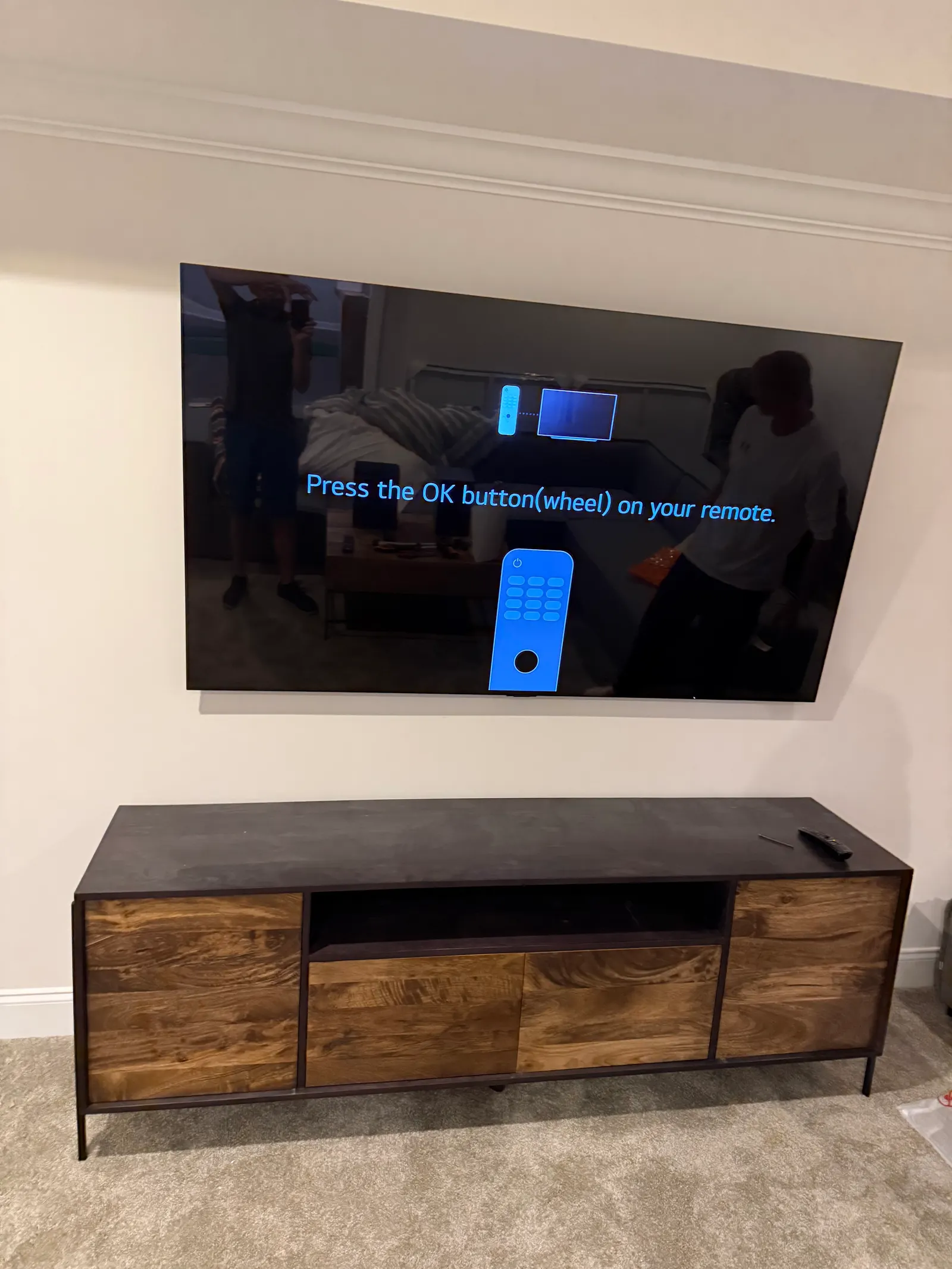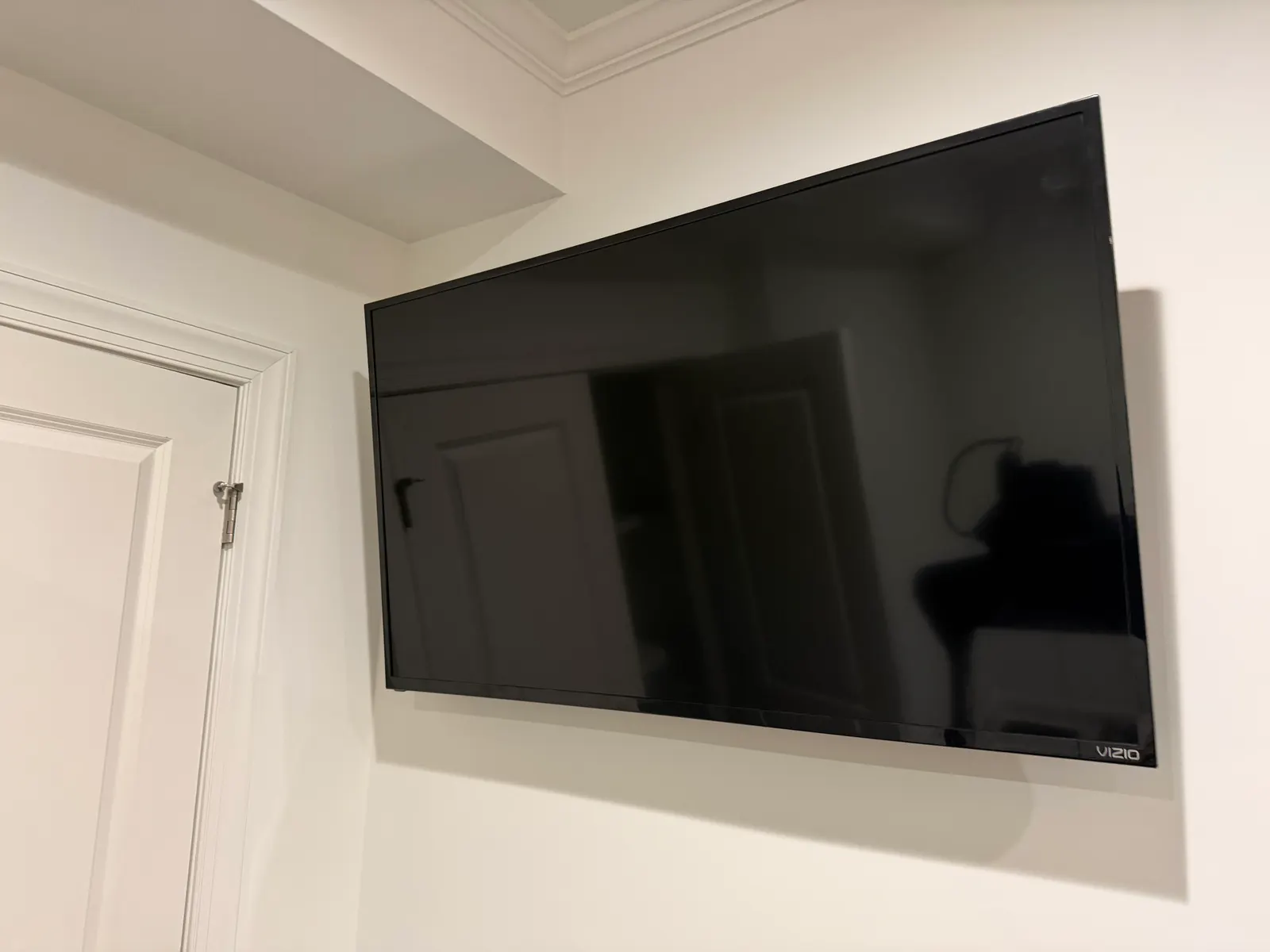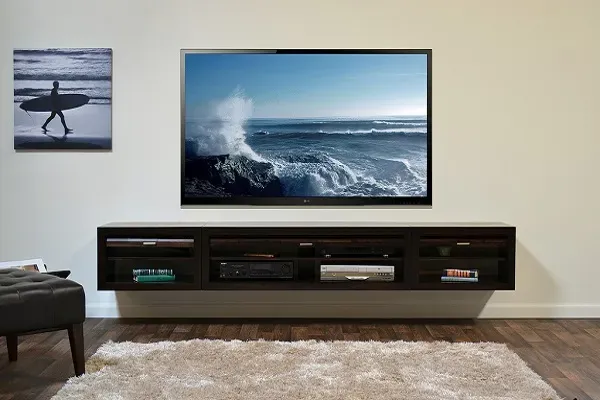
Center the screen at your seated eye level: about 42 inches from the floor in a living room and 42-50 inches in a bedroom. Screen size doesn’t move the center, only the bottom edge, which lands about 28.5 inches up for a 55-inch TV, 26 inches for a 65-inch and 23.5 inches for a 75-inch.
Quick note: This page contains Amazon affiliate links. We may earn a small commission at no extra cost to you if you buy through them.
Screen size is the diagonal, corner to corner, not the width of the cabinet.
Want your own numbers? The TV height calculator takes your screen size, your seat, how far back you sit and anything under the TV, then returns the center height, the bottom-edge mark and the tilt. Watching from bed? Open it on the bed setting.
Almost every height question comes down to one measurement you can take in ten seconds: how high your eyes sit when you watch. Put the middle of the screen there and your neck stays neutral for a whole movie. The charts below apply that rule to the common TV sizes and rooms, and then to the one wall that breaks it, the one over a fireplace.
How high should a TV be from the floor? Chart by TV size
The center stays at about 42 inches from the floor whatever the screen size, because that is where a seated adult’s eyes are on a standard sofa. What changes with size is the bottom edge, and that is the mark you actually put on the wall. A 16:9 screen is about 0.49 times its diagonal tall, so the bottom edge sits half of that below the center.
| TV size (diagonal) | Screen height | Center from floor (sofa) | Bottom edge from floor |
|---|---|---|---|
| 32” | about 15.5 in | 42 in | 34 in |
| 43” | about 21 in | 42 in | 31.5 in |
| 50” | about 24.5 in | 42 in | 29.5 in |
| 55” | about 27 in | 42 in | 28.5 in |
| 65” | about 32 in | 42 in | 26 in |
| 75” | about 37 in | 42 in | 23.5 in |
| 85” | about 42 in | 42 in | 21 in |
On a 75 or 85 inch set the bottom edge ends up low enough to crowd a media console. Nudging the center up to 44-46 inches is a fair trade there. Measure your own seated eye height first, though, because a low sectional or a tall armchair moves the answer more than the TV does.
How high to mount a TV on the wall in a bedroom
Center the TV 42-50 inches from the floor. Where you land inside that range depends on the bed, not the TV:
- Sitting up against the headboard on a standard-height bed, most adults’ eyes sit near 48-50 inches, so center the screen near the top of the range.
- On a low platform bed your eyes drop, so center it lower, toward 42 inches.
- If you mostly watch lying back on pillows, keep the center inside 42-50 inches and angle the screen down a few degrees with a tilting mount so the picture faces you.
The simplest check is the one that works in any room: sit where you watch, have someone measure from the floor to your eyes, and use that number for the center as long as it falls between 42 and 50 inches.
Here is where the bottom edge lands at both ends of the bedroom range, so you can mark the wall before you pick the exact spot:
| TV size | Bottom edge, center at 42 in | Bottom edge, center at 50 in |
|---|---|---|
| 32” | 34 in | 42 in |
| 43” | 31.5 in | 39.5 in |
| 50” | 29.5 in | 37.5 in |
| 55” | 28.5 in | 36.5 in |
| 65” | 26 in | 34 in |
| 75” | 23.5 in | 31.5 in |
A dresser under the TV sets a floor for that bottom edge. If the dresser top is higher than the number in the table, the TV has to go up to clear it, and a slight downward tilt keeps the picture aimed at the bed.
TV mounting height by room
The room decides the number more than the TV does, because it decides how you sit and where your eyes land. These are center heights from the floor, with the mount type that makes each one work.
| Room | Center height from the floor | Mount that does it |
|---|---|---|
| Living room (sofa) | about 42 in | Fixed low-profile mount (SANUS, 40-80 in TVs) |
| Bedroom (from the bed) | 42-50 in | Tilting mount (PERLESMITH, 23-60 in TVs) or the SANUS tilt for 46-90 in |
| Kitchen (standing at the counter) | 54-60 in | Full-motion arm (Mounting Dream, 32-70 in TVs) to turn it toward the counter |
| Home office (desk chair) | about 45 in | Full-motion arm (USX Mount, 32-70 in TVs) to pull it closer |
| Home theater (recliners) | about 38 in | Fixed low-profile mount |
| Above a fireplace | bottom edge 12 in or more above the mantel | MantelMount MM340 pull-down or an advanced tilt |
Desk chairs put your eyes higher than a sofa does, because you sit upright on a taller seat, and recliners put them lower. The kitchen is the one room where people watch standing, so the screen rides higher and the arm lets you swing it toward wherever you are cooking.
Why eye level is the rule
Look straight ahead from where you sit and your neck is relaxed. Every inch the screen climbs above that line tips your head back a little further. A few degrees of upward look is nothing. Past about 15 degrees you feel it by the end of a film, and past 30 degrees we tell people not to do it at all.
That is why the answer for every room above is a seated eye height and not a fixed number on a tape measure. Ceiling height, wall height and the size of the room change nothing, because none of them move your eyes.
Above a fireplace: why the center ends up high
A mantel sets a floor for the bottom of the TV. Leave about 12 inches between the mantel shelf and the bottom edge so the heat coming off the fireplace has somewhere to go, then add half the screen height to find the center.
Say the mantel shelf is 54 inches up. A 65-inch TV’s bottom edge goes to 66 inches and its center to about 82 inches, some 40 inches above the eye line of someone on the sofa. From 12 feet back that is roughly 15 degrees of upward look, right at the comfortable limit, and from 10 feet it is closer to 18.
You have four ways to deal with it:
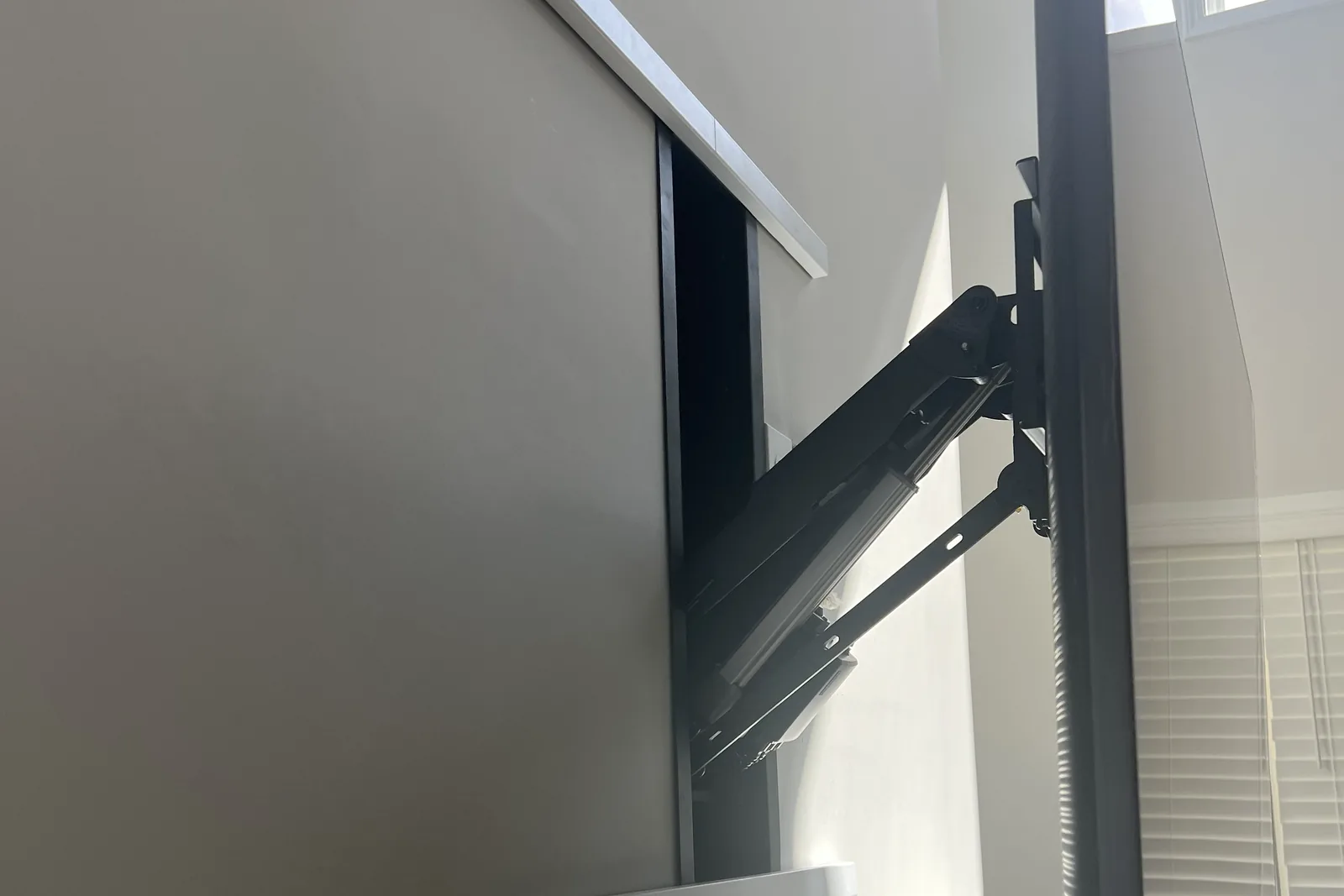
- Tilt it down. An advanced tilt mount pulls the TV off the wall before it angles down, which aims the picture at the room. Your neck still looks up, so this suits occasional viewing.
- Pull it down. A pull-down mount such as the MantelMount MM340 parks the TV above the mantel and brings it down to eye level when you watch. We install pull-downs at the size-tier rate plus $99, with the mount supplied by you. The details are in our MantelMount pull-down guide.
- Move it beside the fireplace. A side wall at eye height keeps the fireplace as the focal point without the neck angle.
- Pick another wall. Put art or a mirror over the mantel and the TV where the seating faces.
The full planning walk-through, including heat and the chimney wall itself, is in our guide to mounting a TV over a fireplace.
How far back you sit changes the height limit
The farther you sit, the smaller the angle a too-high TV creates. Holding the upward look to 15 degrees, with a sofa eye height of 42 inches, the highest comfortable center works out like this:
| Distance from the screen | Highest comfortable center |
|---|---|
| 6 ft | about 61 in |
| 8 ft | about 68 in |
| 10 ft | about 74 in |
| 12 ft | about 81 in |
The math behind it is one line: highest center = eye height + (distance in inches × 0.27), where 0.27 is the tangent of 15 degrees. It is a ceiling, not a target. Eye level is still the most comfortable place for the center.
Working the other way, from where the sofa sits to the screen size you should buy? The TV size calculator turns your seating distance into a comfortable size range.
Work out your own height in three steps
- Measure your eye height. Sit where you watch, sitting the way you actually sit, and have someone measure from the floor to your eyes. That number is the center of the screen.
- Find the bottom edge. Multiply the TV’s diagonal by 0.49 to get the screen height, halve it, and subtract that from the center. For a 65-inch TV and a 44-inch eye height: 65 × 0.49 = 32, half is 16, so the bottom edge goes at 28 inches.
- Place the bracket from the TV, not the wall. Hang the arms on the TV, measure from the bottom of the screen to the hooks, and add that to the bottom-edge mark. That is your bracket line.
If you would rather see it than calculate it, cut a piece of cardboard to the size of the screen, tape it to the wall at the height from step 2 and sit down. Move it an inch at a time until it feels right. Once the height is settled, find the studs with a Franklin ProSensor 710 stud finder before you drill.
Common height mistakes
Hanging it “above the furniture.” A console is 20-24 inches tall, and a small gap above it puts a TV about where it belongs. The trouble starts when the gap grows to a foot or more because the wall looks empty. Measure from your eyes, not from the console.
Copying someone else’s height. A TV that looks right in a friend’s room was set for their sofa, their ceiling and their eyes. Yours will be different.
Centering it on the wall. The middle of a wall has nothing to do with where you sit. On a tall wall it can put the screen 20 inches too high.
Counting on tilt to fix a TV that’s too high. Tilt aims the picture at you, which helps the image. Your neck still looks up at the same angle. Get the height right first and use tilt for the last few degrees. If you are choosing between tilting and swivel mounts, our tilt vs swivel guide compares them, and the VESA pattern chart tells you which brackets fit your TV.
Frequently asked questions
How high should a TV be from the floor?
About 42 inches from the floor to the center of the screen for sofa viewing. That puts the bottom edge at roughly 28.5 inches for a 55-inch TV, 26 inches for a 65-inch and 23.5 inches for a 75-inch. In a bedroom, center it 42-50 inches from the floor.
How high should a TV be mounted in a bedroom?
Center the TV 42-50 inches from the floor. Toward 50 inches if you sit up against the headboard of a standard-height bed, toward 42 inches on a low platform bed. If you watch lying back, stay inside that range and tilt the screen down a few degrees.
How high should I mount a 65-inch TV?
With the center at 42 inches for a sofa, the bottom edge of a 65-inch TV sits at about 26 inches and the top at about 58. In a bedroom, with the center at 42-50 inches, the bottom edge lands between 26 and 34 inches.
Is there a standard TV height?
There is no official standard. Installers work from seated eye level, which puts most living-room centers around 42 inches from the floor.
Should I mount the TV higher if my ceilings are high?
No. A tall ceiling doesn’t move your eyes. Mount from eye level whatever the ceiling height, and let the extra wall above the TV stay empty or hold art.
Can a tilting mount fix a TV that’s too high?
Only partly. Tilt aims the picture at you, but your neck still looks up at the same angle. It is the right tool for the last few degrees, not for a TV that sits a foot too high.
What if people in the house are different heights?
Measure the person who watches the most, from the seat they use. A couple of inches either way is barely noticeable at a normal viewing distance.
Ready to mount at the right height?
We measure eye height from your actual seat before anything is drilled, then level the TV with a digital level and angle gauge.
- Flat-rate labor: $129 (up to 54”), $159 (55-69”), $209 (70-79”), $299 (80-99”), $399 (100”+)
- You provide the bracket, or buy one from us: flat $49 or $69, full-motion $59 or $79
- Pull-down installs over a fireplace: the size-tier rate plus $99
- Same-day slots in all 13 metros when you book before noon, with a 3-year workmanship warranty
Book your install, check the full price list or call (470) 777-4077. Mounting over a mantel? Our fireplace TV mounting service covers heat checks, tilting mounts and pull-downs.
Written by Alex Crabinsky, founder of Express Mounting, which has completed 9,747+ TV installs since 2015.