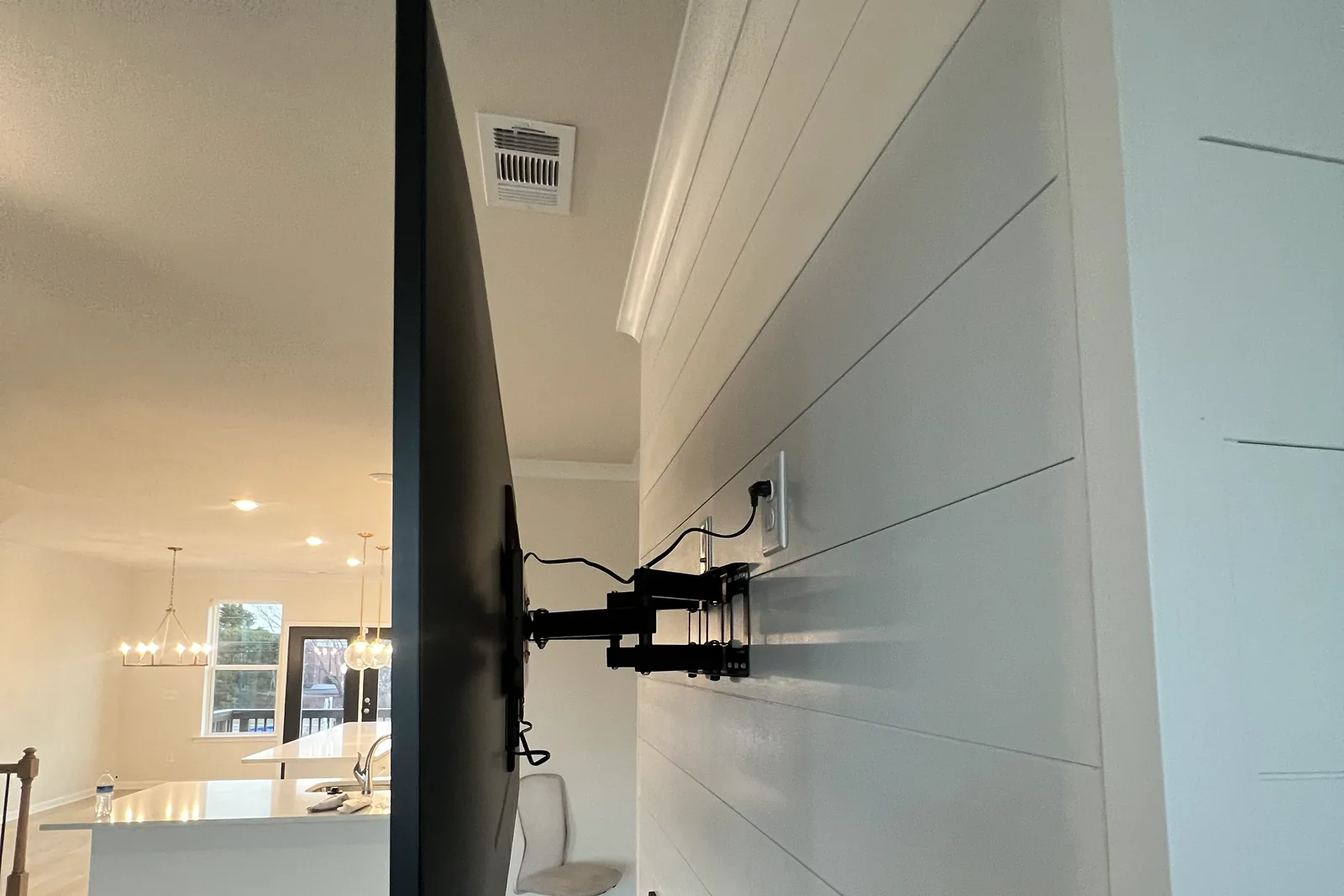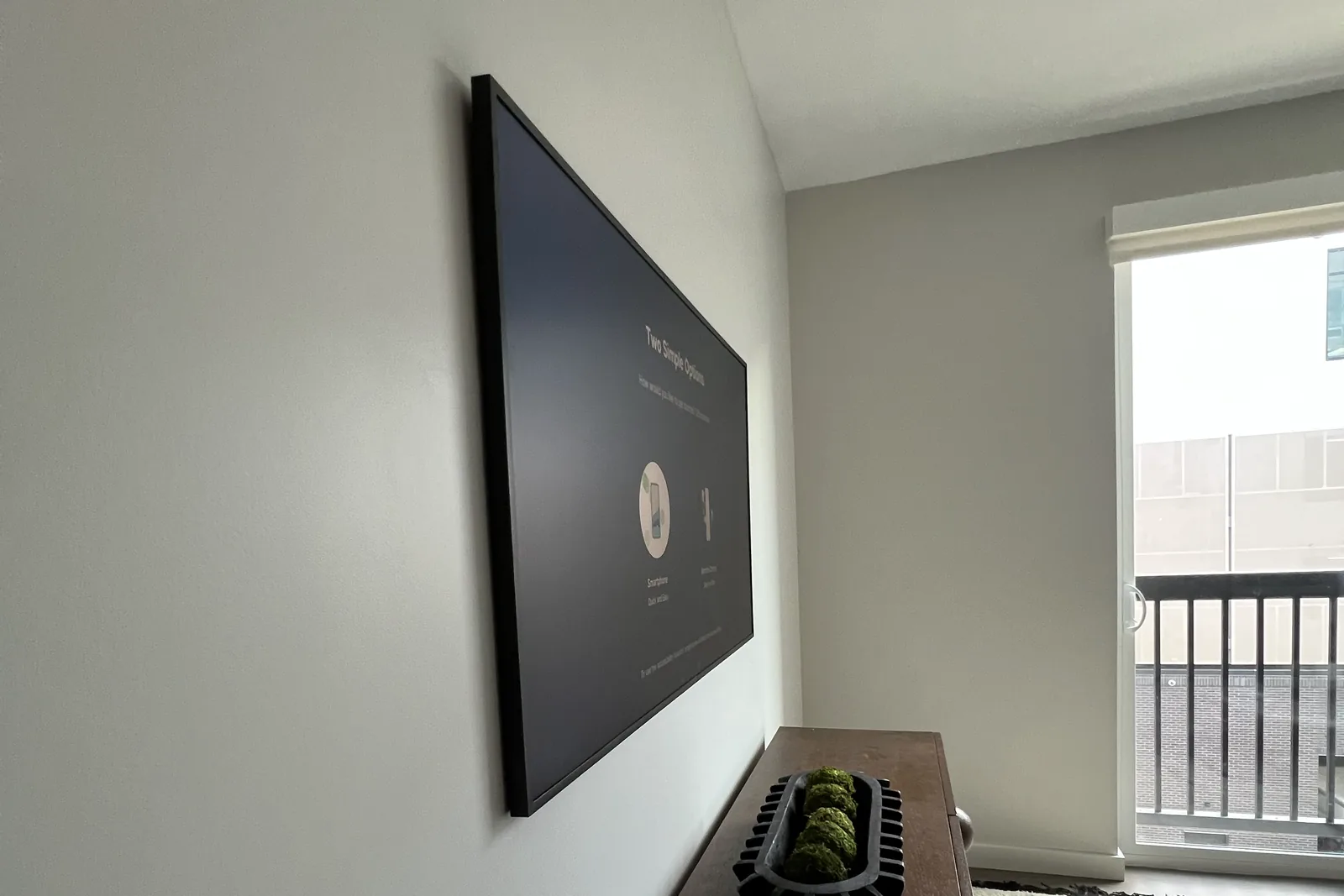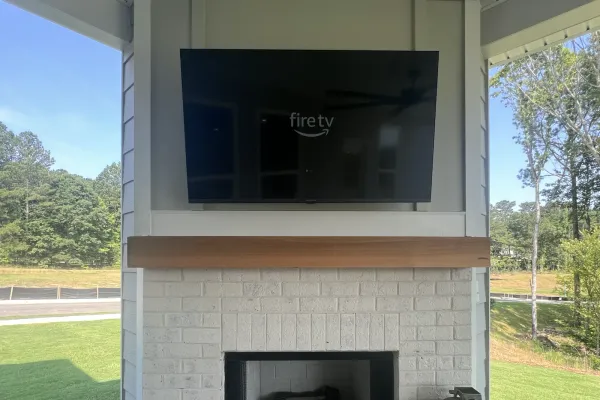
A lanai or outdoor TV install in Tampa Bay costs the same flat labor rate as an indoor one, $129 to $399 by screen size, and most lanai jobs add the $99 masonry surcharge because the house wall under the lanai roof is concrete block. The bracket goes on that wall, never on the aluminum screen enclosure or the pool cage. Near salt water, every exterior fastener is 316 stainless.
This guide covers the job across Hillsborough, Pinellas and Pasco counties, from a Gulf-side deck in St. Pete Beach to a pond-lot lanai in Riverview: which wall takes the bracket, what salt air does to hardware, which TV lasts outside and where the power comes from.
The house wall, never the pool cage
A screen enclosure looks like a handy place for a TV, right beside the pool with a post every few feet. It is the wrong place. A pool cage is aluminum built to carry screen, not a 60-pound panel, and nothing hangs from it.
The TV goes on the wall of the house, under the solid roof of the lanai. The same rule covers the less common spots:
- Pool deck beyond the roofline. The bracket still goes on the house wall, and the set has to be outdoor-rated.
- Ground level under a house raised on pilings. On Treasure Island the enclosure walls down there are often light panels that were never meant to carry anything. A TV mounts to the structure or not at all.
- Condo balcony. In the Clearwater Beach and Sand Key towers the bracket anchors into the concrete wall, never the railing or the slider frame, and only where the board allows it.
Block or wood frame behind the lanai stucco
Stucco hides the wall. Behind it, most Tampa Bay lanai walls are concrete block: the 1950s and 1960s canal ranches of Apollo Beach, Belle Vista and Vina del Mar in St. Pete Beach, Countryside in Clearwater, the single-story subdivisions of Palm Harbor. The two-story homes of Riverview, Westchase, Lansbrook and MiraBay are block on the first floor and wood stud on the second. A lanai sits on the ground, so its wall is the block half.
On block the job is masonry work. A hammer drill takes a 3/16-inch carbide bit through the stucco, sealant goes into each hole, and 1/4-inch Tapcons or stainless masonry screws seat in the block. Block carries the +$99 masonry surcharge outdoors exactly as it does indoors.
Three kinds of house put wood behind the stucco or siding instead: the newest Riverview plats, framed in wood from the slab up, the newest phases of Waterset in Apollo Beach, and the homes raised on pilings in St. Pete Beach and on Treasure Island. There the bracket lags into the framing with 5/16-inch lag bolts, and no surcharge applies.
The two walls look alike from the lanai, so one test hole behind the bracket settles it: gray grit on the bit means block, brown wood fiber means framing.
Thousands of homes along the Pinellas coast were gutted to the block after Helene and rebuilt with new drywall over furring. The block stayed, so a rebuilt house’s lanai wall takes the same anchors it took before the storm.
Salt air on the barrier islands, damp air inland
On the coast the enemy is salt, not rain, and a roof does nothing about salt. On Isle of Capri, Isle of Palms and Paradise Island, the bay side of Treasure Island, zinc-plated lag bolts bloom rust within a season, and a powder-coated bracket starts to bubble wherever a wrench scratched it. On an Apollo Beach canal lot, plated bolts bleed rust down the stucco within a couple of summers. Island Estates in Clearwater gets the same air, and so do Ozona and Crystal Beach, Palm Harbor’s waterfront on St. Joseph Sound.
So near salt water every bolt, washer and masonry screw is 316 stainless, and an indoor bracket is swapped for a powder-coated or stainless one made for outdoor use.
Salt reaches the connections first. An HDMI end or a power plug left in damp, salty air turns green inside a year. That is why the cable leaves the TV in a drip loop, so water falls off the low point instead of reaching the port, and enters the wall through a sealed hole angled downward.
Inland the problem is moisture. A lanai over the Alafia River or a stormwater pond in Riverview, or on a Lansbrook lake lot, wakes up to condensation on anything metal, and plated steel rusts in damp air too. The fasteners there are stainless or coated to match a powder-coated bracket.
Which TV belongs on a Tampa Bay lanai
Shade picks the set. In full shade under a deep roof a regular TV can work, though it still wants a fitted cover, because humidity beads on a cold panel as the morning warms up. Anywhere sun or blown rain reaches, the set should be outdoor-rated.
Sun is the part people misjudge. The Gulf lies due west of the beach towns, so the low afternoon sun comes in under the roof edge of a west-facing lanai, and on a Palm Harbor lake lot it can be the morning sun. Look at the wall at the hour you plan to watch before choosing.
Hurricane season adds one habit. Before a named storm, fold a full-motion arm flat against the wall or bring the set inside. On a condo balcony, ask the board about its rules for the season.
Power, cables and summer lightning
The outlet is an electrician’s work. A lanai TV plugs into a GFCI outlet under a weatherproof in-use cover, the kind that closes with the plug in. If yours has none near the TV spot, an electrician adds it before the install, since we do not wire outlets.
The cables stay on the surface. A block wall has no cavity to fish, so the run from the TV to the outlet rides in a paintable raceway at $79 per TV.
A surge protector goes in line. Florida records more lightning than any other state, and the summer storms that soak a lanai bring it with them. The installer checks that the outlet is grounded, then puts a surge protector between it and the TV.
What to ask the HOA or the condo board
The rules for the outside of a house belong to each community, so we do not guess at them. Before you book, ask the association or the management office:
- Does a TV under the lanai roof, inside the screen, count as an exterior change?
- Does a set that shows from the street, across a pond or from the lake need an architectural review application?
- In a condo: does the board allow a balcony TV and drilling into the balcony wall, in writing?
The installer will not drill exterior stucco for a job that needs approval until you have it in hand, because a patched stucco hole never quite matches.
What a Tampa Bay lanai TV costs
A lanai install is priced like any other TV, by screen size: $129 (up to 54”), $159 (55-69”), $209 (70-79”), $299 (80-94”) and $399 (95” and up, with two technicians as part of the $399). What the lanai adds:
- Masonry surcharge: +$99 when the anchors go into block or concrete, the usual lanai wall. A wood-frame wall carries none.
- Bracket: a separate line. Bring your own, or add ours at $49 flat up to 54 inches and $69 above, $59 and $79 for full-motion. A lanai bracket has to be powder-coated or stainless and made for outdoor use, so settle which one on the booking call.
- Cable run: $79 per TV for a paintable raceway.
- Soundbar mounting: $79. There is no travel fee.
A 65-inch TV on the block wall of a Riverview lanai is $159 plus the $99 masonry surcharge, $258 in labor. On the wood-frame deck wall of a raised Treasure Island home the same TV is $159.
The Tampa Bay cost page adds up three local jobs line by line, the full price list shows every line, and the price estimator prices your own TV and wall.
An outdoor install takes 75-100 minutes. Book before noon for a same-day visit, with the installer at your door within 2-4 hours of confirming. Call (470) 777-4077, 8 AM to 8 PM every day, or request an estimate.
Frequently asked questions
How much does it cost to mount a TV on a lanai in Tampa Bay?
Labor is the flat rate by screen size: $129 up to 54 inches, $159 for 55 to 69, $209 for 70 to 79, $299 for 80 to 94 and $399 for 95 and up. A block lanai wall adds the $99 masonry surcharge. The bracket is a separate line.
Can the TV hang from the pool cage or the screen enclosure?
No. A pool cage is aluminum built to carry screen, not a TV. The bracket goes on the house wall under the solid lanai roof, with every hole through the stucco sealed.
Do I need 316 stainless hardware if I am not on the beach?
Near salt water, yes, and that takes in the Apollo Beach canals, Island Estates in Clearwater and the Ozona and Crystal Beach side of Palm Harbor. Inland, stainless or coated fasteners are still the rule, because plated steel rusts in damp air too.
Can I put a regular indoor TV on a covered lanai?
Only in full shade, deep under the roof, and it still wants a fitted cover. Anywhere the sun or blown rain can reach, the set should be outdoor-rated.
My lanai has no outlet where the TV will go. Can the installer add one?
No. We do not wire outlets, so that part is an electrician’s work and it comes before the install. Ask for a GFCI outlet with a weatherproof in-use cover at the TV spot.