Skip to content
Same-Day Service · Free Estimates Book Online

TV mounting services in Sanford, FL

Sanford TV mounting is flat-rate: $129 up to 54", $159 for 55-69", $209 for 70-79", $299 for 80-99", $399 for 100-inch and up. Cable concealment is $99 per TV, brick or stone adds $99. Same-day slots when booked before noon, and the installer usually arrives within 2-4 hours of your confirmation.

Sanford grew up as an 1870s railroad and steamboat city on Lake Monroe, and its walls changed with each boom. The 1880s-1920s Victorian and bungalow houses in Historic Downtown and the Sanford Historic District, around the brick streets downtown, are pre-war frame with lath-and-plaster. The 1950s-70s mid-century ranches are concrete block, finished in plaster on block or drywall on furring strips. The 2000s-2020s plats on the west side, out to the Heathrow edge, are block-frame two-stories. The installer we dispatch carries 5/16-inch lag bolts and a probe bit for old framing, a hammer drill and 1/4-inch Tapcons for CBS, and a surge protector for every set to handle the summer lightning off Lake Monroe. Book before noon for same-day service anywhere in Sanford.

TV mounting services in Sanford, FL

TV Mounting Cost Estimate

Step 1 of 617%
How many TVs?

Contact Our TV Installers

Ready to schedule your professional TV installation? Contact us for a free quote or book your appointment online. Same-day service available across 15 US metros.

Contact Information

Helps us match you with the installer closest to you.

Look us up before you book

Express Mounting has one Google Business Profile, at our Alpharetta, GA headquarters. Customer reviews for every metro we serve live there.

Orlando installs are done by local installers we dispatch, on the same flat rates and the same warranty.

Every booking comes with

  • 3-year workmanship warranty
  • Same-day installation when you book before noon
  • An installer typically arrives within 2-4 hours of confirmation

Sanford Historic District houses: lath-and-plaster and studs on their own spacing

The 1880s-1920s Victorian and bungalow houses in the Sanford Historic District and around Historic Downtown are pre-war frame, finished in lath-and-plaster over pine studs. The carpenter set the spacing, so 16-inch centers are a hope, not a rule. Your installer starts at the nearest outlet, because an old box is nailed to one side of a stud. Door and window casings help too, since framing always runs beside an opening. Then a 1/16-inch probe bit goes in where the bracket will sit, and solid wood a little past an inch deep confirms the line. The plaster is drilled slowly with the hammer action off, so the keys behind the lath stay attached. Anchors are 5/16-inch lag bolts, 3-1/2 inches long, since plaster and lath use up the first inch. A 50-inch set hangs fine from two lags in a single stud. From 65 inches up, the bracket reaches a second stud, four lags in all. Plaster adds nothing to a Sanford bill. Fishing cable through an old plaster cavity is slow and dusty, so most downtown owners choose the $79 paintable raceway. Plan on 80-100 minutes.

Sanford Historic District houses: lath-and-plaster and studs on their own spacing

Sanford's 1950s-60s block ranches, where the plaster sits right on the CBS

The mid-century block ranches that went up across Sanford in the 1950s and 60s are CBS: concrete block walls, stucco outside and, inside, plaster on block with no cavity behind it. Knock on one and it answers like a sidewalk. Your installer runs a 3/16-inch carbide bit through the first 1/4 inch of plaster with the hammer off, so the finish coat does not pop loose, then turns the hammer drill on once the bit meets block. A bulb blower clears each hole before a 1/4-by-2-3/4-inch Tapcon goes in. The target is solid block over a web, not the hollow core. A bit that suddenly drops has found a core, so that hole moves an inch or takes a masonry anchor made for hollows. Four Tapcons hold a 65-inch panel on a tilt bracket. The +$99 masonry surcharge applies here, though the wall looks like any painted wall. There is no cavity to fish, which makes a painted $79 raceway down to the outlet the tidy answer. Ceilings run 8 feet, so screen center sits near 42 inches. About 70-90 minutes.

Sanford's 1950s-60s block ranches, where the plaster sits right on the CBS

Why a stud finder misreads the furred block in Sanford's later ranches

The later Sanford ranches, built toward the 1970s, skipped the plaster for drywall on furring strips nailed to the block. That hides a layer: 1/2-inch drywall, a 3/4-inch gap where the 1x2 strapping sits, then block. A stud finder calls the strapping a stud. It is not. A lag in a 1x2 holds like a nail in a fence slat, and a hollow-wall toggle cannot open in a gap that shallow. In Mayfair or on the Celery Avenue side, two ranches on one street can differ, so the test hole comes first. Your installer marks the strapping, drills one 3/16-inch hole and reads the depth off the bit: drywall, air, then the hard stop of block. Tapcon's own spec wants at least 1 inch of thread in the block and no more than 1-3/4, so a 2-3/4-inch screw covers the drywall, the gap and a full bite. Four go under a 65-inch panel, six under a full-motion arm. Furred block is still masonry, so the +$99 surcharge stays. The gap is too thin for an HDMI bundle, so concealment means a raceway or an interior partition. Figure 60-80 minutes.

Why a stud finder misreads the furred block in Sanford's later ranches

Sanford's west-side plats toward Heathrow: two floors, two anchors

The 2000s-2020s plats on Sanford's west side, out toward the Heathrow edge, are new traditional two-stories built block-frame: concrete block for the first floor, wood stud for the second, stucco over both. Inside, the floors look alike, so your installer drills a test hole at each TV spot before choosing hardware. On the first floor the bit passes drywall and a furring gap and stops on block, which means Tapcons and the +$99 masonry surcharge. On the second it passes 1/2-inch drywall and bites wood, which means a stud finder, a 7/32-inch pilot and 5/16-inch lag bolts, two per stud, with no surcharge. Great rooms here have 10-foot ceilings, which tempts people to hang high. We hold screen center at 42-48 inches for the sofa unless a fireplace sets the height. Bedrooms get 42-50 inches. Interior partitions and the upstairs walls are open framing, so a $99 in-wall run is usually a clean drop. A furred block exterior wall is not, and that TV gets a raceway or moves to the partition. A 75-inch box needs two people on a turning stair. Figure 50-70 minutes a set.

Sanford's west-side plats toward Heathrow: two floors, two anchors

Lake Monroe waterfront lots: lanai TVs and walls that stay damp

Houses near the Lake Monroe waterfront live with damp air, and a mounted TV feels it. Lake-side walls can run wet in summer, so the installer checks with a moisture meter before drilling. A damp cavity is a poor place for an in-wall cable, and a bracket on wet block stains the paint. On the lanai, the set comes first: an outdoor TV built for humidity, or an indoor panel tucked under the solid roof inside a weather-rated enclosure. A standard set in a screen enclosure facing the water rarely lasts. The bracket gets stainless screws, Tapcons into a block wall or lag bolts into a framed one, and every hole is sealed with exterior sealant before the afternoon rain. Power comes from a weather-rated outlet with an in-use cover, not an extension cord snaked under the door, and the cable drops with a drip loop so water drips off before the jack. A swinging arm is one more joint to corrode, so outdoor sets on the Sanford waterfront go on fixed or tilt brackets. Evening glare off the water sets the tilt angle. Lanai installs run 75-100 minutes.

Lake Monroe waterfront lots: lanai TVs and walls that stay damp

Grounding blocks, two-prong outlets and the surge protector behind a Sanford TV

Florida records more lightning than any other state, and a Sanford summer afternoon often brings a storm in across Lake Monroe. A strike does not have to hit the house to kill a TV. The spike rides in on the power line or the coax. So every Sanford install plans for a surge protector behind the set, with the TV, soundbar and streaming box all plugged into it. The coax gets checked too. The provider's line should land on a grounding block outside, bonded to the house ground, and a missing ground wire gets pointed out so the provider can fix it. The older downtown houses add a wrinkle. A Victorian or bungalow with a two-prong outlet on the TV wall gives the protector no ground to send a spike to, and a protector on an ungrounded outlet does very little. We do not rewire, but we flag it for an electrician before a big panel goes up. Keep HDMI runs short and coil nothing extra behind the set. When a storm parks overhead, pull the protector's plug from the wall.

Grounding blocks, two-prong outlets and the surge protector behind a Sanford TV

Downtown Sanford bungalows: placing a TV around picture molding and tall baseboards

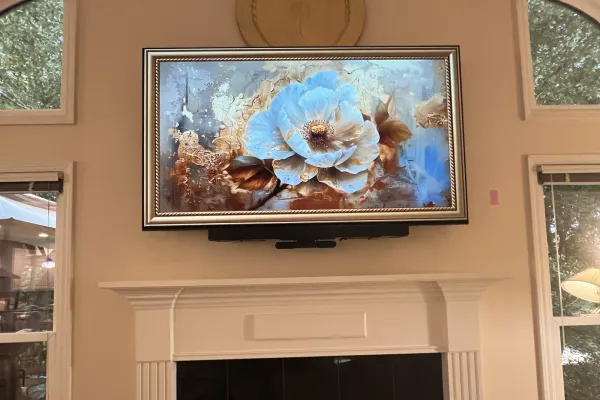
Downtown Sanford's Victorian and bungalow rooms were built for framed pictures, not flat panels. Plenty still carry picture molding near the ceiling, tall baseboards, wide door casings and a mantel that sets the room's center line, and your installer plans around every piece. The bracket goes below the picture molding, never through it. A full-motion arm gets its swing measured against the nearest casing before the first hole, so a 55-inch panel at full extension clears the trim. Outlets here often sit in or just above the baseboard, sometimes on the wrong wall, so the cable path is drawn first: up from the outlet along a casing edge, where a $79 paintable raceway reads as one more piece of trim. Owners after an original look often pick a Samsung Frame, which hangs like a painting. Old plaster walls rarely run plumb, so the level goes on the bracket, not on the molding, and the installer shows you the difference before tightening the last lag. In the Sanford Historic District the placement calls take longer than the drilling. Expect about 90 minutes, a little more with a raceway.

Downtown Sanford bungalows: placing a TV around picture molding and tall baseboards

Field notes from Sanford installs

Sanford’s walls sort by decade. Downtown, the oldest houses are pre-war frame with lath-and-plaster: framing found from the outlet box and casings, proved with a probe bit, then lagged.

The mid-century ranches split in two. The 1950s-60s houses are plaster on block, masonry from the paint back, so the hammer drill comes on after the plaster. The later ranches carry drywall on furring strips, and the Tapcon length comes off a measured test hole. Toward Heathrow, the 2000s-2020s plats are block-frame two-stories with 10-foot great rooms and electric fireplaces, block on the first floor and wood stud on the second.

Two conditions ride along on every Sanford job. Lightning puts a surge protector behind each set and a flag on any ungrounded outlet. Lake Monroe puts a moisture meter on waterfront walls and stainless, sealed hardware on every lanai TV.

TV mounting prices in Sanford

Every Sanford TV mount is priced by screen size: $129 up to 54”, $159 for 55-69”, $209 for 70-79”, $299 for 80-99” and $399 for 100” and up. In-wall cable concealment $99/TV. A paintable raceway on the wall is $79. Anchoring into brick, stone or concrete adds the published +$99 masonry surcharge. On plaster, drywall and metal stud, there is no surcharge. In Sanford the surcharge lands on plaster on block, furred block, a two-story’s block first floor and any brick fireplace. Lath-and-plaster downtown and an upstairs stud wall never pay it. Brackets are their own line: bring yours, or take a flat mount at $49 up to 54” and $69 above, or a full-motion arm at $59 or $79. A soundbar goes up for $79, assembling your own MantelMount pull-down is $99, and there is no travel fee anywhere in Sanford.

How Express Mounting covers Sanford

Alex Crabinsky founded Express Mounting in Atlanta in 2015, and 9,747+ documented installs have shaped the checklist a Sanford job runs on today. Sanford jobs run through vetted Seminole County installers who carry the same hardware, work off the same install checklist, and back every job with the same 3-year workmanship warranty, held by Express Mounting. The installer who takes a Sanford call already expects a probe bit and patience on Historic District plaster, and the hammer drill for a mid-century ranch.
TV mounting in Sanford, FL: common questions

Is TV mounting in Sanford priced by the hour?
No. Sanford pays one flat price per screen size: $129 up to 54 inches, $159 for 55-69 inches, $209 for 70-79 inches, $299 for 80-99 inches and $399 at 100 inches and up. Concealing cables inside the wall is $99 per TV. Plaster on block, furred block and a two-story's block first floor carry the +$99 masonry surcharge, while downtown lath-and-plaster and wood stud do not.
Do you offer same-day TV mounting in Sanford?
Yes, as long as the booking comes in before noon. Ring (470) 777-4077 or book on the website. An installer from our vetted Seminole County network is usually at your door within 2-4 hours of confirming a same-day request, from the Historic District out to the west-side plats near Heathrow.
Can you hang a TV over the fireplace in a Sanford house, old brick or new electric?
Yes. Downtown brick gets drilled at the brick face or the mortar joint, whichever lines up with the mount holes, plus the +$99 masonry surcharge. A west-side electric fireplace sits in a framed chase, so the bracket lags into its studs after a 20-minute heat check. If that leaves the screen too high, a pull-down bracket brings it down, and assembling your own MantelMount is a $99 add-on.
We chose a single-story villa or ranch in Sanford to skip the stairs. Can you set the TV up with that in mind?
Yes. Tell us your chair and we set screen center for it, near 42 inches off the floor in a living room and 42-50 inches in a bedroom. Cords come off the floor, in a $79 paintable raceway on block or plaster or a $99 in-wall run on a framed wall. Remotes get paired and inputs labeled. A soundbar, hung for $79, helps with dialogue.
Can one Sanford visit cover the living room, a bedroom and the lanai?
Yes. Each TV is priced by its own size band, with the masonry surcharge only where a wall is block or brick. A west-side two-story might mean Tapcons in the furred block living room, lag bolts in a stud bedroom upstairs and sealed Tapcons on the lanai, one truck for all three. Plan on 3-4 hours with setup, booked a day ahead.

What Express Mounting Customers Say

Google reviews of our Atlanta installs

Absolutely great service - communication, promptness and responsiveness outstanding. Mount I bought didn't work with the TV and Alex left and got another one. Came back to finish the install. Excellent experience!

Jan Noll

Google review

JN
Alex from Express Mounting did an outstanding job! He helped me take down my old 82-inch TV and professionally mount my new 82-inch setup with ease. He also went above and beyond by organizing and connecting all my peripherals, including my Xbox, PlayStation, and sound system. Everything looks clean, works perfectly, and was done efficiently. Highly recommend!

Jesse Fife

Google review

JF
Alex was experienced and knowledgeable about my 2 TV, outside install. Very pleased with the service. I have already recommended to my friends and neighbors.

Mark Gupton

Google review

MG

Schedule Your TV Installation in Sanford

Book a Sanford TV installation today. The installer we send carries hardware for both the lath-and-plaster houses of the Sanford Historic District and the block-frame two-stories on the west side toward Heathrow. Upfront pricing, same-day availability.

Call (470) 777-4077 Book Online