Skip to content
Same-Day Service · Free Estimates Book Online

TV mounting services in Aurora, IL

Aurora grew up around the Fox River in the 1850s and kept growing east, so the wall behind your TV could be from either end of that. The old core near the Paramount Theatre and through the Tanner District is 1850s to 1920s Victorian and brick foursquare stock: plaster-and-lath inside, solid common brick outside, framing at whatever spacing the carpenter chose. Downtown Aurora also holds converted heavy timber lofts with exposed brick and no studs at all. Out on the Far East Side, Stonebridge and the Route 59 corridor, it is 1990s to 2010s drywall over wood stud with a finished basement below. Your Express Mounting installer brings brad-point bits, 5/16-inch lag bolts, SnapToggles and a hammer drill with Tapcons. Same-day Aurora service when booked before noon.

TV mounting services in Aurora, IL

Aurora TV mounting is flat-rate: $129 up to 54", $159 for 55-69", $209 for 70-79", $255 for 80-inch and up. Cable concealment is $95 per TV, brick or stone adds $99. Same-day slots when booked before noon.

TV Mounting Cost Estimate

Step 1 of 617%
How many TVs?

Contact Our TV Installers

Ready to schedule your professional TV installation? Contact us for a free quote or book your appointment online. Same-day service available across 13 US metros.

Contact Information

Tanner District plaster-and-lath and 1880s framing

The Tanner District holds Aurora's oldest intact houses, and their interior walls are plaster over wood lath, close to an inch thick with the keys counted. An electronic stud finder is nearly useless on that assembly; it picks up lath nails and calls out a stud every few inches. Your installer sweeps the wall with a rare-earth magnet, marks the vertical nail columns that repeat, and drills a single 1/8-inch probe hole at bracket height to prove it before anything bigger goes in. Framing in 1880s Aurora is full-dimension lumber at inconsistent spacing, sometimes 16 inches, sometimes 20 or more, so the anchor layout is drawn on the wall in pencil first. Pilots are brad-point, low speed, hammer function off, which shears far less plaster than a twist bit. Two 5/16 by 3-inch lag bolts with two inches of thread in old-growth wood will carry a 65-inch panel. Original trim in these houses is irreplaceable, so anchors stay well clear of casings and picture rail. Plaster costs minutes, not money. Allow 75 to 100 of them.

Tanner District plaster-and-lath and 1880s framing

Exposed brick in a downtown Aurora heavy timber loft

The converted heavy timber lofts around downtown Aurora and the Fox River are a different animal from a house. Load-bearing walls are multiple wythes of common brick, often left exposed as a finish, with timber posts and beams doing the structural work and no stud cavity anywhere in sight. That means every anchor is masonry work. Your installer drills with a 3/16-inch carbide bit on a hammer drill and sets 1/4 by 2-1/4-inch Tapcons an inch and a quarter into the brick body, always in the face of the brick rather than the mortar joint, because 19th-century lime mortar is far softer than the brick around it. Six anchors is not unusual on a 75-inch panel in a loft with 12-foot ceilings. Concealment is the other conversation: with no cavity to fish, cable goes in a paintable surface raceway or, where the ceiling is open, up and across the timber. Working at that height also means a taller ladder and a second set of hands on the panel. Masonry adds +$99. Loft installs take 90 to 120 minutes.

Exposed brick in a downtown Aurora heavy timber loft

Brick foursquares along the Fox River

The brick foursquare is the workhorse Aurora house of the 1900s and 1910s, and the surprise inside is that its exterior walls are usually solid masonry with plaster furred out over it rather than framed. Rap the wall and it sounds dead. A magnet finds nothing, an electronic finder reads the furring strips as studs, and a bracket lagged into a 1x2 strip will eventually pull free with a 70-pound panel hanging on it. Your installer probes to measure the cavity, then goes through plaster and strip with a hammer drill and seats Tapcons into the brick behind. Interior partition walls in the same foursquare are ordinary framing and take lag bolts at the standard rate, which is why the wall you choose changes the invoice. Foursquare living rooms also run tall, 9 or 10 foot ceilings, and a screen mounted to match the trim line ends up too high; we set height from the sofa instead. Dust off solid brick is heavy, so a catch tray goes up before the first hole turns. Figure 85 to 115 minutes.

Brick foursquares along the Fox River

Far East Side and Stonebridge: drywall over stud, built to a plan

East of the river, Aurora is a much newer city. Stonebridge and the subdivisions off the Route 59 corridor went up from the 1990s onward, and their walls are half-inch drywall over wood studs at 16-inch centers, framed to a plan rather than to habit. Your installer scans both stud edges, confirms the center on the screw line with a magnet, and drills 3/16-inch pilots for two 5/16-inch lag bolts, driven with a torque-limited driver so the threads bite rather than spin. Newer construction hides its own surprises: steel nailing plates over PEX and low-voltage runs, doubled studs around a header, builder blocking that has nothing to do with stud layout. A quick probe hole settles anything ambiguous. Where the layout puts a bracket edge in open drywall, a SnapToggle steadies it while the lags carry the load. Most Aurora east-side family rooms have a real stud bay for concealment, which keeps the $95 cable run simple. Many of these rooms were framed with an outlet already sitting behind the TV, which shortens the visit. Allow 45 to 70 minutes.

Far East Side and Stonebridge: drywall over stud, built to a plan

Route 59 corridor townhomes: shared walls and where the studs run

Townhomes are a large part of newer Aurora, and the wall a homeowner wants the TV on is often the one shared with the neighbor. Those demising walls are built differently from an interior partition: two independent stud walls with an air gap, or a single wall with resilient channel, sometimes with a layer of fire-rated board that reads thicker under a finder. Your installer confirms the assembly before drilling, because a bracket lagged through resilient channel loses most of the sound isolation the wall was built for and can telegraph noise next door. Where the framing allows it, we anchor into the studs of the near wall only, with fasteners short enough to stay inside that leaf. Where it does not, we move the mount to a partition. Screen height in a townhome living room usually gets set low, around 40 to 42 inches to center, because the seating sits close. We also listen on the neighbor's side for telegraphed noise before the last fastener goes tight. Townhome installs in Aurora run 50 to 75 minutes.

Route 59 corridor townhomes: shared walls and where the studs run

Aurora basements and a river that has been in some of them

Basements are standard in Aurora, old core and new subdivisions alike, and they are where the second screen usually lands. The perimeter wall is drywall on 1x2 furring strips over foundation block or a poured foundation, and the strips hold nothing at all. Anchors go through them into the concrete with a hammer drill and 1/4-inch Tapcons at an inch and a quarter of embedment, which puts a perimeter wall into the +$99 masonry surcharge; an interior partition in the same room stays standard rate. The Fox River is the local reason to plan carefully. Low-lying blocks near the water have taken flooding, and freeze-thaw opens hairline foundation cracks every spring across Kane County. Your installer keeps the bracket and the lowest connection at least 18 inches above the highest waterline the homeowner can point out, runs CL2-rated cable, and puts the receiver on an open shelf rather than sealed behind the panel. Anchor heads get a corrosion check before we pack up, and the cable gets a drip loop at the plate. Basement work runs 60 to 90 minutes.

Aurora basements and a river that has been in some of them

What an Aurora appointment includes, and what the van carries

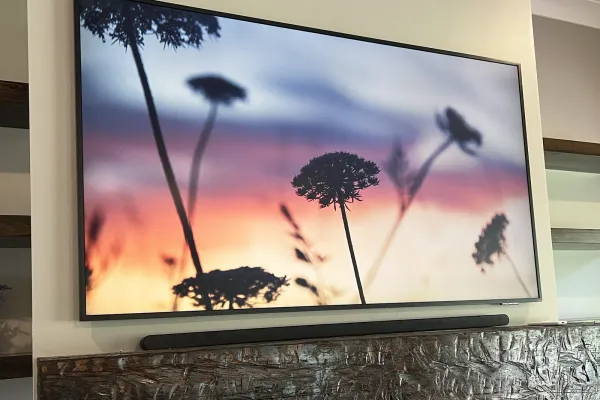
Express Mounting covers the full range of Aurora walls: Tanner District plaster-and-lath, solid common brick in the foursquares and downtown lofts, drywall over wood stud on the Far East Side, townhome demising walls, and furred foundation walls below grade. Each visit opens with the wall read, then mount selection against your TV's VESA pattern and weight, anchor layout, cable management, and a laser-level check before and after the panel goes on. On board: brackets from 32 to 85 inches, electronic and magnetic finders, brad-point and carbide bits, a hammer drill, SnapToggles, lag bolts, an infrared thermometer, a laser level and a torque driver. Setup covers Samsung including Frame models, Sony, LG OLED, TCL and Hisense, with day and evening picture modes, a soundbar on HDMI eARC, and written notes on model, mount and anchor locations. Your TV gets weighed against the bracket rating before a bit turns, because a 75-inch panel and its arm together can hit 90 lbs. Aurora is in Kane County, outside the city of Chicago, so a new recessed outlet is standard licensed electrician work under the National Electrical Code.

What an Aurora appointment includes, and what the van carries

Field notes from Aurora installs

Aurora is two cities on one map, and the Fox River is the seam. West and downtown, the housing goes back to the 1850s: Victorians, brick foursquares, the tight blocks of the Tanner District. Plaster-and-lath interiors, solid common brick exteriors with plaster furred out over the masonry, framing that predates any standard spacing. The converted heavy timber lofts near the Paramount Theatre push that further, with exposed brick walls and no stud cavity at all.

East of the water it is a 1990s to 2010s city. Stonebridge, the Far East Side, the subdivisions along the Route 59 corridor: drywall over wood stud at 16-inch centers, brick veneer up front, townhomes in between, a finished basement under most of it.

That split is the whole job. A magnet sweep and one probe hole tell us whether a lag bolt or a hammer drill comes out of the van. And the river sets the below-grade rules, because low blocks have flooded and freeze-thaw reopens foundation cracks in Kane County every March.

TV mounting prices in Aurora

Aurora TV mounting prices follow the screen, not the address and not the hour: $129 up to 54 inches, $159 for 55-69 inches, $209 for 70-79 inches, $255 for 80 inches and up. Cable concealment is $95 per TV. The published +$99 masonry surcharge attaches to brick, stone and concrete only; plaster, drywall and metal stud carry none. Locally that means a Stonebridge family room on drywall and a Tanner District parlor on plaster both book at the standard rate, while the surcharge appears on a loft brick wall, a furred solid-masonry wall in a foursquare, or a basement foundation wall.

Helpful guides before your Aurora install

How Express Mounting covers Aurora

Alex Crabinsky started Express Mounting in Atlanta in 2015; 7,874 documented installs and a top-rated reputation later, the process is dialed in. Aurora installs are dispatched to vetted Kane County installers who use the same hardware spec and install checklist, and every job carries the same 100% satisfaction guarantee. The installer we dispatch knows the Aurora walls on both sides of the Fox River, and which of them only look like they have studs.
TV mounting in Aurora, IL: common questions

What does it cost to mount a TV in Aurora?
The rate is flat and set by screen size: $129 up to 54 inches, $159 for 55-69, $209 for 70-79, $255 for 80 and up. Cable concealment is $95 per TV. Solid brick, a loft masonry wall or a basement foundation wall adds the published +$99 masonry surcharge. Tanner District plaster and east-side drywall do not.
How soon can an installer reach Aurora?
Book before noon at (470) 777-4077 or online and an installer from our vetted Kane County network is usually at the door within 2-4 hours, from downtown Aurora out past Route 59.
Can you mount a TV on the exposed brick in a downtown Aurora loft?
Yes, and it is one of the stronger walls we work with. We hammer-drill 3/16-inch pilots and set 1/4-inch Tapcons into the face of the brick rather than the old lime mortar, four to six anchors depending on panel size. Cable runs in a paintable raceway or along the timber, since there is no cavity to fish. That wall carries the +$99 masonry surcharge.
Our Aurora basement has flooded from the Fox River before. Is a TV down there a bad idea?
Not if the install is planned around it. We set the bracket and every connection above the highest waterline you can show us, anchor into the foundation instead of the furring strips, run CL2-rated cable, and keep the receiver on an open shelf with a dehumidifier holding near 50 percent so the room stays dry between storms.
Who actually shows up for an Aurora job, and who is accountable?
A background-checked installer from our vetted Kane County network, scheduled and dispatched by Express Mounting. The flat rate is locked when you book, a certificate of insurance is available on request, and the 100% satisfaction guarantee is held by Express Mounting.

What Express Mounting Customers Say

Verified five-star reviews from real Express Mounting customers

They installed my TV on my deck in less than 30 minutes. Very professional and neat.

Alexandru Surugiu

Verified Express Mounting customer

AS
Very knowledgeable and sharp. They installed my TVs on the walls and configured my home network. Highly recommend!

George

Verified Express Mounting customer

G
Great service done by true experts. Fast and accurate, serviced next day. They also provided some nice heavy duty brackets. Highly recommend for any TV mounting needs. They also got me a very reasonable price.

Anastasia Ceclu

Verified Express Mounting customer

AC

Schedule Your TV Installation in Aurora

Schedule your TV installation in Aurora today. Your Express Mounting installer arrives ready for Tanner District plaster-and-lath and solid brick as well as the drywall over wood stud in the Far East Side subdivisions. Upfront pricing, same-day availability.

Call (470) 777-4077 Book Online