Skip to content
Same-Day Service · Free Estimates Book Online

TV mounting services in West Loop, IL

Fulton Market and the Kinzie corridor were meatpacking and cold storage before they were anything else, and the West Loop still mounts like it. The 1900s warehouse conversions off Randolph Street and through Greektown are exposed common brick and heavy timber posts, ceilings at 12 to 16 feet, nothing hidden. The 2010s-2020s glass towers going up beside them are concrete and metal stud. Brick townhomes on the side streets toward the South Loop line fall between the two, drywall over wood stud on four floors. Your Express Mounting installer covers all three in this Chicago neighborhood, carrying 1/4-inch Tapcons and a hammer drill, 5/16-inch lags for timber and stud, 1/4-20 toggle bolts for steel framing, and a laser level for walls that were never plumb. Same-day West Loop service when booked before noon.

TV mounting services in West Loop, IL

West Loop TV mounting is flat-rate: $129 up to 54", $159 for 55-69", $209 for 70-79", $255 for 80-inch and up. Cable concealment is $95 per TV, brick or stone adds $99. Same-day slots when booked before noon.

TV Mounting Cost Estimate

Step 1 of 617%
How many TVs?

Contact Our TV Installers

Ready to schedule your professional TV installation? Contact us for a free quote or book your appointment online. Same-day service available across 13 US metros.

Contact Information

Warehouse brick in the Fulton Market loft conversions

A Fulton Market loft wall is structural common brick, three or four wythes of it, laid around 1905 to hold up floors carrying cold storage. It will hold a television without complaint. The care goes into where the anchors land. Your installer drills the brick body rather than the joints, since century-old lime mortar has no thread strength, and picks whole bricks well clear of any section that has been tuckpointed recently. Each hole takes a 3/16-inch carbide bit on a hammer drill in short passes, gets blown clear, then a 1/4 by 2-3/4-inch Tapcon with an inch and a quarter of embedment. Four anchors handle 75 inches and up. Painted loft brick chips at the surface when a bit wanders, so we start every hole at low speed with the hammer action off, then bring it in once the bit has bitten. Anchors get staggered across courses rather than stacked, and a shop vac runs at the bit so brick dust never reaches the floor. Exposed brick is masonry and carries the published +$99 surcharge. A West Loop loft brick install runs 85 to 115 minutes.

Warehouse brick in the Fulton Market loft conversions

Sixteen-foot ceilings and the West Loop mounting height problem

The most common mistake in a West Loop loft has nothing to do with anchors. It is height. A wall running 14 or 16 feet up invites people to center the TV on it, and the result is a screen you watch with your chin up all evening. Your installer sets the height from the couch instead: eye level from seated position, roughly 42 inches off the floor, lands at the center of the panel, which on a 75-inch screen puts the bottom edge around 24 inches. If a brick chimney, a former loading door opening or a radiator forces the mount higher, we compensate with a tilt bracket, three to five degrees down, and confirm the geometry by sitting where you sit before a hole gets drilled. Open loft plans with two seating groups usually want a full-motion arm instead, which adds $72 to the base rate and lets one screen serve both. We hold the panel up on the wall at the proposed height and let you look at it from the couch before a single hole is drilled. Getting the height right adds ten minutes and saves a patched wall.

Sixteen-foot ceilings and the West Loop mounting height problem

Anchoring to heavy timber posts and beams

The heavy timber loft is the West Loop specialty, and its columns are the best anchor point in Chicago. A 1900s warehouse post is old-growth fir, often 10 by 10 or larger, dense enough that a 5/16 by 3-1/2-inch lag bolt bites hard and holds far past what any drywall anchor can promise. Two conditions come first. The timber has to be sound, so your installer probes with an awl to rule out soft checking on the exposed face, and drills a proper 3/16-inch pilot, because driving a lag dry into seasoned fir splits it along the grain. Column faces are often narrow, so we use a bracket plate that fits the post rather than spanning past it, and a full-motion arm gets mounted only where the post is wide enough to carry the swing load. Some conversions have already furred and drywalled over the posts, in which case we find the timber with a deep-scan stud finder and use a longer lag to cross the furring first. Timber is not masonry, so no surcharge applies. Post installs run 60 to 85 minutes including the probe.

Anchoring to heavy timber posts and beams

Metal stud partitions in the newer Randolph Street towers

The glass towers built through the 2010s and 2020s along Randolph and the Kinzie corridor use light-gauge steel framing behind their drywall, 25-gauge studs at 16 or 24 inches. Steel that light strips out under a lag bolt, so your installer switches hardware entirely: 1/4-20 toggle bolts or SnapToggle-style anchors that open behind the board and clamp the stud web, four points minimum on a 65-inch panel, spread across two studs when the layout cooperates. A metal-scanning stud finder maps the framing and flags the conduit and sprinkler branches the tower has running through the same walls. Where the unit's best wall is a furred-out concrete core instead, the anchor has to reach concrete before it counts, which means a hammer drill, a longer Tapcon to cross the furring, and a vacuum at the bit so no dust lands in the unit. We measure the furring depth on the first hole and size every anchor after it to match. Metal stud carries no surcharge in the West Loop; concrete does. A tower partition install takes 50 to 75 minutes.

Metal stud partitions in the newer Randolph Street towers

Four floors and a media room in a West Loop townhome

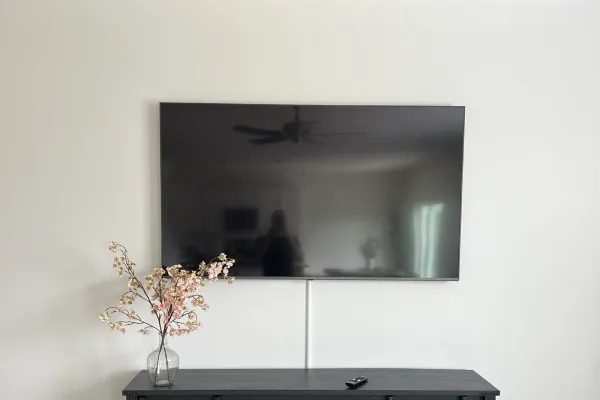
The brick townhomes on the side streets between Greektown and the South Loop line are the ordinary walls of the West Loop: drywall over kiln-dried wood stud at 16 inches, with solid masonry party walls between units and a lower-level room that most owners have turned into the media room. Interior partitions take two 5/16-inch lags into framing, found by reading both stud edges with a stud finder and confirming the center off the drywall screws. The party wall is a different job, hammer drill and Tapcons into brick, which puts it in masonry pricing. Multi-floor townhomes are also where the second and third TVs happen, bedroom on three, main living on two, and we run those in one visit with matched heights so the rooms feel consistent. Stairwell walls in these houses are often the only ones with blocking behind them, which is worth knowing before you pick the wall. Drywall carries no surcharge. A single townhome install runs 45 to 70 minutes; a three-TV day runs closer to three hours.

Four floors and a media room in a West Loop townhome

Rooftop decks and terraces off Randolph and Kinzie

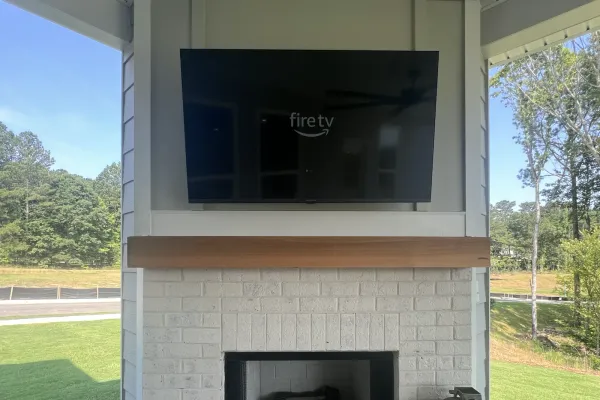
Roof decks are standard in the West Loop, on the townhomes and on the tower amenity levels both, and an outdoor screen up there faces a real Chicago winter. Two things have to be right. The TV itself has to be an outdoor-rated model, since an indoor panel left out through a January of lake-effect snow and freeze-thaw cycling will fail at the seals long before the picture goes. And the mount has to be corrosion-resistant stainless hardware anchored into the parapet brick or the deck structure with Tapcons, not into siding or a screen wall that was never meant to carry load. Your installer checks that the mounting surface is structural before quoting the work, plans the cable run so no connection sits where meltwater collects, drills the parapet on a downward angle so water cannot track into the hole, and adds a weather cover for the off-season. Wind off the open roof also argues for a fixed or tilt mount over a long swing arm. Masonry anchoring on a parapet adds the +$99 surcharge. Deck installs run 90 to 130 minutes.

Rooftop decks and terraces off Randolph and Kinzie

Access, tools and setup on a West Loop appointment

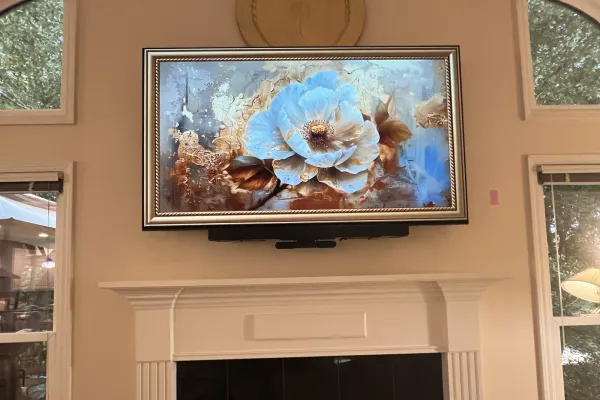
Getting into a West Loop building is part of the job. Loft conversions have freight cars sized for 1900s warehouse doors and a single alley service entrance; the newer towers want a reserved freight elevator window and a certificate of insurance on file, which we provide on request. Give us the building at booking and we work to its rules. On site: wall read, mount selection against your TV's VESA pattern and weight, hardware matched to brick, timber, steel or wood, cable routing, floor protection and a laser level check before and after. The truck carries brackets for 32 to 85 inches, carbide bits, a hammer drill, toggle bolts, lag bolts, an awl and a shop vac. Setup covers Samsung including Frame TVs, Sony, LG OLED, TCL and Hisense, with a bright-room picture mode for the big loft windows and a second evening preset for after dark. Soundbars connect over HDMI eARC, and you leave with written notes on the model, mount and anchor locations. West Loop jobs dispatch to an installer from our vetted Cook County network.

Access, tools and setup on a West Loop appointment

Field notes from West Loop installs

The West Loop gives you three building types inside a few blocks. Fulton Market and the Kinzie corridor are 1900s warehouse conversions: structural common brick, heavy timber posts, mill floors, ceilings that run 12 to 16 feet. The towers that went up along Randolph Street through the 2010s and 2020s are concrete and metal stud. Between them sit brick townhomes with ordinary drywall over wood stud and a solid masonry wall shared with the neighbor.

Every one of those wants different hardware, and the difference is not subtle. Tapcons and a hammer drill for brick and concrete. Lag bolts for timber and wood stud. Toggle bolts for 25-gauge steel, where a lag would strip on the third turn.

Access is the other West Loop constant. Loft freight elevators, alley service entrances, tower reservation windows and insurance certificates decide when a job happens more often than the wall does. Chicago’s conduit-only electrical code applies here too, so power behind the screen is an electrician’s scope while the low-voltage run belongs to us.

TV mounting prices in West Loop

West Loop pricing runs off screen size and nothing else: $129 up to 54 inches, $159 for 55-69, $209 for 70-79, $255 for 80 inches and up. Cable concealment is $95 per TV. Expect the published +$99 masonry surcharge when the bracket lands on brick, stone or concrete, and nothing extra on plaster, drywall and metal stud. That split falls in an unusual place here. A Fulton Market wall of exposed brick takes the surcharge, and so does a roof deck parapet, but the heavy timber post two feet away is wood and stays at the standard rate.

Helpful guides before your West Loop install

How Express Mounting covers West Loop

Alex Crabinsky started Express Mounting in Atlanta in 2015. The 7,874 documented installs since then are the reason the West Loop process looks the way it does. West Loop jobs go to vetted Cook County installers, who carry the same hardware, follow the same install checklist, and stand behind the work with the same 100% satisfaction guarantee. The installer we dispatch already knows what a 1905 warehouse wall takes and where a Randolph Street tower partition needs a toggle instead.
TV mounting in West Loop, IL: common questions

What does it cost to mount a TV in the West Loop?
Flat rate by screen size: $129 up to 54 inches, $159 for 55-69, $209 for 70-79, $255 for 80 and up. Cable concealment is $95 per TV, and a full-motion mount adds $72. Loft brick and a townhome party wall carry the published +$99 masonry surcharge. Timber, drywall and metal stud do not.
How quickly can you mount a TV in the West Loop?
Book before noon at (470) 777-4077 or online and an installer from our vetted Cook County network is usually there within 2-4 hours, from Fulton Market down through Greektown. Buildings that require a reserved freight elevator window are the common exception, and those get the first slot that fits their schedule.
Can a TV go on the exposed brick or a timber post in a Fulton Market loft?
Both work, and they take different hardware. Brick gets Tapcons in a hammer-drilled pilot, set in the brick body rather than the mortar joints. A heavy timber post gets a 5/16-inch lag bolt into a pilot hole, which is the strongest anchor in most loft buildings. We probe the timber for soft spots before committing.
I want an outlet behind the TV in my West Loop loft. Can you add one?
Not that part. Chicago requires branch wiring in metal conduit rather than NM cable, so a new outlet is licensed electrician work anywhere inside the city, the West Loop included. Our $95 concealment covers the low-voltage side, and in a loft with exposed brick we usually run a surface raceway that suits the room better than a hidden line.
Can you mount a TV on a West Loop roof deck?
Yes, with an outdoor-rated TV. Chicago winters and lake-effect weather kill indoor panels left outside, so we mount only weather-rated models, anchor into structural parapet brick or deck framing with stainless hardware, and route cable away from where meltwater sits. Parapet masonry adds the +$99 surcharge, and we fit an off-season cover.

What Express Mounting Customers Say

Verified five-star reviews from real Express Mounting customers

Absolutely great service - communication, promptness and responsiveness outstanding. Mount I bought didn't work with the TV and Alex left and got another one. Came back to finish the install. Excellent experience!

Jan Noll

Verified Express Mounting customer

JN
Alex from Express Mounting did an outstanding job! He helped me take down my old 82-inch TV and professionally mount my new 82-inch setup with ease. He also went above and beyond by organizing and connecting all my peripherals, including my Xbox, PlayStation, and sound system. Everything looks clean, works perfectly, and was done efficiently. Highly recommend!

Jesse Fife

Verified Express Mounting customer

JF
Alex was experienced and knowledgeable about my 2 TV, outside install. Very pleased with the service. I have already recommended to my friends and neighbors.

Mark Gupton

Verified Express Mounting customer

MG

Schedule Your TV Installation in West Loop

Schedule your TV installation in the West Loop today. Your Express Mounting installer handles Fulton Market loft brick and heavy timber as readily as the metal stud walls in the newer Randolph Street towers. Upfront pricing, same-day availability.

Call (470) 777-4077 Book Online