Field notes from University Park installs
Two building stories run side by side in University Park. The originals, 1920s through the 1950s, are Tudor cottages and low ranches around the SMU campus area, Caruth Hills and Snider Plaza: plaster-and-lath inside, brick veneer outside, pier-and-beam under the oldest. The rebuilds replacing them are drywall over wood stud on a post-tension slab, taller ceilings, blocking already set where the TV goes.
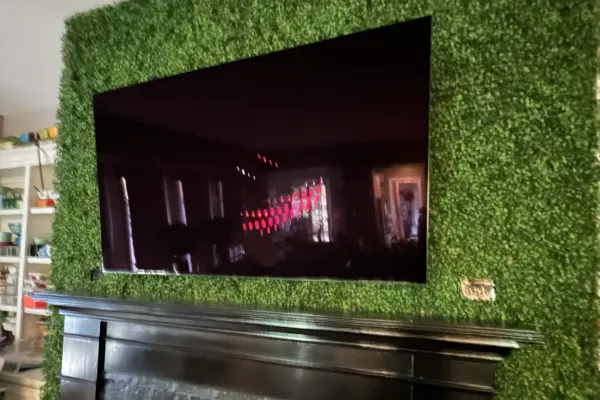
That split decides the tools. Plaster gets a rare-earth magnet on the lath nails, a stepped pilot, no hammer mode, long lag bolts. Drywall over wood stud gets a deep-scan stud finder and a magnet check on the screw line. Brick and cast stone surrounds get carbide bits, Tapcon anchors, and a heat reading before the first hole.
The clay under both is the same. Blackland Prairie clay swells in spring and shrinks under the mature trees every August, so a settlement crack turns up over a door frame and hairlines run through old plaster above an arch. That never stops an install, but the bracket gets leveled against true horizontal instead of a molding line, and anchors go into framing or masonry rather than a patch.
TV mounting prices in University Park
The rate is flat, set by screen size: $129 up to 54”, $159 for 55-69”, $209 for 70-79”, $299 for 80-99”, $399 for 100” and larger. Cable concealment $99/TV. Brick, stone or concrete adds the published +$99 masonry surcharge; plaster and drywall carry no surcharge. In University Park the 1920s brick and cast stone fireplace surrounds are the only walls that trigger it. Original plaster is slower, more careful work, and still standard rate.
How Express Mounting covers University Park
Alex Crabinsky started Express Mounting in Atlanta in 2015, and 9,747+ documented installs later, the process is dialed in. University Park work runs through vetted Dallas County installers who carry the same hardware, work off the same checklist, and back every job with the same 3-year workmanship warranty. The installer we dispatch can tell a 1928 plaster wall from a rebuild by knocking on it.