Skip to content
Same-Day Service · Free Estimates Text a photo

TV mounting services in Capitol Hill, WA

Capitol Hill TV mounting is flat-rate: $129 up to 54", $159 for 55-69", $209 for 70-79", $299 for 80-94", $399 for 95-inch and up (2 technicians). Cable concealment is $99 per TV, brick or stone adds $99. Same-day slots when booked before noon, and the installer usually arrives within 2-4 hours of your confirmation.

“Very nice guys, did a great job installing 3 TVs for me for a very reasonable price.”
George Sholvok, Google review of an Atlanta install

Updated

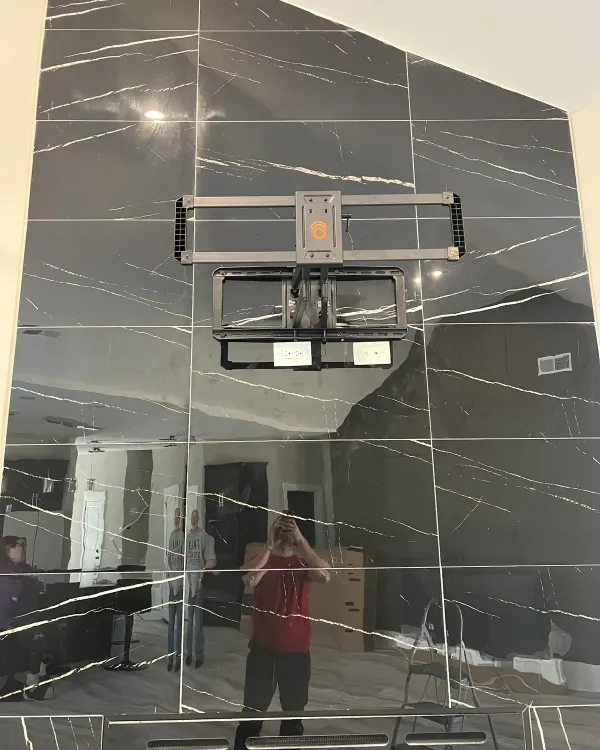
A full-motion wall plate and arm installed on a black marble-look porcelain tile fireplace wall

Documented install, March 2025 By the Atlanta crew.

TV Mounting Cost Estimate

Step 1 of 520%
How big is the TV?
One TV.

Rather we call you?

Leave your number, and we call you about your TV, any day from 8:00 AM to 8:00 PM. Add a note on the wall or the TV if you like.

Contact Information

Helps us match you with the installer closest to you.

Capitol Hill got its name in 1901, a year after James A. Moore bought 160 acres of what had been Broadway Hill. Streetcars on Broadway, 15th and 19th Avenues brought Classic Box houses and the mansions of Millionaire's Row, and the 1920s brought three-story brick-clad apartment buildings. Buildings of that age were finished in painted plaster, and a brick face outside does not mean brick behind your TV. Pike/Pine adds old auto-row buildings of brick and concrete. Your Express Mounting installer carries a rare-earth magnet, 5/16-inch lag bolts for fir studs, toggles, masonry anchors and a hammer drill, and tests every wall before choosing among them. Earthquake country, so big screens go into structure. Same-day Capitol Hill service when booked before noon.

What Express Mounting Customers Say

Google reviews of our Atlanta installs

These guys did an outstanding job installing 2 TVs for us. Highly recommend them for your TV mounting needs.

Angelina Pascar

Google review

AP
We called and requested a same day service and they were able to accommodate, even on a Friday. When our technician got here, he assessed our mounting ask in seconds and immediately got to work.

Kelly Bell

Google review

KB
Great service, thank you Alex

Aleksey Khusanov

Google review

AK

Look us up before you book

Express Mounting has one Google Business Profile, at our Alpharetta, GA headquarters. Customer reviews for every metro we serve live there.

Seattle installs are done by local installers we dispatch, on the same flat rates and the same warranty.

28 Google reviews, every one on that profile, from customers of the Atlanta crew.

Every booking comes with

  • 3-year workmanship warranty
  • Same-day installation when you book before noon
  • An installer typically arrives within 2-4 hours of confirmation

Brick outside, wood frame inside: what a 1920s Capitol Hill apartment building can hide

Most of Capitol Hill's older apartment buildings went up in the 1920s and the first years of the 1930s, along the streetcar lines. From the sidewalk they read as brick. That is a fact about the outside. The city's landmark report on the 1930 Anhalt building at 1600 East John Street describes three stories of wood-frame construction dressed in clinker brick, and says most of its neighbors on the block are three-story brick-clad buildings from the late 1920s. So the wall behind your sofa may be studs, or it may be masonry, and the paint will not say which. The installer finds out with one 1/8-inch pilot hole behind where the TV will hang. Wood shavings on the bit mean lag bolts into a stud and no surcharge. Red or gray dust means brick or concrete, a hammer drill, masonry anchors and the +$99 masonry charge. An outside wall and a wall between two rooms can give different answers in the same apartment, so each wall that will carry a TV gets its own hole.

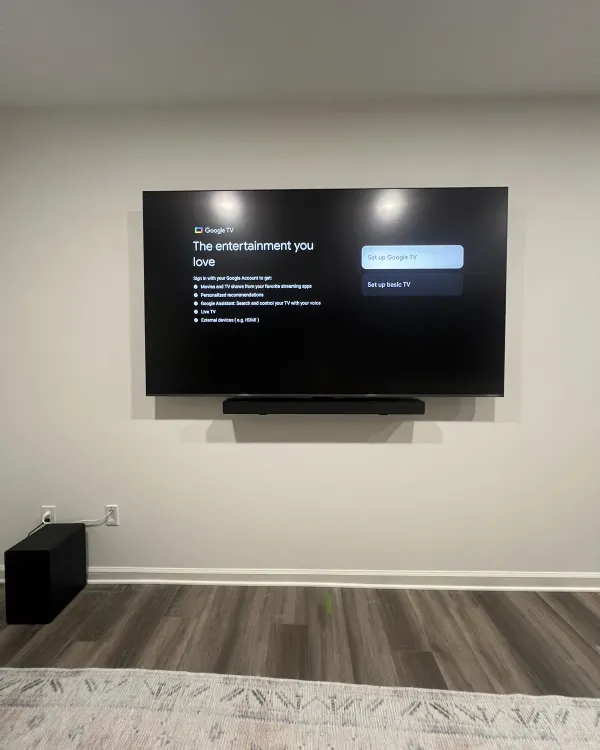
A TV with a soundbar under it on a white wall near a wood-floor hallway

Painted plaster in Anhalt-era courtyard buildings: when the magnet sticks everywhere

Fred Anhalt built his courtyard apartments on Capitol Hill between 1927 and 1930, and the city's reports on two of them list the same interior finish: painted plaster walls and ceilings. That is the normal wall in a Hill building of that age. Plaster over wood lath is read with a rare-earth magnet, which catches the lath nails in vertical rows over each stud. Plaster over metal lath is different. The magnet grabs the whole wall, and it stops being a stud finder. Then the installer works from what is fixed: an outlet or switch box is fastened to a stud on one side, and a row of 1/8-inch pilots along the bracket line finds the rest. Either way the plaster is drilled at low speed through painter's tape, with the hammer action off, and the lag bolts are snugged by hand so the finish coat does not crush. Anhalt's apartments often had fireplaces. If yours does, the screen can go above the mantel only after the installer checks how warm that wall gets. Plaster carries no surcharge.

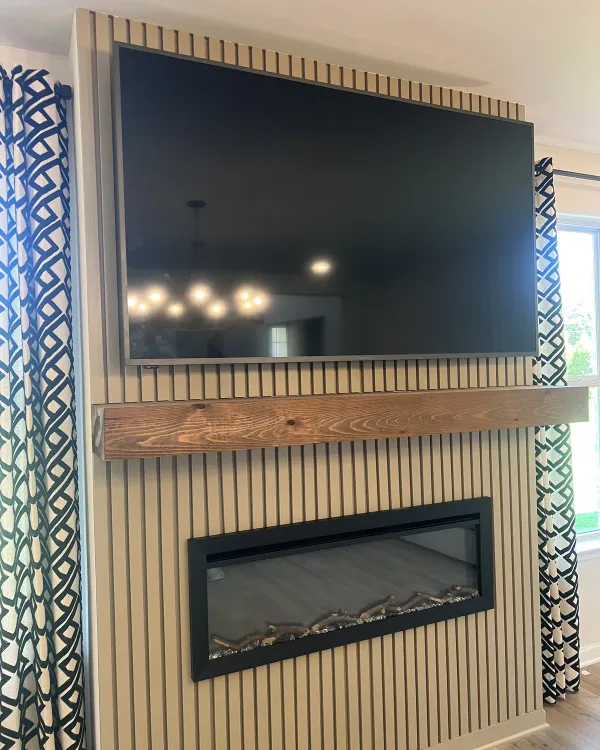
A TV on a vertical slat accent wall above a wood beam mantel and a linear electric fireplace

Classic Box houses off Broadway, 15th and 19th: plaster, fir framing and where the screen sits

Before the apartment boom, Capitol Hill was a streetcar suburb. Middle-class houses went up fast beside the Broadway, 15th Avenue and 19th Avenue lines, many in the Classic Box style and others in Craftsman or Tudor Revival dress, while the mansions gathered on Millionaire's Row along 14th Avenue East and in what is now the Harvard-Belmont Landmark District. A house of 1900 to 1910 was finished in plaster, and the installer expects plaster-and-lath over fir framing until the pilot hole says otherwise. A remodeled room may have drywall over the plaster or over shiplap boards, and the same hole shows that too. The stud hunt is by magnet, since lath confuses an electronic finder, and old framing is not always on 16-inch centers. Height takes thought where ceilings are tall. The eye wants to center a screen on the wall, and that puts it too high for a sofa, so the installer tapes the outline at seated eye level and you look at it before any hole is drilled. Several Harvard-Belmont houses are brick and half-timbered. A brick chimney breast or wall there is masonry at +$99.

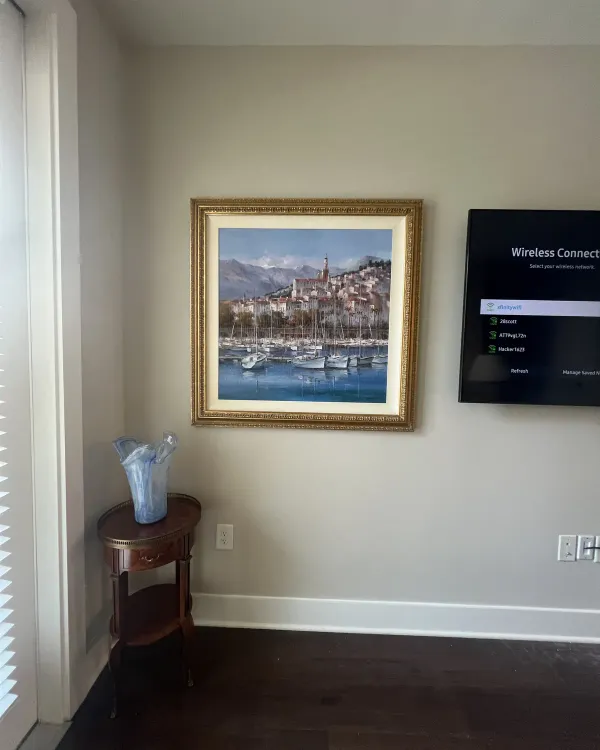
A TV mounted high on a bedroom wall above a framed painting

Pike/Pine auto-row lofts: brick, concrete and heavy timber from the dealership years

The first cars in Seattle were sold on Broadway around 1906, and by 1915 nearly every dealer in the city was on Capitol Hill, most on Broadway, Pike or Pine. A city conservation study describes what they built: solid fireproof structures of concrete or brick, often two to four stories, with showrooms below and ramps to the floors above. In 2008 that study counted 165 of the corridor's 278 buildings as more than 85 years old. Many now hold lofts, studios and offices, and one 1916 auto warehouse on East Union Street was reworked as artists' lofts around its concrete, heavy timbers and brick front. The original walls have no cavity. Brick takes a 3/16-inch carbide bit and a 1/4-inch masonry screw anchor in the brick face or the mortar joint, whichever lines up with the mount holes. Heavy timber is the easy one: a pilot hole and a lag bolt. Masonry adds +$99 and timber adds nothing. Cables cannot drop inside solid walls, so they run in a paintable surface raceway at $79.

Capitol Hill buildings from 1995 on: one pilot hole before any promise

Capitol Hill never stopped building. The city counted sixteen new buildings in the Pike/Pine corridor between 1995 and 2007 alone, with much of the new housing owner-occupied, and the light rail station at Broadway and East John Street opened in 2016. We do not know what any one of these buildings is made of until the wall is tested, and we do not guess. The interior finish in a building this new is drywall. Behind it the pilot hole shows one of three things. Wood shavings: lag bolts into the stud. Bright metal curls: a metal stud, which a lag bolt strips, so the installer opens a 1/2-inch hole and sets steel toggles that spread the pull across the stud. Gray dust: concrete, a hammer drill and masonry anchors, with the +$99 masonry surcharge. Drywall by itself carries only a small set, up to about 32 inches and 30 pounds on rated toggles. Before booking, ask management three things: drilling hours, whether a large box needs a reserved elevator, and whether cable may run inside the wall.

Renting on the Hill: the owner's yes, four small holes and a plan for move-out

Capitol Hill is renter country. The 2000 census found 86.6 percent of its housing units occupied by renters, and many apartments first laid out for families were later divided into smaller ones. So the usual first question here is not about the wall. It is whether you may drill it. Only your owner or manager can answer that, and we do not know your lease, so get the yes in writing before you book. Once you have it, the mount can be planned to leave little behind. A fixed or tilt bracket on a stud needs four lag holes, each about as wide as a pencil, and they fill at move-out. If the owner allows a bracket and forbids cutting the wall, the cables go in a paintable raceway on the surface. A divided apartment has one more wrinkle: the partition added when the unit was split may be newer and thinner than the original plaster walls. The installer tests the wall you picked and tells you if the one beside it is the better choice.

Walk-ups, plaster dust and earthquakes: the day of a Capitol Hill install

Many of the Hill's 1920s buildings are three stories. Where there is no elevator, the installer measures a big box against the stair and the landing before carrying it, and a panel of 95 inches or more comes with two technicians as part of its rate. Plaster dust travels down a shared hallway, so a drop cloth goes on the floor and a vacuum runs at the bit. The bracket is a separate line, matched to the TV's VESA pattern and weight: your own, or ours at $49 or $69 for a flat mount and $59 or $79 for full-motion. The Nisqually earthquake of 2001 measured magnitude 6.8, and the seismic response on any Hill wall is the same: fasteners into studs, timber or masonry, four points for a screen past 65 inches, and the bracket's safety screws set so the panel cannot hop off its rail. Setup covers WiFi, inputs and a soundbar over HDMI eARC, on Samsung including the Frame, Sony, LG OLED, TCL and Hisense. On a rainy day a cold panel warms up before it is switched on, so moisture inside it can clear.

Your Capitol Hill price, before you book

Pick the TV's size, the wall and the mount, and the estimator shows the labor price, from $129 per TV. Then book a time online, or call from 8:00 AM to 8:00 PM.

Field notes from Capitol Hill installs

Capitol Hill was built in three passes. Houses came first, from 1900 into the 1910s: Classic Box houses beside the streetcar lines, mansions on Millionaire’s Row and in Harvard-Belmont. Apartment buildings came second, most of them in the 1920s, many three stories and brick-clad, finished in painted plaster. Pike/Pine filled in alongside as Auto Row, in brick and concrete. Mid-century apartment buildings and, since the mid-1990s, newer condo buildings fill the gaps.

Each pass hands the installer a different wall. Plaster-and-lath over fir studs in a house gets a magnet, a pilot hole and lag bolts. Plaster in a 1920s apartment gets the same test, plus one question the brick outside cannot answer: is it wood or masonry back there? Loft brick and concrete get a hammer drill and masonry anchors. A newer building is tested first, since the hole can show wood, steel or concrete.

Most people here rent, so the owner’s permission comes before the booking. And this is earthquake country: big screens are fastened to structure, never to drywall alone.

TV mounting prices in Capitol Hill

Capitol Hill is priced by the screen, never by the hour: $129 up to 54”, $159 for 55-69”, $209 for 70-79”, $299 for 80-94”, $399 for 95” and up. Concealing the cables inside the wall is $99 per TV. A paintable raceway on the wall is $79. Brick, stone or concrete brings the published +$99 masonry surcharge. Plaster, drywall and metal stud bring no surcharge. On the Hill the surcharge lands on exposed brick or concrete in a Pike/Pine loft and on any apartment wall that turns out to be masonry, and it stays off painted plaster over studs, drywall and a metal stud partition. The bracket is separate: bring yours, or ours is $49 or $69 flat and $59 or $79 full-motion. Soundbar install $79. No travel fee anywhere in Capitol Hill.

How Express Mounting covers Capitol Hill

Express Mounting has been Alex Crabinsky’s company since he started it in Atlanta in 2015, and 9,747+ documented installs are behind the checklist that reaches a Capitol Hill apartment. Capitol Hill jobs run through vetted King County installers who carry the same hardware, work off the same install checklist, and back every job with the same 3-year workmanship warranty, held by Express Mounting. The installer we dispatch already knows that a brick-clad Capitol Hill building proves nothing about the wall inside it, and drills one small hole to find out.
TV mounting and installation in Capitol Hill, WA: common questions

What does it cost to mount a TV in Capitol Hill?

The rate is flat and set by screen size: $129 up to 54 inches, $159 for 55-69, $209 for 70-79, $299 for 80-94 and $399 for 95 and up. Cable concealment inside the wall is $99 per TV. An anchor into brick, stone or concrete, as in a Pike/Pine loft, adds the +$99 masonry surcharge. Painted plaster in a 1920s apartment, drywall and metal stud carry no surcharge. The bracket is extra, yours or one of ours.

Can I get a TV mounted on Capitol Hill today?

Yes, if you book before noon. Call (470) 777-4077 or book online. An installer from our vetted King County network arrives within 2-4 hours of confirming a same-day request, anywhere from Pike/Pine up Broadway to Volunteer Park.

My Capitol Hill building is brick on the outside. Is the wall behind my TV brick too?

Not necessarily. The city's landmark report on the 1930 Anhalt building at 1600 East John Street describes a wood-frame structure with a clinker brick skin, and many 1920s buildings on the Hill are described as brick-clad. One small pilot hole settles it for your wall. If the anchor goes into studs through plaster, there is no surcharge. If it goes into brick or concrete, the +$99 masonry surcharge applies.

I rent my Capitol Hill apartment. Will my landlord allow a wall mount?

Only your landlord or building manager can say, and we do not know your lease. Ask before you book, and get the answer in writing. If drilling is allowed, a fixed bracket leaves four small holes that fill at move-out. If cutting into the wall is not, a paintable raceway carries the cables on the surface. Buildings inside the Harvard-Belmont Landmark District are worth the same question to management.

Who does the work on a Capitol Hill job, and who answers for it afterward?

An installer from our vetted King County network, dispatched by Express Mounting and working from the hardware list and install checklist we use in Atlanta. The flat rate is locked when you book. The 3-year workmanship warranty is held by Express Mounting, not by the individual installer.

Call (470) 777-4077 Text a photo

Text a photo of your wall

Point your phone's camera here to start a text to +14707774077. Add a photo of the wall and your TV's size, and we reply with your price and the first open time.

QR code that starts a text message to +14707774077
Use the quote form instead