Skip to content
Same-Day Service · Free Estimates Text a photo

TV mounting services in West Seattle, WA

West Seattle TV mounting is flat-rate: $129 up to 54", $159 for 55-69", $209 for 70-79", $299 for 80-94", $399 for 95-inch and up (2 technicians). Cable concealment is $99 per TV, brick or stone adds $99. Same-day slots when booked before noon, and the installer usually arrives within 2-4 hours of your confirmation.

“Very happy with the work. Polite, cleaned up after, and paid close attention to detail to make sure it was the ideal spot.”
John Leahy, Google review of an Atlanta install

Updated

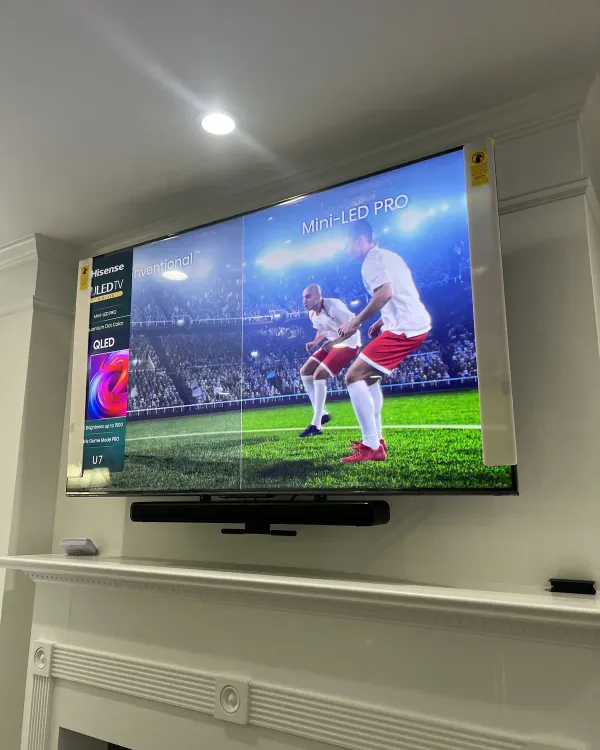
A Hisense mini-LED TV mounted inside a white paneled alcove, showing a soccer broadcast

Documented install, July 2025 By the Atlanta crew.

TV Mounting Cost Estimate

Step 1 of 520%
How big is the TV?
One TV.

Rather we call you?

Leave your number, and we call you about your TV, any day from 8:00 AM to 8:00 PM. Add a note on the wall or the TV if you like.

Contact Information

Helps us match you with the installer closest to you.

West Seattle is a peninsula with its own timeline. The Denny Party landed at Alki in 1851, the Admiral district was platted in 1885, and the streetcar lines that met at the Junction in 1907 set off the boom that filled the hills with Craftsman bungalows. War-worker housing and post-war tract houses came next, High Point was rebuilt from 2003, and six-story apartment buildings now stand at the Junction. So the walls run from plaster-and-lath over fir studs to mid-century drywall to poured concrete in a daylight basement. Your Express Mounting installer brings a rare-earth magnet, 5/16-inch lag bolts, toggles, masonry anchors and a hammer drill, and plans for Puget Sound moisture, view-home glare and earthquake country. Same-day West Seattle service when booked before noon.

What Express Mounting Customers Say

Google reviews of our Atlanta installs

These guys did an awesome job installing 4 TVs on my outdoor patio of full motion mounts side by side, highly recommend them!

Kaleb Bogunskov

Google review

KB
Wonderful communication. Expert installation. On time and competitively priced! I would definitely use them again!

Ferber Buckley

Google review

FB
Absolutely great service - communication, promptness and responsiveness outstanding. Mount I bought didn't work with the TV and Alex left and got another one. Came back to finish the install. Excellent experience!

Jan Noll

Google review

JN

Look us up before you book

Express Mounting has one Google Business Profile, at our Alpharetta, GA headquarters. Customer reviews for every metro we serve live there.

Seattle installs are done by local installers we dispatch, on the same flat rates and the same warranty.

28 Google reviews, every one on that profile, from customers of the Atlanta crew.

Every booking comes with

  • 3-year workmanship warranty
  • Same-day installation when you book before noon
  • An installer typically arrives within 2-4 hours of confirmation

The 1907 streetcar boom: plaster houses on the blocks around the West Seattle Junction

The Junction is named for an event. In 1907 the streetcar line from the Admiral district met a new line running south to Fauntleroy, at what is now California Avenue SW and SW Alaska Street, and lot buyers followed the cars. West Seattle joined the City of Seattle that same summer. A historic survey of the Junction says the residential blocks around it were fully built up with single-family houses by the 1930s, which makes this the peninsula's pre-war belt. Houses of those years were finished in plaster. A city landmark report on one of them, a 1915 Craftsman in Admiral, records plaster walls and ceilings in every main room. For a TV that means the stud hunt is done by magnet, not by electronic finder: a rare-earth magnet picks up the lath nails in vertical rows, and a 1/8-inch pilot hole confirms wood behind them. The plaster is drilled slowly through painter's tape, and 5/16-inch lag bolts go into the framing. No masonry, so no surcharge. Plan on 60 to 80 minutes for a bungalow living room.

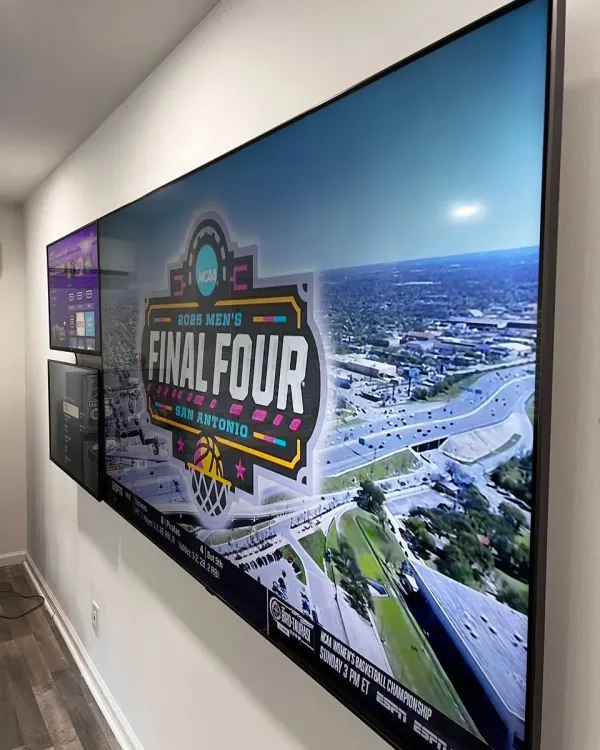
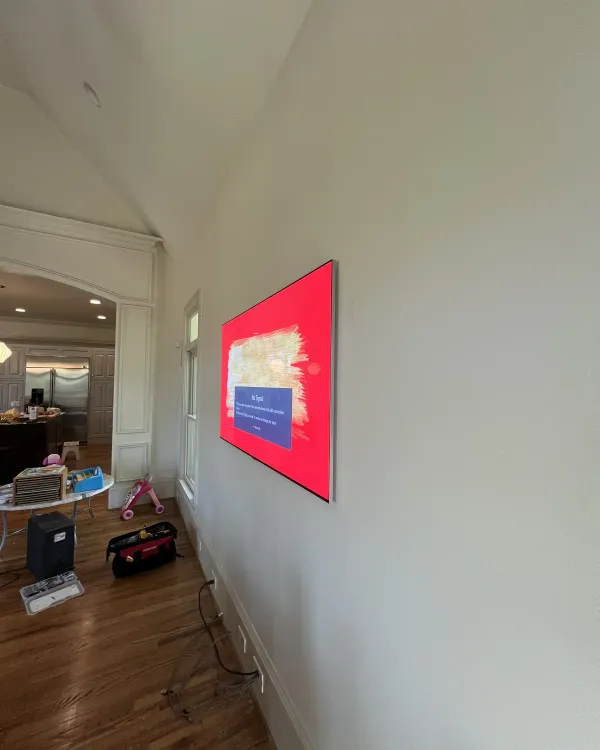
A TV on a flat mount on a cream living-room wall above a wood floor

Admiral bungalows on sloped lots: fir framing upstairs, poured concrete in the daylight basement

The Admiral district was the first part of the peninsula sold as a residential suburb, replatted in 1885 into 50-by-150-foot lots and pitched on fresh air and views. The ground is hilly, and the houses step down it. The city's report on the 1915 Bloss House describes the pattern: a wood-frame Craftsman on a steep lot, sitting on a poured concrete foundation with a basement below. The same report notes that a ready supply of Douglas fir suited bungalows like it. Upstairs, then, the installer expects dense old fir behind plaster, and lag bolts turned by hand at the end. Downstairs is another wall. In a daylight basement the uphill side is poured concrete and the downhill side is framed, with windows facing the yard. A TV on the framed wall is ordinary stud work at the base rate. A TV on the concrete side takes a hammer drill, a 3/16-inch carbide bit and masonry anchors, and adds +$99. Concrete below grade can run damp in a wet winter, so cables there run in a surface raceway and never loose against the wall.

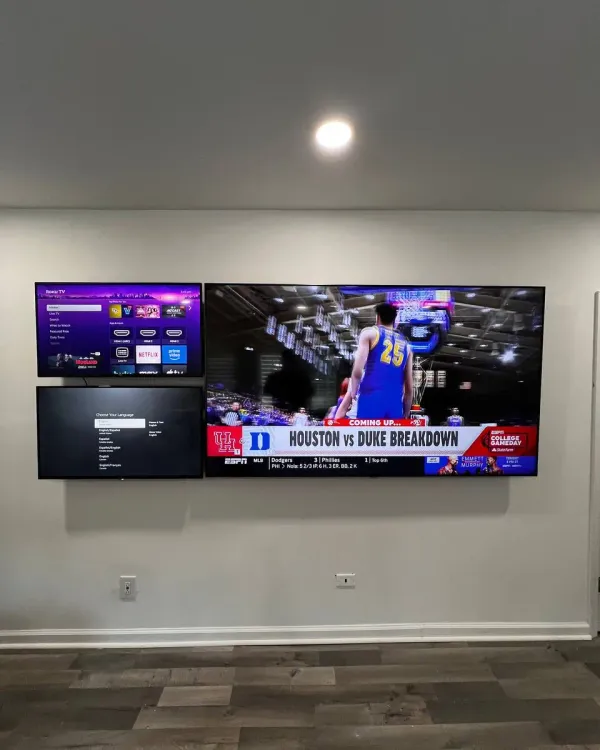
A large TV on a gray basement wall showing a basketball broadcast, a second screen to its left

Alki cottages and waterfront condos: glare off the water, walls tested first

Alki grew up as a resort, a strip of summer cottages and vacation homes that saw itself as separate from the town on the hill. Bungalows still stand along the beach, and medium-rise apartment and condo buildings now sit beside them facing the water. Both raise the same question first: where does a screen go in a room built around a window? The answer is rarely the window wall and rarely straight across from it. A side wall with a full-motion arm lets the screen swing toward the seats at night and fold flat by day. A tilt bracket trims the reflection when the only free wall faces the glass. As for the walls, an Alki cottage may be plaster, later drywall or board paneling, so it gets a magnet pass and a pilot hole. A waterfront condo is tested first too, since the hole can show wood, steel or concrete. Wood takes lag bolts, a metal stud takes steel toggles, and concrete takes masonry anchors at +$99. Condo owners should ask their association about drilling hours and in-wall cable before booking.

Two TVs mounted side by side on a gray basement wall over a wood-look floor

War-worker housing and post-war tracts: West Seattle's mid-century drywall generation

World War II changed the peninsula in four years. Shipyards and aircraft plants pulled workers in, West Seattle's population doubled to more than 70,000, and about 1,300 rental units of worker housing were built. After the war, federally backed home loans for returning veterans set off another surge: thousands of tract homes, duplexes and apartments. These mid-century houses tend to be the simplest walls in West Seattle. The installer expects drywall over wood stud, but a house from the late 1940s can still be plaster, so the magnet and the pilot hole come out anyway. On drywall an electronic stud finder works, a magnet confirms the screw line, and the bracket goes up on 5/16-inch lag bolts: two in one stud for a 55-inch set, four across two studs past 65 inches. In a rambler the living room wall is low and wide, so the screen center lands near seated eye level. In a split-level the TV wall often sits beside a short stair, and the height is checked from both levels. Drywall carries no surcharge. These installs run 45 to 60 minutes.

High Point after 2003: a rebuilt neighborhood with one generation of walls

High Point holds the highest ground in Seattle, 520 feet up, and it has been built twice. The first time was during World War II, as government housing. The second began in 2003, when the Seattle Housing Authority started a six-year rebuild that cleared the old housing, streets and utilities and put up about 1,600 new homes as a mixed-income neighborhood. Everything here is one age. The interior walls are drywall. The installer still confirms the framing with a stud finder and a 1/8-inch pilot before any lag bolt goes in, and a wall shared with the next home gets a test hole of its own. Newer walls tend to be full of insulation and blocking, so an in-wall cable drop at $99 per TV is worked through patiently with a fish tape and never forced. High Point has rental housing as well as owned homes. If you rent, ask the housing authority or your property manager before booking whether a wall mount is allowed and whether the wall may be opened for cable. A surface raceway is the fallback.

Six-story Junction apartments: questions for management before the drill comes out

For most of a century the Junction was one and two stories tall. Small apartment buildings arrived in the late 1920s, small modern ones after the war, and the nine-story Alaska House in 1976. Then, from about 2010, single-story buildings along California Avenue and SW Alaska Street gave way to six-story structures with scores of apartments over shops and underground parking. For those buildings there are two sets of questions. The first set is for management, before you book. Which hours allow drilling? Does a large TV box need a reserved elevator? May cable run inside the wall? Tell us the answers and the visit is scheduled around them. The price does not change. The second set belongs to the wall, and one pilot hole answers it: wood shavings, bright steel or gray concrete dust. Lag bolts, steel toggles or masonry anchors follow, and only concrete adds the +$99 masonry surcharge. Drywall alone is enough for a small set, up to about 32 inches and 30 pounds on rated toggles, and for nothing bigger.

Finishing a West Seattle visit: structure, bracket, setup and the view from the sofa

The last part of a West Seattle visit starts with the seismic question. The Nisqually earthquake of 2001 measured magnitude 6.8, and nobody here expects it to be the last. A mounted TV is safer than one on a stand in a shake, provided the fasteners are in structure, so that is the rule: lag bolts in framing, anchors in concrete, four points for any screen past 65 inches, and the bracket's safety screws tightened so the panel cannot jump its rail. The bracket is priced apart from the labor. Use your own, or take ours at $49 or $69 for a flat mount and $59 or $79 for full-motion, matched to the VESA pattern and weight. In a bedroom the screen center goes 42 to 50 inches off the floor. Setup follows: WiFi, inputs, picture mode and a soundbar over HDMI eARC, on Samsung including the Frame, Sony, LG OLED, TCL and Hisense. On a wet day a cold panel warms up before it is switched on. Then you sit down, look at height and level, and say so if anything is off.

Your West Seattle price, before you book

Pick the TV's size, the wall and the mount, and the estimator shows the labor price, from $129 per TV. Then book a time online, or call from 8:00 AM to 8:00 PM.

Field notes from West Seattle installs

West Seattle was settled first and built late. The landing at Alki was in 1851, but the peninsula’s houses mostly date from three later pushes: the streetcar boom that began in 1907 and ran to 1929, the war-worker and post-war surge of the 1940s and 1950s, and the rebuilding since 2003 at High Point and around the Junction.

Craftsman bungalows in Admiral and around the Junction are plaster-and-lath over fir studs: a magnet, a pilot hole, lag bolts. Mid-century tract houses are mostly drywall over wood stud. Hillside lots add a daylight basement with poured concrete on the uphill side, which is hammer-drill work. Alki condos and the six-story Junction buildings are tested first, because the pilot hole can show wood, steel or concrete.

Three conditions run across the peninsula. Views mean glare, so placement is checked from the seat in daylight. Rain and damp basements keep cables off bare concrete. And this is earthquake country, so every large screen is fastened to structure.

TV mounting prices in West Seattle

West Seattle TV mounting follows a single flat schedule: $129 up to 54”, $159 for 55-69”, $209 for 70-79”, $299 for 80-94”, $399 for 95” and up. Cable concealment inside the wall runs $99 per TV. A paintable raceway on the surface is $79. Brick, stone or concrete adds the published +$99 masonry surcharge. Plaster, drywall and metal stud add no surcharge. On the peninsula the surcharge mostly shows up on the poured concrete wall of a daylight basement or a concrete wall in an apartment building, and a bungalow’s plaster, a rambler’s drywall and a metal stud partition stay at the base rate. The bracket is its own line, $49 or $69 flat and $59 or $79 full-motion if you take one of ours. Soundbar install $79. No travel fee anywhere in West Seattle.

How Express Mounting covers West Seattle

Alex Crabinsky opened Express Mounting in Atlanta in 2015. The 9,747+ documented installs since are what the West Seattle checklist is built from. West Seattle jobs run through vetted King County installers who carry the same hardware, work off the same install checklist, and back every job with the same 3-year workmanship warranty, held by Express Mounting. The installer we dispatch already knows that an Admiral bungalow is plaster upstairs and concrete in the basement, and that a Junction apartment wall has to be tested before it is trusted.
TV mounting and installation in West Seattle, WA: common questions

How is TV mounting priced in West Seattle?

By screen size, at a flat rate: $129 up to 54 inches, $159 for 55-69, $209 for 70-79, $299 for 80-94 and $399 for 95 and up. Cable concealment inside the wall is $99 per TV. Brick, stone or concrete adds the +$99 masonry surcharge, which here usually means the poured concrete side of a daylight basement. Craftsman plaster, post-war drywall and metal stud carry no surcharge. The bracket is extra, yours or ours.

Does same-day service reach all of West Seattle, from Alki to Arbor Heights?

Yes, when you book before noon. Call (470) 777-4077 or book online, and an installer from our vetted King County network arrives within 2-4 hours of confirming a same-day request. That holds for Alki, Admiral, the Junction, Morgan Junction, Fauntleroy, Delridge, High Point and Arbor Heights.

Can a TV hang on the concrete wall of a daylight basement in West Seattle?

Yes. The installer uses a hammer drill, a 3/16-inch carbide bit and 1/4-inch masonry anchors, four for most screens and six behind a full-motion arm. Concrete is masonry, so the +$99 surcharge applies. If the framed wall across the room suits the seating as well, that one mounts at the base rate.

I rent at High Point or in a Junction apartment building. Who has to approve a wall mount?

Your landlord does: the housing authority, the property manager or the owner. We do not know your lease or your building's rules, so ask before you book and tell us what they said about drilling hours and cable inside the wall. If a bracket is allowed and cutting the wall is not, the cables run in a paintable surface raceway.

Our living room faces the Sound. Where should the TV go so it does not fight the windows?

Usually on a side wall, at a right angle to the glass, on a full-motion arm that turns the screen toward the seats. If the only open wall faces the windows, a tilt bracket cuts the reflection. The installer tapes the outline on the wall and you check it from the sofa in daylight before a hole is drilled.

Call (470) 777-4077 Text a photo

Text a photo of your wall

Point your phone's camera here to start a text to +14707774077. Add a photo of the wall and your TV's size, and we reply with your price and the first open time.

QR code that starts a text message to +14707774077
Use the quote form instead