Skip to content
Same-Day Service · Free Estimates Book Online

TV mounting services in Temple Terrace, FL

Temple Terrace TV mounting is flat-rate: $129 up to 54", $159 for 55-69", $209 for 70-79", $299 for 80-99", $399 for 100-inch and up. Cable concealment is $99 per TV, brick or stone adds $99. Same-day slots when booked before noon, and the installer usually arrives within 2-4 hours of your confirmation.

Temple Terrace was planned in the 1920s as a Mediterranean Revival golf-course community, one of the first in the country, and incorporated in 1925. Its 1920s houses around the golf course are stucco over hollow clay tile or wood frame, plaster inside. The 1950s to 1970s ranches are concrete block, plaster on block in the earlier ones and drywall over furring strips later. From Temple Terrace Estates and Terrace Park to Riverhills and the Hillsborough River bluff, the installer we dispatch carries toggles for clay tile, a hammer drill and 1/4-inch Tapcons for block, 5/16-inch lag bolts for frame, and an outlet tester for every surge protector. Summer lightning is the steady hazard, river flooding the other one on the bluff lots. Book before noon for same-day Temple Terrace service.

TV mounting services in Temple Terrace, FL

TV Mounting Cost Estimate

Step 1 of 617%
How many TVs?

Contact Our TV Installers

Ready to schedule your professional TV installation? Contact us for a free quote or book your appointment online. Same-day service available across 15 US metros.

Contact Information

Helps us match you with the installer closest to you.

Look us up before you book

Express Mounting has one Google Business Profile, at our Alpharetta, GA headquarters. Customer reviews for every metro we serve live there.

Tampa Bay installs are done by local installers we dispatch, on the same flat rates and the same warranty.

Every booking comes with

  • 3-year workmanship warranty
  • Same-day installation when you book before noon
  • An installer typically arrives within 2-4 hours of confirmation

Temple Terrace's 1920s houses: drilling the hollow clay tile behind the stucco

The houses built when Temple Terrace was laid out in the 1920s are the most delicate walls in the city, because many of them are stucco over hollow clay tile instead of concrete block. Clay tile is fired clay, the same family as a flowerpot, with large hollow cells behind thin faces. Hit it with a hammer drill and a face can crack, and a cracked face holds nothing. So the installer drills it with the hammer function off, a sharp 3/16-inch carbide bit and slow, even pressure. The first hole doubles as the wall read: red-orange dust means clay tile, gray dust means block. On clay tile the bracket hangs from toggle bolts that open inside the cell, rather than Tapcons, which can split the thin webs they bite. Four toggles carry a 55-inch panel, and a 65-inch or larger screen gets six, spread across the plate so no single tile takes the load. Painter's tape over the plaster skin keeps each hole clean. Clay tile is masonry, so the +$99 surcharge applies, and an install in one of these houses runs 90-120 minutes.

Temple Terrace's 1920s houses: drilling the hollow clay tile behind the stucco

Temple Terrace ranches of the 1950s and 1960s, where the plaster sits right on the block

The mid-century ranches that filled in Temple Terrace through the 1950s and 1960s are concrete block under stucco, and in many of them the plaster was troweled straight onto the inside face of the block. No furring, no air gap, no cavity. That makes the anchoring simple and the cable work hard. The installer taps the wall, sees gray dust from the first 3/16-inch hole, and sizes the Tapcon to the plaster plus at least an inch of block, which a 1/4-by-2-3/4-inch screw covers. Each hole is aimed at a solid web of the block instead of the middle of a hollow cell. If a hole drops into a cell anyway, a sleeve anchor replaces the screw. Anchor count follows the screen: three for a 50-inch, four from 55 inches up. With nothing to fish behind the plaster, the cables come down in a slim raceway painted to the wall, $79. With 8-foot ceilings the screen looks right with its center near 42 inches, and a terrazzo floor, where one survives, gets a drop cloth first. Block carries the +$99 masonry surcharge. Allow 60-75 minutes.

Temple Terrace ranches of the 1950s and 1960s, where the plaster sits right on the block

Temple Terrace lath and plaster, and finding a 1920s stud from the outlet box

Not every wall in a 1920s Temple Terrace house is clay tile. Interior partitions, and some outside walls, are wood frame with lath and plaster, and those are the gentlest walls in the city to mount on. A stud finder reads lath as one solid surface, so the installer starts from something the original builder left behind: an outlet or switch box, which was nailed to the side of a stud. A tape measure from there gives a likely line, and a 1/16-inch probe hole, low enough that the TV will hide it, confirms wood instead of air. Old studs wander off 16-inch spacing, so each one is found, never assumed. The plaster is cut with a carbide bit and the hammer function off. Lags are 5/16 inch and long, 3-1/2 inches, since plaster and lath use up the first inch and a half before the threads ever reach the stud. Two go into each stud, and anything over 55 inches spans two studs. Lath-and-plaster carries no surcharge, and a frame wall like this can take in-wall cables where the bay is open. Expect 70-90 minutes.

Temple Terrace lath and plaster, and finding a 1920s stud from the outlet box

Temple Terrace river-bluff homes and the plan for high water

Along the Hillsborough River bluff, Temple Terrace has a hazard of its own: river flooding on the bluff lots. A TV mount does nothing about high water, but the plan around it can keep a flood from taking the electronics too. On a ground-floor wall that has seen water, the installer checks the wall first. Soft paper at the bottom of the drywall, a swollen baseboard or a musty smell from the test hole means the wall needs drying and a repair before it carries a TV. Where the wall is sound, the plan goes up, not down. The cable box, the router and the surge protector sit on a small shelf or a bracket behind the screen instead of a floor-level console, and the power comes from an outlet an electrician has moved up the wall, not one a foot off the floor. A wall-mounted soundbar, $79, keeps one more device off the floor. Humidity on a river lot is hard on electronics too, so nothing gets shut inside a closed cabinet. The block wall still carries the +$99 masonry surcharge. A river-bluff install planned this way runs 75-100 minutes.

Temple Terrace river-bluff homes and the plan for high water

Temple Terrace wiring and lightning: test the ground before trusting the surge protector

Florida gets more lightning than any other state, and a Temple Terrace summer afternoon shows why. A surge protector between the outlet and the TV is the cheapest protection a mounted screen can have, but in an older house it only works when the outlet is grounded. A 1920s house near the golf course or a 1950s ranch can still have two-prong outlets, or three-prong outlets that were swapped in later with no ground wire behind them. A protector plugged into one of those has nowhere to send a spike, so it does far less than its box promises. Before the TV goes live, the installer plugs a three-light tester into the outlet. The correct pattern means a working ground. An open-ground reading means the fix is an electrician, not a cheater plug. The TV, the soundbar and the streaming box then share the one tested outlet. Where a room has no grounded outlet near the TV wall at all, the installer marks the spot so the electrician knows exactly where the new one goes. The tester takes 30 seconds of a Temple Terrace visit.

Temple Terrace wiring and lightning: test the ground before trusting the surge protector

Temple Terrace walls that can carry a full-motion arm, and the one that should not

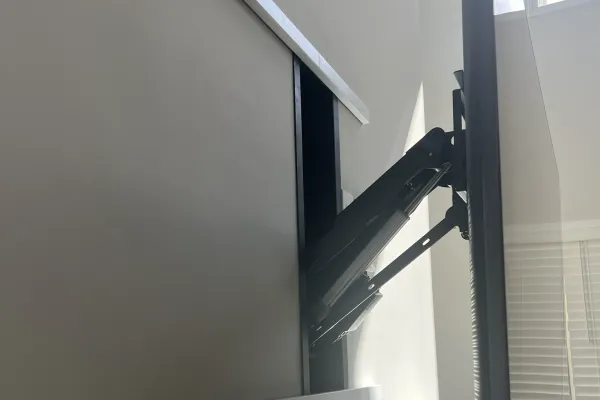
A full-motion arm is the hardest thing to hang on a Temple Terrace wall, because every inch the screen swings out works the anchors harder. Pull a 65-inch panel out on a 20-inch arm and the top anchors feel several times the load of the same panel on a flat bracket. So the wall decides how far the arm can go. On plaster on block in a mid-century ranch, the wall plate takes four 1/4-inch Tapcons in solid webs, six on a 75-inch or larger panel. On lath and plaster in a 1920s house, the plate spans two studs with four lag bolts, never one stud alone. Hollow clay tile is the cautious case: toggles across the full plate, a shorter arm, and sometimes the plain advice that a tilt bracket is the right choice for that wall. Tension gets set before the TV goes on, and the swing gets tested out to full extension and back before the installer leaves. Our full-motion brackets are $59 up to 54 inches and $79 above, and the clay tile and block walls carry the +$99 masonry surcharge. Allow 90-120 minutes.

Temple Terrace walls that can carry a full-motion arm, and the one that should not

Temple Terrace's 1920s rooms: picture rail, arches and a cable route that respects them

The 1920s rooms in Temple Terrace were built for framed pictures, not flat screens, and the trim shows it. Where a picture rail survives, a foot or so below the ceiling, it was meant for paintings hung on wire hooks and will not carry a TV, so the bracket goes on the wall below it, with the top of the screen kept a couple of inches clear so the rail still reads as an unbroken line. Arched openings and deep window returns are part of the Mediterranean Revival plan, and they limit where a wide screen fits. The installer outlines the TV in painter's tape before anything is drilled, a 2-minute step that catches a 75-inch screen about to overlap an arch. Cables are the other question. Plaster over clay tile cannot be fished, so the neatest route is a slim raceway painted to the wall and run down beside a door casing or along the baseboard, where the eye already expects a line, $79. Old plaster is rarely flat, so a slim bracket gets a thin shim at the low corner to keep the screen level.

Temple Terrace's 1920s rooms: picture rail, arches and a cable route that respects them

Field notes from Temple Terrace installs

Temple Terrace’s 1920s Mediterranean Revival houses are the slow jobs. Their walls are stucco over hollow clay tile or wood frame, with plaster inside. Clay tile gets the hammer function off and toggles inside the cells. Lath-and-plaster partitions get their studs found from the outlet boxes, then long lag bolts.

The 1950s to 1970s ranches are concrete block. The earlier ones have plaster straight on the block: short Tapcons, and a raceway for the cables. The later ones have drywall over furring strips: longer Tapcons across the 3/4-inch gap, and a channel behind the drywall for an HDMI run.

Two hazards shape the plan. Summer lightning puts every TV on a surge protector, after a tester confirms the outlet’s ground. On the Hillsborough River bluff lots, river flooding moves the electronics up off the floor.

TV mounting prices in Temple Terrace

Every Temple Terrace TV is priced by its screen size: $129 up to 54”, $159 for 55-69”, $209 for 70-79”, $299 for 80-99”, $399 for 100” and up. Hiding the cables inside a wall is $99 per TV, and a raceway on the surface is $79. The +$99 masonry surcharge applies to brick, stone and concrete. Plaster, drywall and metal stud carry none. In Temple Terrace that puts the surcharge on 1920s clay tile and ranch block, and keeps it off lath-and-plaster partitions and drywall on wood stud. Our brackets, if you want one: flat $49 up to 54 inches or $69 above, full-motion $59 or $79. A soundbar under the TV is $79. Nothing is added for the drive to Temple Terrace.

How Express Mounting covers Temple Terrace

Express Mounting has been Alex Crabinsky’s company since 2015, and 9,747+ documented installs later the process behind a Temple Terrace job is dialed in. A vetted Hillsborough County installer handles Temple Terrace, with the same hardware, the same checklist, and the same 3-year workmanship warranty, held by Express Mounting, on every job. Hammer off for 1920s clay tile, hammer on for ranch block: the installer we send to Temple Terrace knows the difference before the first hole.
TV mounting in Temple Terrace, FL: common questions

How is TV mounting priced in Temple Terrace?
By screen size, at a flat rate: $129 up to 54 inches, $159 for 55 to 69, $209 for 70 to 79, $299 for 80 to 99 and $399 for 100 and up, with in-wall cable concealment at $99 per TV. Hollow clay tile and concrete block carry the +$99 masonry surcharge. The lath-and-plaster of a 1920s house and drywall over wood stud carry none.
Can someone mount my TV in Temple Terrace today?
Yes. Book before noon and it can be done today. Call (470) 777-4077 or book through the website. An installer from our vetted Hillsborough County network is usually at your door within 2-4 hours of confirming a same-day request, from the golf course streets to the river bluff.
Does a two-story Temple Terrace house need different hardware upstairs and down?
Often, yes. Where the ground floor is block or hollow clay tile and the upper floor is wood frame, each floor gets its own wall read. Downstairs, block takes Tapcons from a hammer drill and clay tile takes toggles with the hammer off, both with the +$99 masonry surcharge. Upstairs, studs take 5/16-inch lag bolts with no surcharge, and a bedroom screen goes 42-50 inches to center.
We're opening walls for a Temple Terrace remodel. Should we add a media box for the TV?
Yes, while the walls are open. Ask the electrician for an outlet where the TV will hang, a recessed media box beside it and a 2-inch conduit down to the console. The installer then pulls HDMI through it at the $99 in-wall rate. On plaster over block nothing can be fished later, so a remodel is the chance to get it right.
Can the soundbar go on the wall under the TV during the same Temple Terrace visit?
Yes, for $79. On block it gets its own pair of Tapcons. On lath and plaster in a 1920s house it goes into the same studs as the TV, or onto an adapter on the TV bracket where the plaster has had enough holes. It connects over HDMI ARC or eARC, and the installer sets the TV to send its sound there before leaving.

What Express Mounting Customers Say

Google reviews of our Atlanta installs

We called and requested a same day service and they were able to accommodate, even on a Friday. When our technician got here, he assessed our mounting ask in seconds and immediately got to work.

Kelly Bell

Google review

KB
Great service, thank you Alex

Aleksey Khusanov

Google review

AK
These guys did an awesome job installing 4 TVs on my outdoor patio of full motion mounts side by side, highly recommend them!

Kaleb Bogunskov

Google review

KB

Schedule Your TV Installation in Temple Terrace

Put a Temple Terrace TV installation on the calendar today. The installer we dispatch arrives ready for the hollow clay tile and plaster of a 1920s house near the golf course and the plaster-on-block walls of a mid-century ranch. Upfront pricing and same-day slots.

Call (470) 777-4077 Book Online