Skip to content
Same-Day Service · Free Estimates Text a photo

TV mounting services in Batavia, IL

Batavia TV mounting is flat-rate: $129 up to 54", $159 for 55-69", $209 for 70-79", $299 for 80-94", $399 for 95-inch and up (2 technicians). Cable concealment is $99 per TV, brick or stone adds $99. Same-day slots when booked before noon, and the installer usually arrives within 2-4 hours of your confirmation.

“Wonderful communication. Expert installation. On time and competitively priced!”
Ferber Buckley, Google review of an Atlanta install

Updated

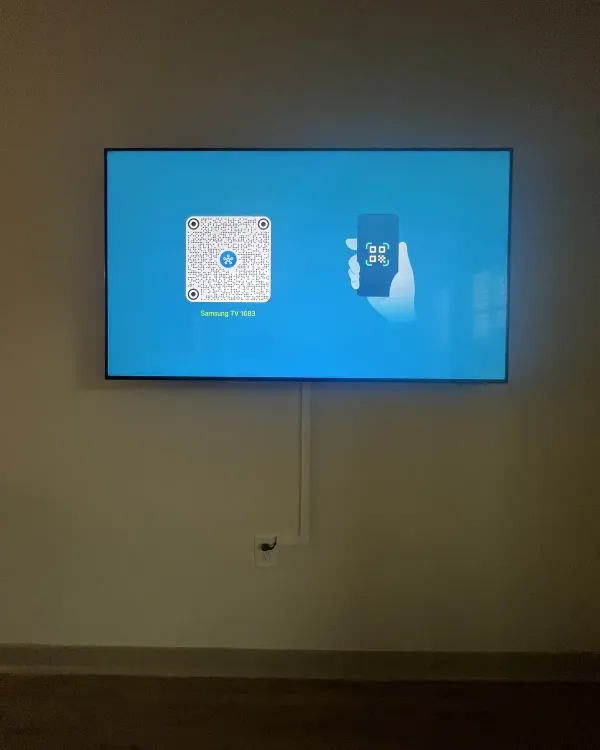
A TV on a tan wall with a paintable cable raceway running down to the outlet

Documented install, June 2025 By the Atlanta crew.

TV Mounting Cost Estimate

Step 1 of 520%
How big is the TV?
One TV.

Rather we call you?

Leave your number, and we call you about your TV, any day from 8:00 AM to 8:00 PM. Add a note on the wall or the TV if you like.

Contact Information

Helps us match you with the installer closest to you.

Batavia was settled on the Fox River in 1833 and spent its first century making things: quarried stone and, above all, windmills, which is where the name Windmill City comes from. The streets near downtown hold the houses of those years, frame and plaster-and-lath, along with buildings of local quarry stone. Farther out, Woodland Hills, Cherry Park, Fox Trail, Braeburn and Tanglewood Hills trace the decades from the 1960s to the 2000s, where the installer expects drywall over wood stud. Your Express Mounting installer brings a rare-earth magnet and low-speed bits for plaster, 5/16-inch lag bolts for studs, and a hammer drill with 1/4-inch Tapcons for stone, brick and basement foundation walls. Freeze-thaw and the river make the damp check standard. Same-day Batavia service when booked before noon.

What Express Mounting Customers Say

Google reviews of our Atlanta installs

Best service experience! On time, very knowledgeable and experienced and fair price. Highly recommend.

Laurel Turk

Google review

LT
Appreciate such a quick availability after the order placement, definitely recommend, great job.

Andrei Luncas

Google review

AL
Excellent service. Arrived on time. Did everything top-notch. Highly recommend for all your TV mounting needs.

Oleg Pascari

Google review

OP

Look us up before you book

Express Mounting has one Google Business Profile, at our Alpharetta, GA headquarters. Customer reviews for every metro we serve live there.

Chicago installs are done by local installers we dispatch, on the same flat rates and the same warranty.

28 Google reviews, every one on that profile, from customers of the Atlanta crew.

Every booking comes with

  • 3-year workmanship warranty
  • Same-day installation when you book before noon
  • An installer typically arrives within 2-4 hours of confirmation

Windmill City houses: 1850s to 1920s framing near downtown Batavia and the plaster over it

Batavia's first settlers arrived in 1833, and by 1900 it had 3,871 residents and a reputation as a factory town. The U.S. Wind Engine & Pump Company opened here in 1857 as the country's first mass-production windmill works, and five more windmill makers followed. Houses from those decades still stand on Main Street, Lincoln Street and First Street, a few of them dating to about 1850. A house of that age was finished in plaster over wood lath, so that is what the installer expects and then confirms. Plaster-and-lath defeats an electronic stud finder, because the lath is one continuous layer of wood. A rare-earth magnet slid across the wall catches the nails that hold lath to each stud and shows them as vertical rows. A 1/8-inch pilot hole settles it: steady resistance and clean shavings mean a stud. Old framing is not always on 16-inch centers, so each stud is found on its own. The plaster is drilled at low speed through painter's tape, and 5/16-inch lag bolts go into the wood. Plaster carries no surcharge.

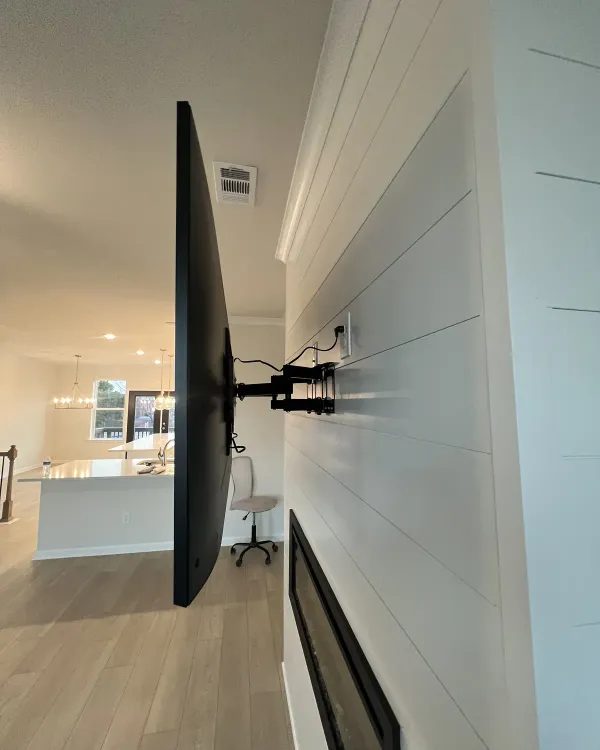
Side view of the same TV on its full-motion arm, showing the shiplap wall and an open kitchen behind

Batavia quarry stone: old factory buildings, storefronts and Bellevue Place

Stone was one of Batavia's first products. Local quarries supplied the town's own builders and, after the fire of 1871, shipped stone to help rebuild Chicago. Many of the stone factory buildings from the windmill years are still in use as offices and storefronts, and City Hall itself occupies the former Appleton Manufacturing plant. Bellevue Place on Jefferson Street, built of locally quarried stone in 1853 and 1854 as the Batavia Institute, was converted to apartments in the 1980s. Inside a building like these, an outside wall may be solid stone behind plaster, while a partition added in a later conversion may be wood or steel stud. Each wall is tested first. Where the bit brings out pale stone dust, the job is masonry: a hammer drill, a 3/16-inch carbide bit, and 1/4-inch Tapcons set at least an inch into sound material, at +$99. Hand-laid stone has irregular joints, so the bracket is shifted along its slots until every anchor has solid stone around it. Solid masonry has no cavity for cable, and a paintable surface raceway handles that.

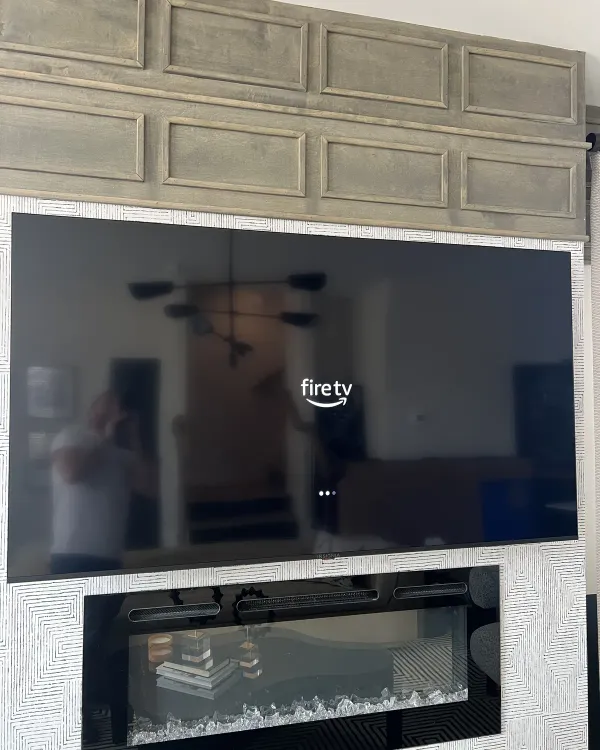
A TV mounted on a textured accent wall above a linear electric fireplace, under gray coffered paneling

Woodland Hills, Batavia Highlands and Breton Manor: what the 1960s and 1970s left in the wall

Batavia grew slowly for a long time, from 5,838 residents in 1950 to 9,060 in 1970, and the subdivisions of those years are modest ones: Woodland Hills and Batavia Highlands from the 1960s, Breton Manor from the 1970s. By then builders had largely moved from plaster to drywall, so the installer expects drywall over wood stud and checks for the exception: a late plaster job over gypsum lath, which sounds harder when knocked and drills out gritty. The pilot hole shows it. Where a room has a flat 8-foot ceiling, the TV sits lower than people expect: the center of the screen belongs near seated eye level, not in the middle of the wall. A return-air grille or a thermostat sometimes sits on the best wall, and a wider mount plate lets the bracket reach two studs while the screen stays centered on the sofa. A fixed or tilt bracket is usually all such a room needs. If the house has a brick fireplace, that wall is masonry at +$99 and gets Tapcons in place of lag bolts.

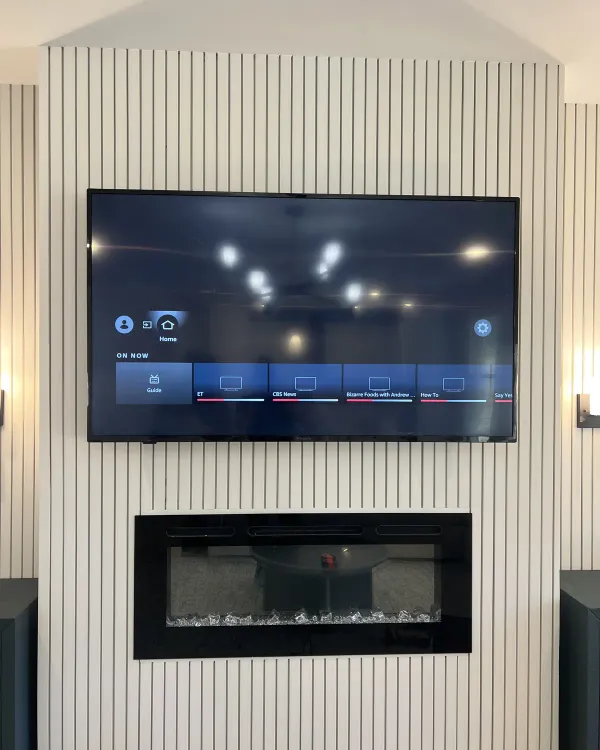
A TV mounted on a vertical slat accent wall above a linear electric fireplace

Cherry Park, Fox Trail and Braeburn: the twenty years when Batavia nearly doubled

Between 1980 and 2000 Batavia went from 12,574 residents to 23,866, and a large share of the houses in town date from that stretch or the few years after it. Heather Creek came in the early 1980s, Crestview Meadows and the Knolls of Batavia late in that decade, then Cherry Park, Braeburn and Fox Trail in the early 1990s, and Weaver Landing, Trout Farm and Tanglewood Hills around 2000, out by Randall Road. Drywall over wood stud is the working assumption in all of them, verified with a stud finder, a magnet on the fastener rows and a pilot hole. What changes from the older subdivisions is scale. Where a house has a two-story family room, that wall is a different job from an 8-foot one. The installer checks the bracket's VESA range against the TV first, then puts four lag bolts into two separate studs for anything 75 inches or larger. On a tall wall the screen still belongs low, near seated eye level. A 95-inch or larger panel arrives with two technicians, part of its $399 price.

Georgetown, Waterford at the Fox and Heritage Ridge: the long wall of a Batavia townhome

Waterford at the Fox dates from the early 1990s, Georgetown from the middle of that decade, and Heritage Ridge on McKee Road from 2002. A townhome living room often has one long wall, and that long wall is often the one shared with the house next door. A pilot hole behind the TV position shows whether the shared wall is wood stud, steel stud or concrete block, and the hardware follows: lag bolts, SnapToggles, or Tapcons with the +$99 masonry surcharge. Hiding cable takes more thought here than in a detached house. A shared wall may be packed with insulation or built as two layers, which makes a fish-tape drop slow or impractical. The installer tries the drop, and if the cavity will not pass a cable, says so before cutting a second opening. In-wall concealment is $99 per TV where the wall allows it. Where it does not, the cable runs in a paintable surface channel, or the TV moves to an interior partition. Ask your association whether it has anything to say about work on a shared wall.

Batavia's downtown historic district and the Fox River: two questions to ask before the drill

Two local facts come before a Batavia install. The first is the city's downtown historic district. Batavia has a Historic Preservation Commission. What the commission reviews is for the city to tell you, and we do not quote its rules. A TV on an interior wall changes nothing on the outside of a building. An outdoor TV, a cable through an exterior wall or anything fastened to a facade is another matter, so ask the city first if your plan touches the outside. The second fact is the river. The Fox runs through the middle of town under the Wilson Street bridge, and winters here bring repeated freeze-thaw. A basement foundation wall is checked for damp, staining and white mineral bloom before any anchor goes in. If it passes, the installer drills through the furring strips and seats 1/4-inch Tapcons in the foundation block or poured foundation, which is masonry at +$99. If it does not, a framed partition takes the TV on lag bolts.

Brackets, outlets and setup: the parts of a Batavia visit that are the same in every house

Whatever the wall turns out to be, some parts of a Batavia visit do not change. The bracket is its own line on the quote: bring yours, or take one of ours at $49 or $69 for a flat bracket and $59 or $79 for a full-motion arm, by screen size. It is matched to the TV's VESA pattern and weight before a hole is drilled. Height follows the seat. The installer tapes the outline on the wall, and you sit and look before anything is fastened. In a bedroom the center of the screen goes 42 to 50 inches off the floor. Level is set with a laser and checked again with the panel hanging. Power is the one thing we leave alone. A new outlet behind the TV is an electrician's work, and the electrician you hire will know what the city requires. Our concealment is low-voltage only. Then setup: WiFi joined, inputs named, and a soundbar connected over HDMI eARC, with soundbar mounting at $79. Samsung including the Frame, Sony, LG OLED, TCL and Hisense are routine.

Your Batavia price, before you book

Pick the TV's size, the wall and the mount, and the estimator shows the labor price, from $129 per TV. Then book a time online, or call from 8:00 AM to 8:00 PM.

Field notes from Batavia installs

Batavia has more kinds of wall than most towns its size, because it has been building since the 1830s. Near downtown are the houses of the windmill years, frame and plaster-and-lath, read with a magnet and drilled slowly. Mixed in are buildings of local quarry stone, former factories among them, where a mount is hammer drill and Tapcon work and every wall is tested before anything is assumed.

Woodland Hills and Breton Manor came in the 1960s and 1970s, then Cherry Park, Braeburn and Fox Trail as the population nearly doubled between 1980 and 2000, then Tanglewood Hills and Trout Farm out toward Randall Road. The installer expects drywall over wood stud in all of them, confirms it, and uses lag bolts.

Freeze-thaw and a river in the middle of town mean a basement foundation wall gets a damp check first. And the downtown historic district is the city’s to explain, so anything that touches the outside of a building there starts with a call to the city.

TV mounting prices in Batavia

Batavia is priced by screen size, the same as everywhere we work: $129 up to 54”, $159 for 55-69”, $209 for 70-79”, $299 for 80-94”, $399 for 95” and up. Hiding cable inside the wall is $99 per TV. A paintable raceway on the wall surface is $79. The published +$99 masonry surcharge covers brick, stone, block and concrete. There is no surcharge on plaster, drywall or metal stud. In Batavia the surcharge shows up on a quarry stone wall downtown, a brick fireplace or a basement foundation wall, and never on the plaster of an 1850s house or the drywall of Fox Trail. The bracket is separate, yours or ours at $49 or $69 flat and $59 or $79 full-motion. Soundbar install $79. No travel fee anywhere in Batavia.

How Express Mounting covers Batavia

Express Mounting has been at this since 2015, when Alex Crabinsky started the company in Atlanta, and 9,747+ documented installs stand behind the routine a Batavia job follows. Batavia jobs run through vetted Kane County installers who carry the same hardware, work off the same install checklist, and back every job with the same 3-year workmanship warranty, held by Express Mounting. The installer we dispatch already knows that a house near downtown Batavia is plaster until proven otherwise and that a stone wall wants a hammer drill.
TV mounting and installation in Batavia, IL: common questions

Do stone walls or old plaster change what a Batavia TV mount costs?

Stone does, plaster does not. The base rate goes by screen size: $129 up to 54 inches, $159 for 55-69, $209 for 70-79, $299 for 80-94, $399 for 95 and up. Anchoring into stone, brick, block or concrete adds the +$99 masonry surcharge. Plaster-and-lath in an older house near downtown, drywall and metal stud carry no surcharge. In-wall cable concealment is $99 per TV. Bring your own bracket or add one of ours, priced separately.

Will an installer cross the Fox River to the east side of Batavia the day I call?

Yes, on either bank, when you book before noon. Call (470) 777-4077 or book online. An installer from our vetted Kane County network arrives within 2-4 hours of confirming a same-day request, from the streets near downtown out to Randall Road and Kirk Road.

Can a TV hang on the stone wall of an old downtown Batavia building?

Yes, if the stone is sound, and the test hole checks that. The installer uses a hammer drill, a 3/16-inch carbide bit and 1/4-inch Tapcons, and shifts the bracket until each anchor sits in solid stone and not in a crumbling joint. Stone is masonry, so the +$99 surcharge applies. Cables run on the surface, because a solid wall has no cavity.

I live in an old house in downtown Batavia. Who do I ask before drilling into its walls?

If the house is in the city's downtown historic district, ask the city what its Historic Preservation Commission reviews. What we can describe is the job: a bracket on an interior wall, with nothing changed on the outside of the building. If your plan involves an outdoor TV or a cable through an exterior wall, ask the city before booking.

Is the wall in a 1960s Woodland Hills house different from one in a 1990s Fox Trail house?

Usually both are drywall over wood stud, and both are tested. The 1960s wall is the one more likely to surprise: a late plaster finish, thinner board, or studs that do not sit on even centers. In a 1990s house the questions are more about size, such as a tall family-room wall and a 75-inch or larger screen on four lag bolts across two studs.

Batavia ZIP code we cover

  • 60510

Not sure your address is in range? Text us your ZIP or address, or call (470) 777-4077.

Call (470) 777-4077 Text a photo

Text a photo of your wall

Point your phone's camera here to start a text to +14707774077. Add a photo of the wall and your TV's size, and we reply with your price and the first open time.

QR code that starts a text message to +14707774077
Use the quote form instead