Skip to content
Same-Day Service · Free Estimates Text a photo

TV mounting services in Uptown, IL

Uptown TV mounting is flat-rate: $129 up to 54", $159 for 55-69", $209 for 70-79", $299 for 80-94", $399 for 95-inch and up (2 technicians). Cable concealment is $99 per TV, brick or stone adds $99. Same-day slots when booked before noon, and the installer usually arrives within 2-4 hours of your confirmation.

“Very nice guys, did a great job installing 3 TVs for me for a very reasonable price.”
George Sholvok, Google review of an Atlanta install

Updated

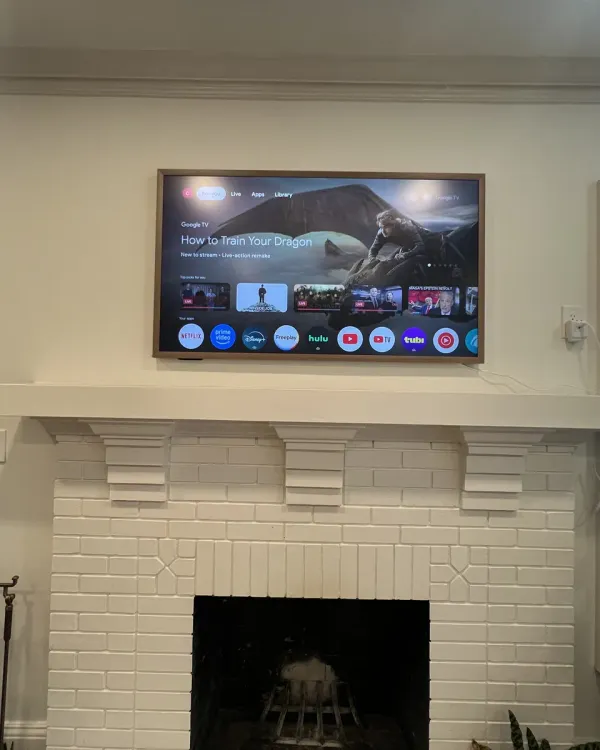
A TV mounted above a white mantel on a white painted-brick fireplace in a cottage living room

Documented install, July 2025 By the Atlanta crew.

TV Mounting Cost Estimate

Step 1 of 520%
How big is the TV?
One TV.

Rather we call you?

Leave your number, and we call you about your TV, any day from 8:00 AM to 8:00 PM. Add a note on the wall or the TV if you like.

Contact Information

Helps us match you with the installer closest to you.

Uptown filled in fast. A building boom ran from the 1890s into the 1920s, and the 'L' reached Wilson Avenue in 1900. Six-flats, courtyard buildings, greystones and apartment hotels came out of those years, and high-rises took the lakefront afterward. The neighborhood takes in Sheridan Park, Buena Park, Margate Park, Clarendon Park and Argyle Street. Older buildings are plaster-and-lath and common brick. The high-rises are concrete and metal stud. Your Express Mounting installer carries a rare-earth magnet and 5/16-inch lag bolts for studs behind plaster, a hammer drill with 3/16-inch carbide bits and 1/4-inch Tapcons for brick and concrete, and SnapToggles for metal stud. Chicago's conduit electrical code applies throughout, and the Sheridan Park and Buena Park landmark districts concern building exteriors. Same-day Uptown service when booked before noon.

What Express Mounting Customers Say

Google reviews of our Atlanta installs

There are not too many companies you can call and schedule for same-day professional services! These guys came out and did an excellent job mounting my 55-inch TV over a fireplace. I can not recommend them enough and will be using them for all my mounting needs in the future! Thank you Express Mounting team!

Mando Avila

Google review

MA
Amazing company. I needed a TV mounted ASAP for my son's birthday. They came out to our house after work hours to ensure this was completed for us for his birthday party the next morning. Very professional and helpful. Truly a great company!

Joseph McMurray

Google review

JM
Very happy with the work. Polite, cleaned up after, and paid close attention to detail to make sure it was the ideal spot. Enjoying the TV on the deck for many NFL Sundays. Thanks!

John Leahy

Google review

JL

Look us up before you book

Express Mounting has one Google Business Profile, at our Alpharetta, GA headquarters. Customer reviews for every metro we serve live there.

Chicago installs are done by local installers we dispatch, on the same flat rates and the same warranty.

28 Google reviews, every one on that profile, from customers of the Atlanta crew.

Every booking comes with

  • 3-year workmanship warranty
  • Same-day installation when you book before noon
  • An installer typically arrives within 2-4 hours of confirmation

After the 'L' reached Wilson Avenue in 1900: the boom that built Uptown's plaster walls

Uptown's housing boom began around the turn of the 20th century, and the 'L' reaching Wilson Avenue in 1900 fed it. Into the 1920s the neighborhood filled with six-flats, courtyard buildings, greystones and apartment hotels. Nearly everything from those decades was finished the same way inside: plaster-and-lath. Narrow wood strips, the lath, were nailed across the studs with gaps between them, and wet plaster was pushed through the gaps so it hooked over the back of each strip. Those hooks are called keys, and they are what still holds a plaster wall together. Two consequences for a TV. Plaster on lath is strong as a sheet and weak at a point, so it never carries a television by itself. The load goes to the wood stud behind it, or to the common brick of an outside wall. And the lath hides the studs from electronic finders, so they are found the old way, with a magnet and a pilot hole. The lakefront high-rises came later and are another material altogether: concrete and metal stud.

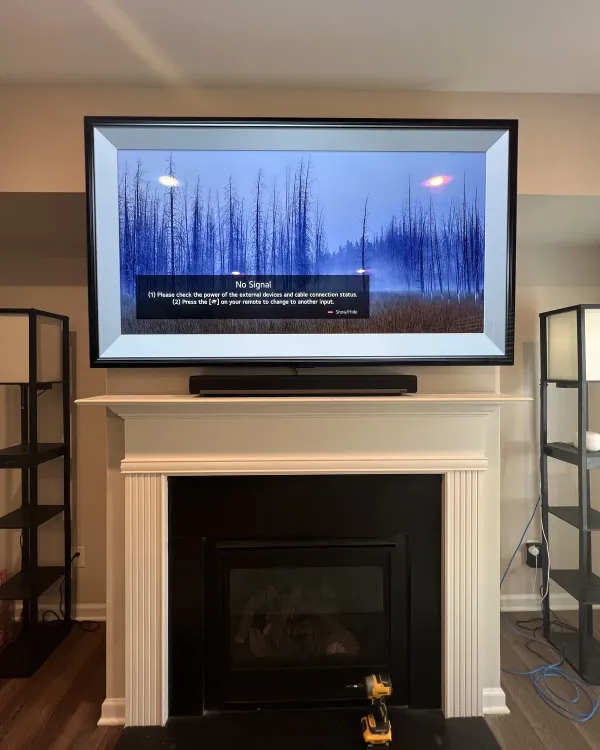
A Samsung Frame TV with a white bezel and a soundbar mounted above a white mantel fireplace

Sheridan Park six-flats: sound plaster, loose plaster and where the lag bolts go

Sheridan Park is six-flats, single-family houses and courtyard apartment buildings, and it has been a recognized historic district since 1985. In a six-flat apartment the question is rarely whether the wall can hold a TV. It is what shape the plaster is in. Before marking anything the installer presses on the wall with a flat hand and taps across the area the bracket will cover. Tight plaster sounds dull and does not move. Plaster whose keys have let go sounds drummy and gives slightly under the palm. A bracket should not be tightened against a loose patch, so the mount shifts a few inches to sound plaster or moves to another wall. Then the studs: a magnet for the lath nails, a 1/8-inch pilot to confirm wood. Two 5/16-inch lag bolts per stud carry the weight, and the last turns are made by hand so the bracket seats on the plaster without cracking it. Stud walls stay at the base rate. An outside wall of common brick takes Tapcons at +$99. Plan on 60 to 85 minutes.

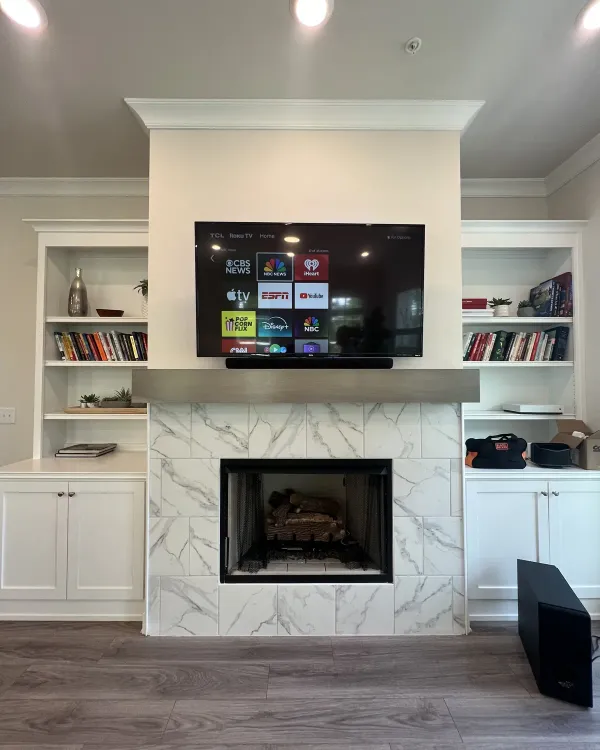
A TV and soundbar above a marble-tile fireplace flanked by white built-in bookshelves

The Winthrop-Kenmore corridor: big apartments divided in wartime, walls of two ages

During World War II many large apartments along the Winthrop-Kenmore corridor were divided into smaller units. That history still shows up when a TV goes on the wall. An apartment carved out of a larger one can have original walls from the boom years next to walls added when the place was split, and a later rehab may have added a third generation in drywall. So in a divided unit the installer tests the exact wall you picked and does not assume it matches the one beside it: magnet, knock, one pilot hole. Original plaster-and-lath over wood stud takes lag bolts. A later partition gets whatever its framing calls for, and if that framing is too light for the screen you want, you hear it before anything is drilled. Smaller units raise layout questions too. With only one wall that works, a full-motion arm lets the same screen face the sofa and the bed. Outlets can be far from the best TV spot, and a paintable raceway at $79 carries the cord and cables there neatly. Allow 60 to 90 minutes.

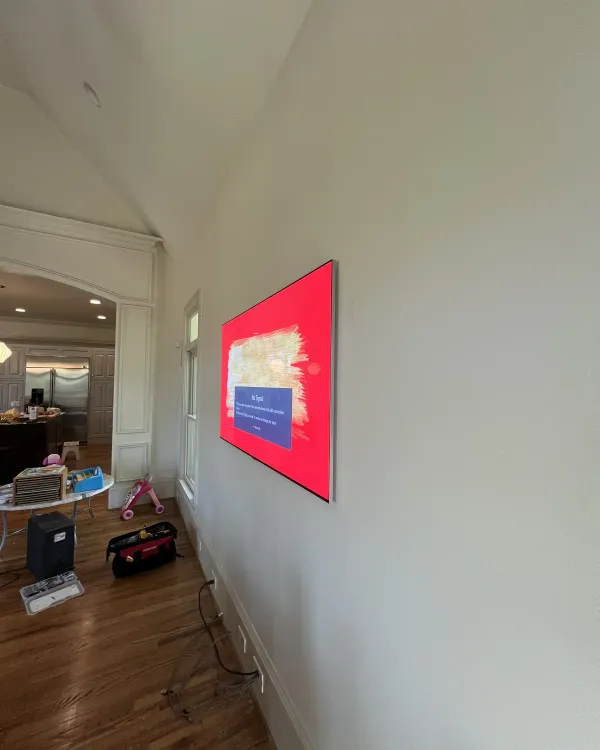
A TV on a flat mount on a cream living-room wall above a wood floor

Uptown's lakefront high-rises: toggles in metal stud, Tapcons in concrete

High-rises dominate Uptown's lakefront today, and their walls have nothing in common with the six-flats elsewhere in the neighborhood. Partitions are metal stud behind drywall. The structure is concrete. The common mistake in these buildings is treating a metal stud like a wood one. A lag bolt cuts a thread in thin steel, feels tight for a moment, then spins free. The installer finds the studs with a magnet, drills 1/2 inch through drywall and steel, and sets SnapToggles, whose metal channel bridges the stud from behind. A fixed bracket gets four. A full-motion arm gets six across two studs, since an extended arm pulls harder on the top row. Concrete turns up at columns and structural walls. There a hammer drill, a 3/16-inch carbide bit and 1/4-inch Tapcons do the work, and concrete counts as masonry at +$99. Metal stud has no surcharge. Before choosing a time, ask the management office about drilling hours and whether a large box needs the service elevator. A lake view also means glare, and a tilt bracket helps. Figure 60 to 90 minutes.

Houses and greystones in Sheridan Park and Buena Park: landmark outside, plaster inside

Uptown is not all apartments. Sheridan Park and Buena Park have single-family houses, and the neighborhood has greystones too. Both areas are landmark districts. That status concerns the outside of the buildings. A TV on an interior wall is inside work, and anything you have in mind that would show from the street is worth raising with the city before you book. Inside, a house of the boom years is plaster-and-lath over wood studs between rooms, and where an outer wall is common brick it is anchored as masonry. A house also tends to mean more than one TV. Living room, a bedroom, a finished basement if there is one: all can be done in one visit, each priced by its own screen size. Where a living room has a fireplace, the chimney breast is masonry, anchored with Tapcons at +$99, and the height above a mantel calls for a tilt bracket. In a bedroom where the TV is watched from bed, its center goes 42 to 50 inches above the floor. A 95-inch screen or bigger comes with two technicians as part of its price.

Conduit behind the plaster: power, HDMI and raceways in an Uptown apartment

Uptown is in the City of Chicago, and the Chicago Electrical Code requires wiring to run in metal conduit. NM cable is not allowed inside the city. For anyone mounting a TV, the rule draws a clear line. Power on one side: a new outlet behind the screen is an electrician's job, and an electrician working in the city will run it in EMT. Signal on the other: HDMI, optical, network and speaker cable are low-voltage, and hiding them is part of what we do. In-wall concealment costs $99 per TV. It suits a stud wall, plaster-and-lath in a six-flat or a metal stud partition in a high-rise, and the installer checks the bay with a magnet first so the cut misses any conduit. Common brick and concrete have no hollow to use. There a paintable raceway at $79 takes the cables down the wall in one straight line. If no outlet sits behind the TV, the power cord shares the raceway to the nearest one. Renters should ask the owner before any opening is cut in a wall.

An Uptown install day in lake-effect season: the carry, the dust and the first picture

Winter in Uptown is lake-effect winter, and the lake is close. A panel carried in from the cold is unboxed and left to warm before it is powered, so moisture that forms on cold parts has time to dry. In a building with no elevator the box goes up by hand, and the installer checks each landing and turn against its size first. Inside, a drop cloth covers the floor and a vacuum is held at the bit, since plaster dust settles on everything in a small apartment. The bracket has to suit the TV's VESA pattern and its weight. It is extra: use your own, or ours runs $49 or $69 for a flat mount and $59 or $79 for full-motion, by screen size. Bring your own pull-down mount and assembling it is a $99 add-on. The outline is taped up for your approval, and a laser checks level before and after the panel hangs. Then setup: WiFi, inputs, and a soundbar over HDMI eARC, with soundbar mounting at $79. Samsung including the Frame, Sony, LG OLED, TCL and Hisense are everyday work.

Your Uptown price, before you book

Pick the TV's size, the wall and the mount, and the estimator shows the labor price, from $129 per TV. Then book a time online, or call from 8:00 AM to 8:00 PM.

Field notes from Uptown installs

Uptown was built in a hurry and then built again at the water’s edge. The boom that started around the turn of the 20th century, helped along when the ‘L’ reached Wilson Avenue in 1900, produced six-flats, courtyard buildings, greystones and apartment hotels, plus single-family houses in Sheridan Park and Buena Park. Those buildings are plaster-and-lath and common brick. High-rises of concrete and metal stud now dominate the lakefront.

Plaster is checked for loose patches, studs are found by magnet, and lag bolts carry the load. Common brick takes a hammer drill and Tapcons. In a high-rise, metal stud takes SnapToggles and concrete takes Tapcons. Along the Winthrop-Kenmore corridor, where large apartments were divided during World War II, each wall is tested separately because walls of different ages sit side by side.

Under Chicago’s conduit code, a new outlet belongs to an electrician. The landmark districts in Sheridan Park and Buena Park concern exteriors. Lake-effect winters mean a cold TV warms up before it is switched on.

TV mounting prices in Uptown

Uptown installs are billed at a flat rate per TV: $129 up to 54”, $159 for 55-69”, $209 for 70-79”, $299 for 80-94”, $399 for 95” and up. Running cables inside the wall adds $99 per TV. A paintable surface raceway is $79. The published +$99 masonry surcharge covers brick, stone and concrete. Plaster, drywall and metal stud are never surcharged. In Uptown, a six-flat or courtyard-building partition of plaster-and-lath and a high-rise partition of metal stud both stay at the base rate. The surcharge applies when the anchor goes into the common brick of an older building’s outer wall or into high-rise concrete. The bracket is billed apart: your own, or ours at $49 or $69 flat and $59 or $79 full-motion. Soundbar install is $79. There is no travel fee anywhere in Uptown.

How Express Mounting covers Uptown

Since Alex Crabinsky founded Express Mounting in Atlanta in 2015, the company has documented 9,747+ installs, and an Uptown visit follows the checklist that record produced. Uptown jobs run through vetted Cook County installers who carry the same hardware, work off the same install checklist, and back every job with the same 3-year workmanship warranty, held by Express Mounting. The installer we dispatch already knows to test old plaster before trusting it, to keep lag bolts out of metal stud, and to ask what a divided apartment’s walls are made of.
TV mounting and installation in Uptown, IL: common questions

What is the flat rate for a TV install in Uptown?

It depends only on screen size: $129 up to 54 inches, $159 for 55-69, $209 for 70-79, $299 for 80-94 and $399 for 95 and up. Concealing cables inside the wall is $99 per TV. Anchoring into common brick in an older building or concrete in a lakefront high-rise adds the +$99 masonry surcharge. Plaster-and-lath, drywall and metal stud carry no surcharge. The bracket is extra, yours or one of ours.

Can someone mount my TV in Uptown this afternoon?

Yes, as long as you book before noon. Use the online form or call (470) 777-4077, and an installer from our vetted Cook County network arrives within 2-4 hours of confirming a same-day request. That applies across Sheridan Park, Buena Park, Margate Park, Clarendon Park and Argyle Street, from the blocks around the Aragon Ballroom to the lakefront at Montrose Harbor.

Will plaster-and-lath in an Uptown six-flat hold a 65-inch TV?

The plaster does not hold it. The wood studs behind it do. The installer finds them with a magnet and a pilot hole, then drives 5/16-inch lag bolts through the plaster into two studs. Loose plaster is checked for first, and the bracket moves if a patch has let go. If the wall turns out to be common brick, Tapcons replace the lags and the +$99 masonry surcharge applies.

Do the Sheridan Park and Buena Park landmark districts affect mounting a TV indoors?

Landmark status in those districts concerns building exteriors, and a TV on an interior wall is inside work. If your plan involves anything visible from outside, raise it with the city before booking. The rule that does reach indoors is the Chicago Electrical Code: a new outlet is an electrician's job, run in conduit.

I rent an apartment in Uptown. What should I settle before I book?

Three things. Get the owner's or management's permission in writing, and ask whether drilling is limited to certain hours. Decide on the bracket: a fixed one leaves four small holes to fill when you move. And choose a surface raceway over in-wall concealment unless the owner agrees to openings in the wall.

Call (470) 777-4077 Text a photo

Text a photo of your wall

Point your phone's camera here to start a text to +14707774077. Add a photo of the wall and your TV's size, and we reply with your price and the first open time.

QR code that starts a text message to +14707774077
Use the quote form instead