Skip to content
Same-Day Service · Free Estimates Book Online

TV mounting services in St. Cloud, FL

St. Cloud TV mounting is flat-rate: $129 up to 54", $159 for 55-69", $209 for 70-79", $299 for 80-99", $399 for 100-inch and up. Cable concealment is $99 per TV, brick or stone adds $99. Same-day slots when booked before noon, and the installer usually arrives within 2-4 hours of your confirmation.

St. Cloud was founded in 1909 as a veterans' colony on the shore of East Lake Tohopekaliga, and its walls still tell you the decade. The 1920s-50s pre-war cottages downtown are wood frame with lath-and-plaster. The block ranches are concrete block with furring strips behind the drywall. The 2000s-2020s growth, from the Narcoossee corridor to the Harmony edge and Canoe Creek, brought block-frame two-stories and, in the newest plats, drywall on wood frame. Your Express Mounting installer carries 3-1/2-inch lag bolts for old pine, 1/4-inch Tapcons and a hammer drill for block, SnapToggles for hollow cores and a surge protector behind each TV, since lightning is part of every St. Cloud summer. Book before noon and the TV can be up in St. Cloud the same day.

TV mounting services in St. Cloud, FL

TV Mounting Cost Estimate

Step 1 of 617%
How many TVs?

Contact Our TV Installers

Ready to schedule your professional TV installation? Contact us for a free quote or book your appointment online. Same-day service available across 15 US metros.

Contact Information

Helps us match you with the installer closest to you.

Look us up before you book

Express Mounting has one Google Business Profile, at our Alpharetta, GA headquarters. Customer reviews for every metro we serve live there.

Orlando installs are done by local installers we dispatch, on the same flat rates and the same warranty.

Every booking comes with

  • 3-year workmanship warranty
  • Same-day installation when you book before noon
  • An installer typically arrives within 2-4 hours of confirmation

St. Cloud's 1920s-50s downtown cottages: lath-and-plaster, the outlet box and a probe hole

St. Cloud started as a veterans' colony in 1909, and the cottages built downtown from the 1920s to the 1950s are wood frame with lath-and-plaster inside. That plaster throws a stud finder off, so the installer starts at the outlet. A box in a downtown St. Cloud cottage is usually nailed to a stud, though one added later may hang on the lath alone, so its edge gives a first guess and a 1/16-inch probe hole inside the bracket footprint confirms wood. The next stud sits about 16 inches over, since pre-war carpenters laid out from their own corner. Plaster and lath run close to an inch thick in these cottages, so the bolt is a 5/16-by-3-1/2-inch lag, not the 3-inch one in the mount bag, driven into a 3/16-inch pilot drilled in rotary mode. A 43-inch bedroom set can live on one stud, and anything from 55 inches up gets a bracket wide enough to catch two. There is no charge for the plaster. Cables ride in a $79 paintable raceway, because fishing through lath means patching plaster. Figure 70-90 minutes per cottage.

St. Cloud's 1920s-50s downtown cottages: lath-and-plaster, the outlet box and a probe hole

Furred block in a St. Cloud ranch: adding up the stack before choosing the Tapcon

St. Cloud's block ranches are concrete block outside, 1x2 furring strips nailed to the block, and drywall hung on the strips. Any anchor has to pass three layers and still bite block, so the installer adds them up first: 1/2 inch of drywall, 3/4 inch of strip or air gap, and at least 1-1/4 inches of embedment. That stack makes a 2-3/4-inch Tapcon the shortest one that works. The hole gets a 3/16-inch carbide bit in the hammer drill, bored half an inch past the screw's reach so the dust has somewhere to go. Torque is the second trap. Drive a Tapcon hard against drywall floating over the gap and the gypsum crushes and the plate tips, so a short steel sleeve goes through the drywall to let the bracket bear on block, and the last turn is by hand. A 65-inch panel rides on four Tapcons, a full-motion arm on six. Block means the +$99 masonry surcharge. An exterior block wall leaves only that thin gap for a cable, so a $79 raceway is the usual plan there. About an hour per ranch.

Furred block in a St. Cloud ranch: adding up the stack before choosing the Tapcon

Narcoossee corridor two-stories: block below, wood above, and the color of the dust

The Narcoossee corridor is St. Cloud's growth corridor, and a lot of what went up along it in the 2000s-2020s is the new-traditional two-story, built block-frame: a concrete block ground floor with a wood-framed second story, stucco over both. From the driveway the two floors look the same. From inside, the bit tells. A 3/16-inch carbide bit in rotary mode pushes out white gypsum dust first, then pale wood shavings or grey grit, and grey grit means block. On the first floor that means Tapcons through the furring and the +$99 masonry surcharge. On the second floor every wall is 2x4 studs on 16-inch centers, even the outside ones, so a bonus-room or bedroom TV goes on 5/16-inch lag bolts with no surcharge. First-floor interior partitions are usually wood stud as well, and that is often the better TV wall, since it opens up an in-wall cable run the block cannot give. Upstairs bedroom sets go at a 42-50 inch center. One test bore per floor keeps a St. Cloud wall from turning into a patch job. Figure 60-80 minutes per set.

Narcoossee corridor two-stories: block below, wood above, and the color of the dust

The newest St. Cloud plats: drywall on wood frame, 24-inch centers and a longer rail

St. Cloud counted 58,964 residents in 2020 and an estimated 74,960 in 2025, and the newest plats built for that growth are drywall on wood frame. They are fast walls to anchor and unforgiving to finish. New framing is not always on 16-inch centers. Some runs 24, and a bracket with a short rail then catches one stud, not two. The installer maps the bay with a stud finder, confirms each stud with a finish nail tapped where the bracket plate will hide the hole, and picks a rail long enough to reach both studs. Lag bolts are 5/16 inch into a 3/16-inch pilot, with at least 2-1/2 inches of thread in the wood. A drop cloth goes down and a vacuum rides the bit, because white baseboard shows drywall dust for weeks. Great rooms in these plans can run 10-foot ceilings, sometimes with an electric fireplace built into the TV wall. An electric insert throws its heat forward, so the wall above it usually passes a quick hand check, and the screen still goes at seated eye height. About 45-60 minutes per set.

The newest St. Cloud plats: drywall on wood frame, 24-inch centers and a longer rail

On the East Lake Toho shore: lakefront moisture, screened porches and an outdoor-rated set

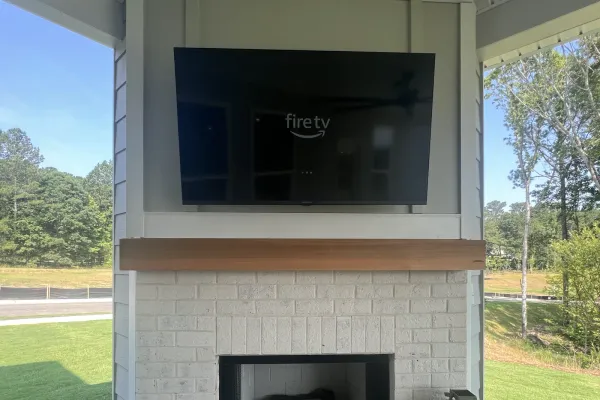
Houses on the East Lake Tohopekaliga shore and the streets near the lakefront park trade the view for damp air. A screened porch or lanai on a St. Cloud lake lot rarely dries out between June and September, which changes both the hardware and the TV. The bracket belongs on the house wall beneath the porch roof, never on the aluminum frame of the screen enclosure: stainless lag bolts into framing on a frame wall, Tapcons on block, and exterior sealant in every hole before the fastener goes in. An indoor TV on a lakefront porch fogs inside the panel within a season or two, so the talk starts with an outdoor-rated set, or full shade and a fitted cover at the least. Power comes from a GFCI outlet with an in-use cover, and every cord leaves the TV with a drip loop so water runs off before it reaches a jack. Wind crosses open water with nothing to slow it, so a porch arm gets locked at its viewing angle. Porch installs on the East Lake Toho side take 75-100 minutes.

On the East Lake Toho shore: lakefront moisture, screened porches and an outdoor-rated set

Lightning season in St. Cloud: surge protectors, coax lines and a grounded outlet

Florida logs more lightning than any other state, and in 2018 fourteen Florida counties ranked in the top fifteen US counties for lightning density. A strike does not need to hit the house to ruin a panel. The spike often rides in on the cable or Ethernet line, not just the power cord, so the surge protector your installer sets behind the TV has coax and Ethernet ports as well as outlets, and the TV, streaming box and soundbar all plug into that one unit so they share a ground. A protector only works from a grounded outlet. In a downtown St. Cloud cottage the receptacle behind the TV can still be an ungrounded two-prong, and a protector on an adapter there protects almost nothing, so the installer points it out and leaves the fix to an electrician. A lakefront house with a long run out to the porch gets a second protector at the porch outlet. Cable runs stay short, never wound in a coil behind the set. When a storm sits over East Lake Toho, pulling the plug is still the surest move.

Lightning season in St. Cloud: surge protectors, coax lines and a grounded outlet

Where the outlet sits in a St. Cloud house, and how the cable gets to it

The outlet decides the cable plan more than the TV does, and in St. Cloud it moves with the decade. In a downtown cottage it is one receptacle low on the baseboard, and the cavity behind the plaster is no place to fish, so the cable drops in a $79 paintable raceway to the nearest plug. In a block ranch the TV usually lands on an exterior wall with the outlet about 12 inches off the floor and only the furring gap behind the drywall, so the raceway wins again. Move the TV to an interior wood partition and the in-wall run is $99 per TV. Builders in the newer Narcoossee corridor plats may have set a power outlet and a low-voltage plate at TV height on the family-room wall, which turns the in-wall job into a short drop inside one bay, checked for blocking with a long flex bit before it is quoted. In-wall rated HDMI goes inside the wall, and the TV's own power cord never does. Five minutes on the cable path saves an hour of patching.

Where the outlet sits in a St. Cloud house, and how the cable gets to it

Field notes from St. Cloud installs

St. Cloud has four kinds of TV wall, and they line up with how the town grew. The 1909 colony streets downtown carry 1920s-50s cottages with lath-and-plaster over rough-sawn pine, found from the outlet box, then lagged with 3-1/2-inch bolts. The block ranches are concrete block behind furring strips, so the Tapcon length gets added up layer by layer.

The Narcoossee corridor two-stories pair a block ground floor with a wood-stud upper floor, read by the color of the dust a carbide bit throws. The newest plats are drywall on wood frame, sometimes on 24-inch centers, which decides the bracket width.

Two local conditions ride along on every job. Lightning means a surge protector that also guards the coax and Ethernet, on a grounded outlet. Lakefront moisture along East Lake Toho calls for stainless fasteners, sealant in every hole and a TV rated for outdoor air on any porch that faces the water.

TV mounting prices in St. Cloud

St. Cloud TV mounting is priced per TV by screen size: $129 up to 54”, $159 for 55-69”, $209 for 70-79”, $299 for 80-99” and $399 for 100” and up. Hiding cables inside the wall is $99 per TV, and a paintable surface raceway runs $79. Anchoring into brick, stone or concrete adds the published +$99 masonry surcharge. On plaster, drywall and metal stud, there is no surcharge. In St. Cloud the surcharge lands on the block ranches and the block first floor of a two-story, not on the downtown plaster cottages, the wood-stud second floors or the newest drywall plats. The bracket is a separate line: your own, or one of ours, a flat mount for $49 or $69 and a full-motion arm for $59 or $79. Soundbar install $79, and no travel fee anywhere in St. Cloud.

How Express Mounting covers St. Cloud

Alex Crabinsky founded Express Mounting in Atlanta in 2015, and 9,747+ documented installs have shaped the checklist a St. Cloud job runs on today. St. Cloud jobs run through vetted Osceola County installers who carry the same hardware, work off the same install checklist, and back every job with the same 3-year workmanship warranty, held by Express Mounting. The installer we dispatch already knows that a downtown cottage starts at the outlet box and a Narcoossee two-story starts with the color of the dust.
TV mounting in St. Cloud, FL: common questions

What do you charge to mount a TV in St. Cloud?
One flat rate per TV by screen size: $129 up to 54 inches, $159 for 55-69 inches, $209 for 70-79 inches, $299 for 80-99 inches and $399 at 100 inches and up. Running the cables inside the wall adds $99 per TV. Concrete block, furred or bare, adds the +$99 masonry surcharge. Downtown plaster, upstairs wood stud and the newest drywall plats add nothing.
Can an installer come out to St. Cloud today?
Yes, as long as you book before noon. Ring (470) 777-4077 or book on the website. An installer from our vetted Osceola County network typically arrives within 2-4 hours of confirming a same-day request, from the downtown cottages to the Narcoossee corridor. Hours run 8 AM to 8 PM, every day.
What anchor holds a TV on furred block in a St. Cloud ranch?
A 1/4-inch Tapcon sized to the whole stack, drywall plus the 3/4-inch furring gap plus a full 1-1/4 inches of block, which usually means a 2-3/4-inch screw. A plastic drywall anchor fails here because it opens into air. Where the bit breaks into a hollow core, a SnapToggle behind the face shell takes the load. The +$99 masonry surcharge applies.
Does the CDD in a newer St. Cloud subdivision have to approve a TV mount?
No. A community development district builds and maintains roads, ponds and amenity centers, and its charge usually shows up on the property tax bill. It has no say over a TV on an interior wall. A porch TV that shows from the street or the water may fall under your plat's deed covenants, so read them before we drill outside.
Can one visit handle the family room, the primary bedroom and the bonus room in a St. Cloud two-story?
Yes, three rooms in one visit is a routine booking. The block first-floor family room takes Tapcons and the masonry surcharge, the upstairs rooms take lag bolts into wood studs, and each TV is priced at its own size band. Bedroom screens go at a 42-50 inch center. Plan on 2.5-3 hours.

What Express Mounting Customers Say

Google reviews of our Atlanta installs

We called and requested a same day service and they were able to accommodate, even on a Friday. When our technician got here, he assessed our mounting ask in seconds and immediately got to work.

Kelly Bell

Google review

KB
Great service, thank you Alex

Aleksey Khusanov

Google review

AK
These guys did an awesome job installing 4 TVs on my outdoor patio of full motion mounts side by side, highly recommend them!

Kaleb Bogunskov

Google review

KB

Schedule Your TV Installation in St. Cloud

Book a St. Cloud install and the installer arrives ready for either end of town, from lath-and-plaster in a downtown cottage to the block-frame two-stories along the Narcoossee corridor. Flat upfront pricing, same-day slots when you book before noon.

Call (470) 777-4077 Book Online