Skip to content
Same-Day Service · Free Estimates Text a photo

TV mounting services in Old Town, IL

Old Town TV mounting is flat-rate: $129 up to 54", $159 for 55-69", $209 for 70-79", $299 for 80-94", $399 for 95-inch and up (2 technicians). Cable concealment is $99 per TV, brick or stone adds $99. Same-day slots when booked before noon, and the installer usually arrives within 2-4 hours of your confirmation.

“Very nice guys, did a great job installing 3 TVs for me for a very reasonable price.”
George Sholvok, Google review of an Atlanta install

Updated

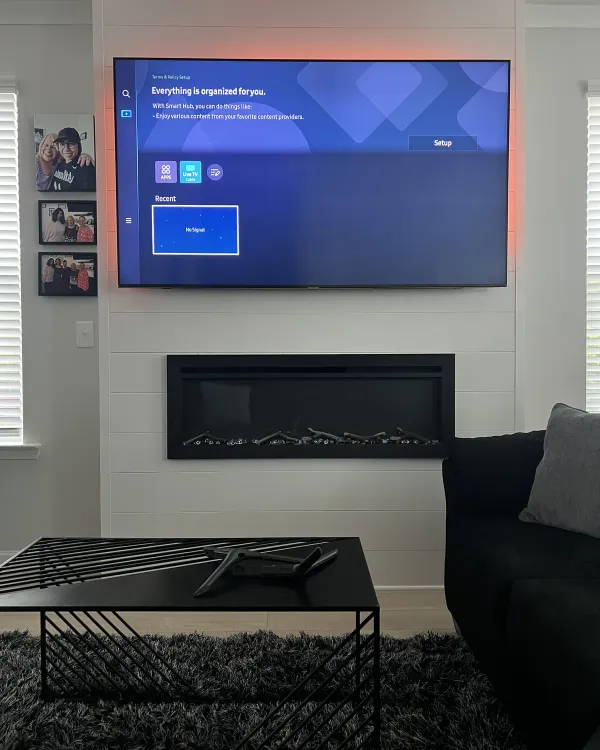
A TV mounted on a white shiplap wall above a linear electric fireplace, a black sectional in front

Documented install, June 2025 By the Atlanta crew.

TV Mounting Cost Estimate

Step 1 of 520%
How big is the TV?
One TV.

Rather we call you?

Leave your number, and we call you about your TV, any day from 8:00 AM to 8:00 PM. Add a note on the wall or the TV if you like.

Contact Information

Helps us match you with the installer closest to you.

The Great Chicago Fire of October 1871 flattened Old Town, and the neighborhood standing today was built in the thirty years after it. Small frame cottages came first. Then the city banned wood construction, and brick cottages, rowhouses and three- and four-story flats filled the Old Town Triangle, Crilly Court and the blocks off Wells Street. Behind the paint that means plaster-and-lath over wood studs in the frame cottages and plaster over brick in most of the rest. Your Express Mounting installer brings 5/16-inch lag bolts, a hammer drill, 3/16-inch carbide bits and 1/4-inch Tapcons, SnapToggles, and a magnet for finding studs behind plaster. Chicago's conduit electrical code applies. Same-day Old Town service when booked before noon.

What Express Mounting Customers Say

Google reviews of our Atlanta installs

These guys did an awesome job installing 4 TVs on my outdoor patio of full motion mounts side by side, highly recommend them!

Kaleb Bogunskov

Google review

KB
Wonderful communication. Expert installation. On time and competitively priced! I would definitely use them again!

Ferber Buckley

Google review

FB
Absolutely great service - communication, promptness and responsiveness outstanding. Mount I bought didn't work with the TV and Alex left and got another one. Came back to finish the install. Excellent experience!

Jan Noll

Google review

JN

Look us up before you book

Express Mounting has one Google Business Profile, at our Alpharetta, GA headquarters. Customer reviews for every metro we serve live there.

Chicago installs are done by local installers we dispatch, on the same flat rates and the same warranty.

28 Google reviews, every one on that profile, from customers of the Atlanta crew.

Every booking comes with

  • 3-year workmanship warranty
  • Same-day installation when you book before noon
  • An installer typically arrives within 2-4 hours of confirmation

Built back after the 1871 fire: Old Town's frame cottages and the studs behind their plaster

The fire of October 1871 left little of Old Town standing beyond the walls of St. Michael's Church. The first houses back were small frame cottages, many about twenty feet wide and thirty deep, one or one-and-a-half stories, set side by side on narrow lots. The National Register survey of the Old Town Triangle counted about a hundred frame buildings. Houses of the 1870s were finished in plaster, so the installer expects plaster-and-lath over wood studs and then proves it. An electronic stud finder is little use here, because lath is a continuous layer of wood under the plaster. A rare-earth magnet catches the nail rows where the lath crosses each stud. A 1/8-inch pilot hole settles the matter, with clean shavings and steady resistance meaning wood. Framing this old does not always sit on 16-inch centers, so every stud is located separately. Plaster is drilled at low speed through painter's tape, and 5/16-inch lag bolts go into the framing, four of them for a screen past 55 inches. Plaster carries no surcharge. Allow 60 to 80 minutes.

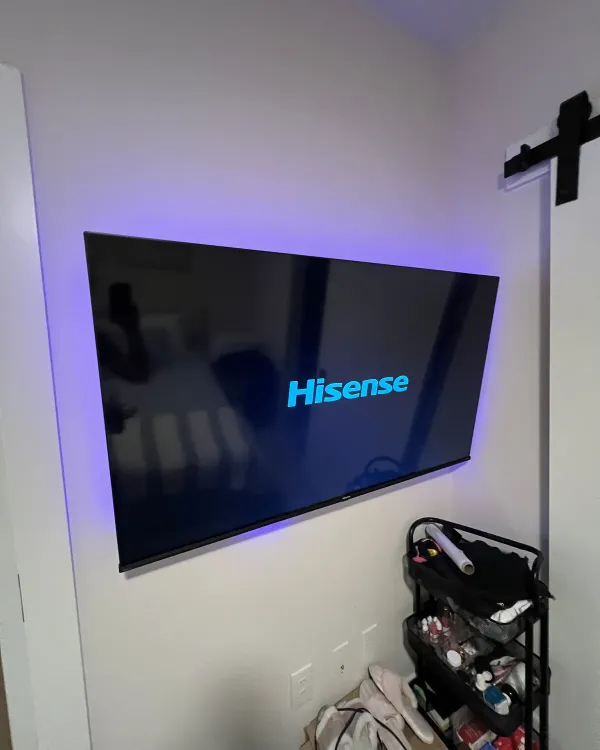
A Hisense TV on a white wall with purple LED bias lighting glowing behind it

Brick after the wood ban: Old Town rowhouses, brick cottages and the Sullivan Row

After the first wave of frame cottages, Chicago banned further wood construction, and Old Town went on building in brick and stone. That is why the National Register survey of the Old Town Triangle found brick buildings outnumbering frame ones by more than two to one. They run from brick cottages of 1873 on Cleveland Avenue to the five row houses Louis Sullivan designed on Lincoln Park West in 1884 and 1885. On the outside walls and the walls shared with the house next door, the installer expects brick behind the plaster, sometimes with thin furring strips between. One 3/16-inch test hole goes in where the TV will cover it, and the bit reports the layers: plaster, then a short gap or none, then brick. That depth chooses the Tapcon, which has to thread an inch or more into the brick. Each anchor sits in the brick face or the mortar joint, whichever lines up with the mount holes. The hammer action comes on only after the bit has cleared the plaster. Brick counts as masonry here, which adds +$99. Plan on 75 to 100 minutes.

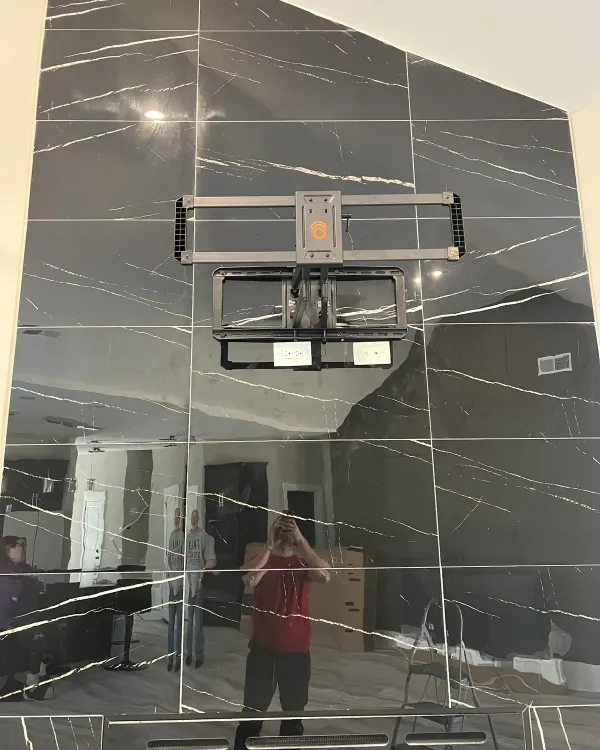
A full-motion wall plate and arm installed on a black marble-look porcelain tile fireplace wall

Crilly Court and the Wells Street flats: apartments from 1885 to 1893, divided again since

Daniel F. Crilly bought his block in 1884 and built on it until 1893: twelve small houses along the west side of Crilly Court, four-story apartment buildings, and the Wells Street block of stores with apartments above. Brick flats of three and four stories like these stand among the cottages all through the Triangle. Old apartment buildings get rearranged. The Crilly building's 40 apartments were divided into 64 around 1946, and a history like that leaves one unit with walls of different ages: original plaster, and partitions added decades later that may be drywall over stud. So in an Old Town flat the installer tests every wall separately, with a magnet pass, a knock and a pilot hole behind the TV position. Wood takes lag bolts. Brick takes Tapcons and the masonry surcharge. Drywall with nothing behind it carries only a small set, up to about 32 inches and 30 pounds on rated toggles. Where the flat is a walk-up, the TV box is measured against the stair and its landings before anyone lifts it.

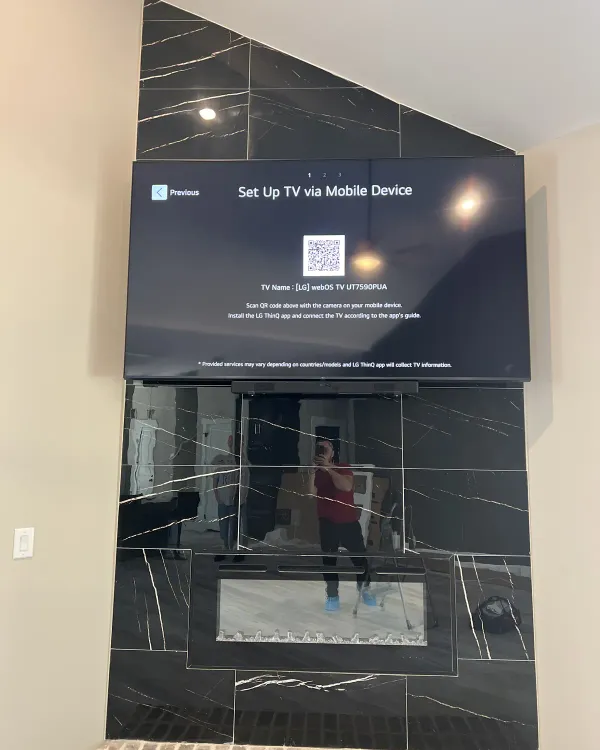
A TV set up on the full-motion mount on the black tile fireplace wall

Coach houses and rear dwellings: mounting a TV in the building behind the building

Old Town lots often hold two homes. That same survey counts dozens of properties with a livable rear dwelling. It also records garages with chauffeurs' quarters, built for families who lived on the Gold Coast, most of them residences now. One back building on Sedgwick Street is a documented fire cottage from the months after the 1871 fire. A rear building changes two things about a TV install. Access comes first. The way in is often a gangway or an alley gate, so tell us when you book, and give the width if you can. The installer checks the TV box against the narrowest point before it leaves the street. Then the walls. A converted garage can have brick outside walls and partitions that were added during the conversion, and no photo shows which is which. Every wall gets tested. Rooms in these buildings tend to be small, so the outline of the screen is taped up and judged from the seat first. A full-motion arm that folds flat often suits a tight room.

A landmark district on one-block streets: parking, carrying and who to ask in Old Town

The Old Town Triangle has been a Chicago Landmark district since 1977 and on the National Register since 1984. Two practical points follow for a TV job. One is the street plan. Old Town's streets form a modified grid, narrow and tree-lined, and some run a single block before they end. The installer may have to park around the corner and carry the tools and the TV in, so a 75-inch or 85-inch box is planned for at booking. Say which door is easiest and whether there are steps up from the sidewalk. The other point is the designation itself. Mounting a TV is indoor work on an inside wall. We do not interpret landmark rules, and if you want to know what the designation covers at your address, the city can tell you. A condo or a rented flat adds its own layer. Ask the association or the owner before booking, and get a renter's permission in writing. A fixed bracket leaves four small holes to fill later. None of this changes the flat rate.

Metal conduit behind 1870s plaster: outlets and cable concealment in Old Town

Old Town is inside the City of Chicago, and the Chicago Electrical Code requires wiring in metal conduit. Flexible NM cable is not allowed in the city. For a TV, that makes a new outlet behind the screen an electrician's job, run in EMT, and separate from a mounting visit. The mounting visit covers low-voltage cable only: HDMI, optical, speaker and network. Concealing those inside the wall is $99 per TV wherever the wall has a cavity. A frame cottage partition does. The installer cuts two small openings with an oscillating tool, slowly, so the plaster does not crack beyond the cover plate, and steers the fish tape away from any conduit the magnet has found. Plaster laid over brick has no cavity worth counting on. On that wall a paintable raceway at $79 carries the cables down in one straight line. Sometimes neither is needed, because an outlet already sits behind the TV spot and the console stands directly below. Either way the installer shows you the route and the plate positions before cutting anything.

Visit day in Old Town: the kit, the bracket and the height check

The installer we dispatch to Old Town carries the full kit, because no wall here is known until it is tested: a hammer drill, 3/16-inch carbide bits, Tapcons in three lengths, 5/16-inch lag bolts, SnapToggles, a rare-earth magnet, a stud finder, a laser level and a vacuum. Plaster dust is fine, so a drop cloth goes down and the vacuum runs at the bit. The bracket is priced apart from the labor, so use your own or buy ours: $49 for a flat bracket up to 54 inches and $69 above, $59 or $79 for full-motion. Either way it has to match the VESA pattern and the weight of your TV. Height comes from where you sit. In a living room the screen's center lands near seated eye level, and in a bedroom, watched from bed, the center goes 42 to 50 inches off the floor. A laser line confirms level twice, once on the bare bracket and once with the TV on it. Setup covers WiFi, inputs and a soundbar over HDMI eARC, on Samsung including the Frame, Sony, LG OLED, TCL and Hisense.

Your Old Town price, before you book

Pick the TV's size, the wall and the mount, and the estimator shows the labor price, from $129 per TV. Then book a time online, or call from 8:00 AM to 8:00 PM.

Field notes from Old Town installs

Old Town was built twice, and only the second version is on the wall an installer drills. Farmers and tradesmen from Germany settled the fields above North Avenue in the 1850s. The fire of 1871 erased that neighborhood. What replaced it went up between 1871 and about 1900: frame cottages at first, then brick cottages, rowhouses and flats once wood construction was banned.

So an Old Town wall is plaster, and the question is what stands behind it. In a frame cottage it is wood studs under plaster-and-lath, loaded with lag bolts. In the brick buildings it is brick, sometimes behind furring strips, reached with a hammer drill and Tapcons. Redivided flats, coach houses and 1970s infill add drywall to the mix, and the towers at the Wells and Division end are tested like any unknown wall.

The local hazards are age and access. Brick and mortar that have been through well over a century of freeze-thaw get checked before an anchor is trusted, and fresh tuckpointing is left alone. The streets are narrow and some are a block long, so a big box is planned for. Chicago’s conduit code makes a new outlet an electrician’s work.

TV mounting prices in Old Town

Old Town pricing follows the screen, not the building: $129 up to 54”, $159 for 55-69”, $209 for 70-79”, $299 for 80-94”, $399 for 95” and up. Concealment inside an Old Town wall is $99 per TV. A paintable raceway, for walls with no cavity, is $79. Brick, stone and concrete are masonry and add the published +$99 surcharge, while plaster, drywall and metal stud add nothing. In Old Town the dividing line runs between the frame cottages and nearly everything else: a mount lagged into cottage studs through plaster-and-lath stays at the base rate, and a mount anchored through plaster into the brick of a rowhouse, a flat or a chimney breast is masonry. Brackets are quoted apart from labor: $49 or $69 for a flat one of ours, $59 or $79 for full-motion. Soundbar install is $79. No travel fee anywhere in Old Town.

How Express Mounting covers Old Town

Alex Crabinsky opened Express Mounting in Atlanta in 2015, and the 9,747+ documented installs since then are what the Old Town checklist is built from. Old Town jobs run through vetted Cook County installers who carry the same hardware, work off the same install checklist, and back every job with the same 3-year workmanship warranty, held by Express Mounting. The installer we dispatch already knows that an Old Town cottage hides studs behind its plaster, that a rowhouse hides brick, and that the pilot hole decides between them.
TV mounting and installation in Old Town, IL: common questions

What does it cost to mount a TV in Old Town?

A flat rate set by screen size: $129 up to 54 inches, $159 for 55-69, $209 for 70-79, $299 for 80-94 and $399 for 95 and up. In-wall concealment of the cables is $99 per TV. Anchoring into the brick behind rowhouse or flat plaster adds the +$99 masonry surcharge. Plaster-and-lath over cottage studs, drywall and metal stud carry no surcharge. The bracket is extra: yours, or one of ours.

Can an installer reach Old Town the same day I call?

Yes, when you book before noon, by phone at (470) 777-4077 or online. An installer from our vetted Cook County network arrives within 2-4 hours of confirming a same-day request, in the Triangle, on Wells Street or down toward Division.

Will the plaster wall of an Old Town frame cottage hold a 65-inch TV?

The plaster does not hold it. The wood studs behind the plaster-and-lath do. The installer finds them with a magnet and a pilot hole, then drives 5/16-inch lag bolts into two studs. If the test hole finds brick instead, the mount goes on Tapcons and the +$99 masonry surcharge applies.

My home is in the Old Town Triangle landmark district. Who should I ask before a TV goes up?

A TV mount is indoor work on an inside wall, and we do not interpret landmark rules. For a question about what the designation covers at your address, ask the city. If you live in a condo or rent your flat, ask the association or the owner as well.

Do you mount TVs in the newer towers near Wells and Division?

Yes. Old Town Park at 1140 N. Wells opened its first tower, 32 stories, in 2018, and tower walls are tested first. A pilot hole behind the TV position shows wood, steel or concrete. Steel stud takes SnapToggles. Concrete takes Tapcons and the +$99 masonry surcharge. Ask management about drilling hours before you book.

Call (470) 777-4077 Text a photo

Text a photo of your wall

Point your phone's camera here to start a text to +14707774077. Add a photo of the wall and your TV's size, and we reply with your price and the first open time.

QR code that starts a text message to +14707774077
Use the quote form instead