Skip to content
Same-Day Service · Free Estimates Text a photo

TV mounting services in The Loop, IL

The Loop TV mounting is flat-rate: $129 up to 54", $159 for 55-69", $209 for 70-79", $299 for 80-94", $399 for 95-inch and up (2 technicians). Cable concealment is $99 per TV, brick or stone adds $99. Same-day slots when booked before noon, and the installer usually arrives within 2-4 hours of your confirmation.

“Everything looks clean, works perfectly, and was done efficiently.”
Jesse Fife, Google review of an Atlanta install

Updated

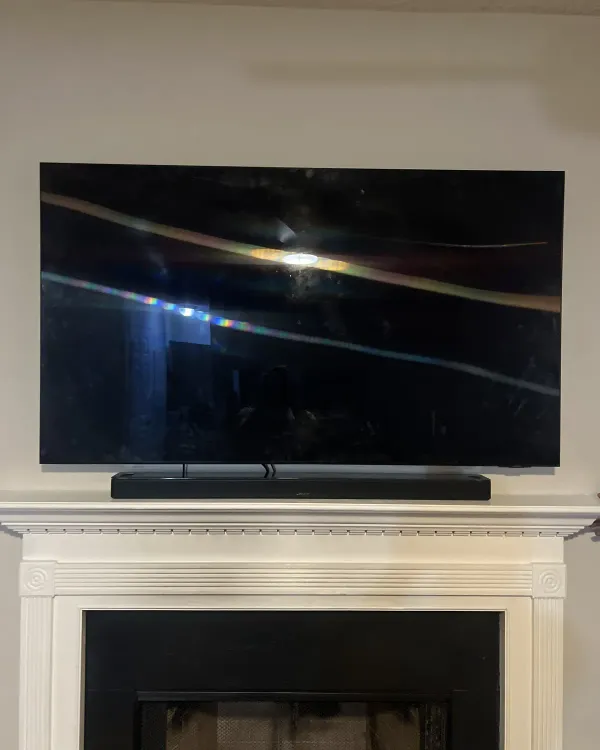
A TV with a soundbar beneath it mounted above a white mantel fireplace

Documented install, March 2025 By the Atlanta crew.

TV Mounting Cost Estimate

Step 1 of 520%
How big is the TV?
One TV.

Rather we call you?

Leave your number, and we call you about your TV, any day from 8:00 AM to 8:00 PM. Add a note on the wall or the TV if you like.

Contact Information

Helps us match you with the installer closest to you.

The Loop was built for work. The 'L' closed its circuit around 35 downtown blocks in 1897, and from 1900 to 1960 the number of people living inside it fell. That has reversed. About 6,500 residents in 1980 became more than 42,000 by 2020, housed in office buildings converted to apartments along LaSalle, Dearborn and Michigan Avenue and in the new towers of Lakeshore East. No two of those buildings promise the same wall, so nothing is assumed. Your Express Mounting installer brings a magnet, a hammer drill, 3/16-inch carbide bits and 1/4-inch Tapcons for brick and concrete, SnapToggles for metal stud and 5/16-inch lag bolts for wood, then lets a pilot hole pick. Chicago's conduit electrical code applies. Same-day service in the Loop when booked before noon.

What Express Mounting Customers Say

Google reviews of our Atlanta installs

These guys did an outstanding job installing 2 TVs for us. Highly recommend them for your TV mounting needs.

Angelina Pascar

Google review

AP
We called and requested a same day service and they were able to accommodate, even on a Friday. When our technician got here, he assessed our mounting ask in seconds and immediately got to work.

Kelly Bell

Google review

KB
Great service, thank you Alex

Aleksey Khusanov

Google review

AK

Look us up before you book

Express Mounting has one Google Business Profile, at our Alpharetta, GA headquarters. Customer reviews for every metro we serve live there.

Chicago installs are done by local installers we dispatch, on the same flat rates and the same warranty.

28 Google reviews, every one on that profile, from customers of the Atlanta crew.

Every booking comes with

  • 3-year workmanship warranty
  • Same-day installation when you book before noon
  • An installer typically arrives within 2-4 hours of confirmation

From 6,462 residents to more than 42,000: the Loop became a place people live

For most of its history the Loop emptied out at night. The census counted 24,074 residents in 1890 and only 4,337 in 1960. Then the direction changed. There were 6,462 people living here in 1980, 16,244 in 2000 and 42,298 in 2020, a rise of 158 percent in twenty years, and since 1950 no other Chicago community area has grown more in percentage terms. The homes those people moved into are not houses, flats or bungalows. They are apartments made out of office buildings and units in towers built since 2000. That matters for a TV because neither kind comes with a standard wall. An office building from 1905 and a glass tower from 2020 can both show smooth painted drywall, and behind it one wall has wood, another steel, another brick, another concrete. So every Loop visit starts the same way: a magnet across the wall, a knock, and one 1/8-inch pilot hole behind where the TV will hang. Wood shavings, bright metal, red dust or gray dust. The hardware comes out of the bag after that, never before.

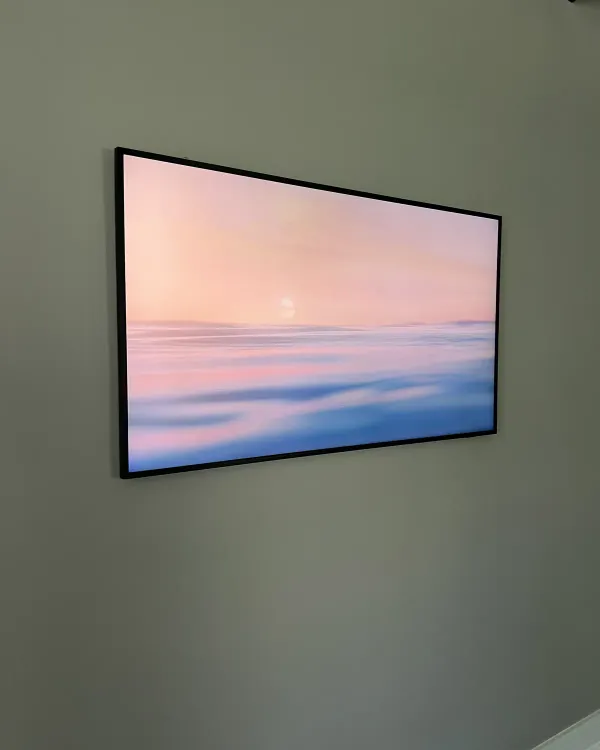
A TV in Art Mode showing a pastel sky on a gray wall

LaSalle Street's office-to-apartment conversions: walls in a building designed for desks

LaSalle Street is the Loop's financial corridor, and since 2022 a city program has been turning its emptied office floors into housing. The first building to open under that program is the Bellwether Residences at 79 West Monroe: the Rector Building of 1905, with 117 apartments on floors 7 through 14 and first tenants in late summer 2026. More conversions are under way. An apartment made from an office floor has walls of two generations. The partitions that divide the unit are new, put up during the conversion. Whether their studs are steel or wood is a thing the installer checks with a magnet and a pilot hole, not a thing anyone should guess. Bright metal on the bit means SnapToggles through a 1/2-inch hole, four for a fixed bracket and six for a full-motion arm. Wood shavings mean 5/16-inch lag bolts. Drywall alone, between studs, carries a small set only, up to about 32 inches and 30 pounds. None of that adds a surcharge. A partition install in a converted Loop apartment takes 50 to 75 minutes.

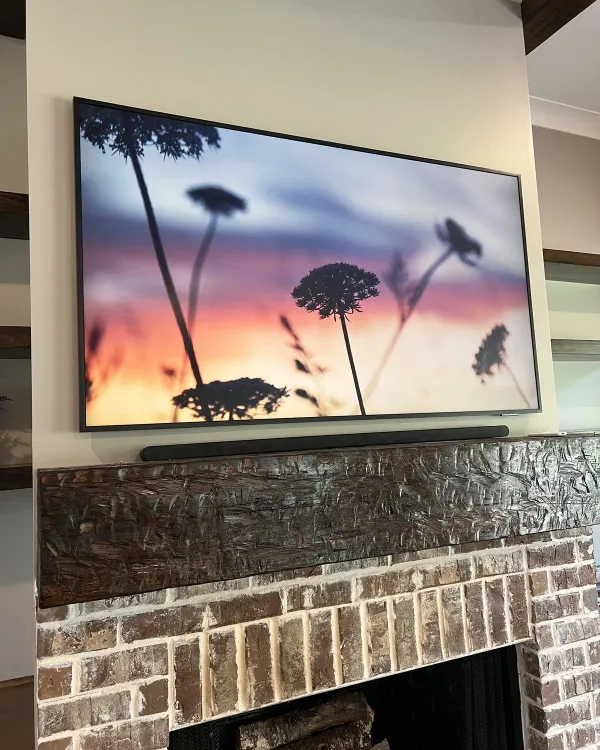
A Samsung Frame TV in Art Mode with a soundbar beneath it above a rustic brick fireplace with a dark wood mantel

The Fisher Building, the Straus Building and other old towers: what the outside walls and columns hide

Conversions are not new in the Loop. The Fisher Building at 343 South Dearborn, built in 1895-96 and a Chicago Landmark since 1978, has apartments on floors 3 through 20. The Straus Building of 1924, at 310 South Michigan Avenue in the Historic Michigan Boulevard District facing Grant Park, became the condominiums of Metropolitan Tower in 2007. In buildings like these the old structure is still there at the perimeter and at the columns, behind whatever finish the conversion put over it. We do not state what any one building is made of. The first hole says. If the bit passes drywall, crosses a gap and then meets something hard, the installer notes each depth, because an anchor only counts once its thread is in the solid material. Brick or concrete takes a 3/16-inch carbide bit on a hammer drill and a 1/4-inch Tapcon long enough to span the furring gap. In brick it goes in the face or the mortar joint, whichever lines up with the mount holes. Masonry carries the +$99 surcharge. If the hole shows something hollow or crumbly, the TV moves to a partition.

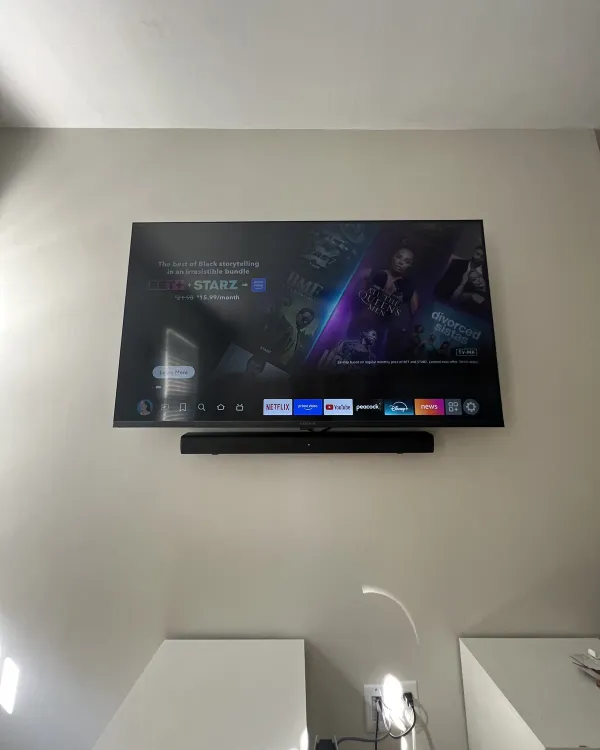
A TV with a soundbar below it on a white bedroom wall beside a closet

Lakeshore East and the New Eastside: towers and townhouses on the old railyards

East of Michigan Avenue and north of Randolph, the New Eastside stands on what was lakebed and then Illinois Central railyard. Lakeshore East is its newest part: a master plan from 2001, a six-acre park opened in 2005, and towers finished one after another, from The Lancaster and The Shoreham in 2005 through Aqua in 2009 to the St. Regis in 2020 and Cirrus and Cascade in 2021. The Benton Place Parkhomes added townhouses in 2009. These are the newest walls in the Loop, and they still get tested first: the pilot hole shows steel stud, wood or concrete. Where a unit has long runs of window, the screen ends up on a partition or a column face, and the anchor follows the material. Toggles in steel. Tapcons in concrete, with the +$99 masonry surcharge. Lag bolts in wood. In a townhouse, the wall shared with the neighbor gets a test hole of its own, since it may not match the walls inside the house. A screen past 65 inches spans two studs on four points.

Three street levels and one front desk: getting a TV to the door at a Loop address

The New Eastside runs on a triple-level street system. Trucks make deliveries on the lower levels, through traffic uses the middle, and a building can face more than one of them. So the front door and the delivery entrance are not always on the same level, and an installer carrying a boxed TV needs to know which one to use. Ask your building's management before you book, and pass along what they say: the level and street for deliveries, whether an outside installer must be registered ahead of time, which hours allow drilling, and whether a large box rides a service elevator that has to be reserved. The same four questions fit a converted building on LaSalle or Dearborn, where shops or a school may occupy the lower floors. We do not know your building's rules and will not guess them. None of it changes the flat rate. A panel of 95 inches or more comes with two technicians as part of its price, and the box is measured against the elevator before anyone lifts it.

Chicago wiring rules downtown: the outlet, the HDMI run and the raceway

The Loop is the center of the City of Chicago, and the Chicago Electrical Code requires wiring in metal conduit. NM cable, the flexible kind used in most of the country, is not allowed here. For a TV the meaning is simple. A new outlet behind the screen is an electrician's work, run in EMT, and it is not part of our visit. Our side is low-voltage: HDMI, optical, speaker and network cable. Concealment inside the wall is $99 per TV, and the wall decides how it is done. A stud partition has an open bay, so the cable drops by fish tape from a plate behind the panel to a plate near the console, kept away from any conduit the magnet finds. A brick or concrete wall has no bay at all. There a paintable raceway on the surface, $79, carries the cable down. Renters should ask the landlord before any plate is cut in, and a raceway is the option that leaves the least behind. If an outlet already sits behind the TV spot, the cord plugs in.

Brackets, height and setup: the last half hour of a Loop install

Once the wall is known, the rest of a Loop visit moves quickly. The bracket is matched to the TV's VESA pattern and weight, and it is its own line on the quote: yours, or one of ours at $49 or $69 for a flat bracket and $59 or $79 for full-motion, by screen size. A tilt suits a screen set above eye level. A full-motion arm earns its keep in an open plan where the kitchen and the sofa both want the picture. Height follows the seat: the screen's center near seated eye level in a living room, 42 to 50 inches off the floor in a bedroom watched from the bed. The outline is taped on the wall for you to judge before drilling. Level is checked with a laser before the bracket is fastened and again with the panel on. Then WiFi, inputs, picture mode and a soundbar over HDMI eARC. Samsung including the Frame, Sony, LG OLED, TCL and Hisense are routine. In a lake-effect winter, a cold panel warms up before it is powered on.

Your The Loop price, before you book

Pick the TV's size, the wall and the mount, and the estimator shows the labor price, from $129 per TV. Then book a time online, or call from 8:00 AM to 8:00 PM.

Field notes from The Loop installs

People have moved into the Loop faster than into any other part of Chicago, and they moved into buildings that were never meant to be homes. An office tower from 1896 on Dearborn. A 1905 building on Monroe whose upper floors became apartments in 2026. A 1924 tower on Michigan Avenue facing Grant Park. East of there, Lakeshore East put up new towers on old railyards between 2005 and 2021.

That mix is why the installer treats every Loop wall as unknown. Partitions added in a conversion are stud walls, steel or wood, and take toggles or lag bolts. Outside walls and columns in the older buildings can be brick or concrete behind the finish, and take a hammer drill and Tapcons.

Two things hold on every block. Chicago’s conduit code makes a new outlet an electrician’s work, so our concealment is low-voltage only. And every building here has a management office with its own rules on deliveries, hours and elevators, so that call comes before the booking.

TV mounting prices in The Loop

Screen size sets the price in the Loop, and the building does not: $129 up to 54”, $159 for 55-69”, $209 for 70-79”, $299 for 80-94”, $399 for 95” and up. Per TV, concealment inside the wall is $99. A paintable raceway on the surface is $79. Brick, stone or concrete adds the published +$99 masonry surcharge. Plaster, drywall and metal stud are priced at the plain rate. In practice a stud partition in a converted apartment or a Lakeshore East tower stays at the base rate, and the surcharge shows up when the anchors have to reach brick or concrete at an outside wall or a column. The bracket is separate: bring your own, or ours is $49 or $69 flat and $59 or $79 full-motion. Soundbar install $79. No travel fee anywhere in the Loop.

How Express Mounting covers The Loop

Alex Crabinsky started Express Mounting in Atlanta in 2015, and the 9,747+ documented installs since then are where the routine for a Loop job comes from. Loop jobs run through vetted Cook County installers who carry the same hardware, work off the same install checklist, and back every job with the same 3-year workmanship warranty, held by Express Mounting. The installer we dispatch already knows that a converted office building can hide three kinds of wall in one apartment, and tests each before drilling.
TV mounting and installation in The Loop, IL: common questions

What does Express Mounting charge to hang a TV in the Loop?

A flat rate by screen size: $129 up to 54 inches, $159 for 55-69, $209 for 70-79, $299 for 80-94 and $399 for 95 and up. Hiding cable inside the wall is $99 per TV. If the anchors go into brick or concrete, as they can on an outside wall or column of a converted office building, the +$99 masonry surcharge applies. Metal stud, drywall and plaster carry no surcharge. The bracket is separate, yours or ours.

Can an installer be at a Loop apartment the day I book?

Yes, when you book before noon, online or by phone at (470) 777-4077. An installer from our vetted Cook County network arrives within 2-4 hours of confirming a same-day request, anywhere from LaSalle Street to Lakeshore East. If your building wants notice before an outside installer comes up, settle that with management first.

My Loop apartment used to be an office. What is behind the walls?

It varies by building and by wall, so the installer tests before choosing hardware. Partitions put up in a conversion have steel or wood studs behind drywall. Outside walls and columns can have brick or concrete behind the finish. A magnet and one small pilot hole show which, and the anchors follow: SnapToggles for steel, lag bolts for wood, Tapcons for masonry.

Where does the installer unload at a Lakeshore East or New Eastside building?

Your building decides, so ask management which level and entrance deliveries use. The New Eastside has a triple-level street system, and the delivery entrance is not always on the level of the front door. Ask at the same time about registration, drilling hours and the service elevator.

I rent in the Loop. Which setup leaves the least to patch when I move out?

A fixed or tilt bracket on four fasteners leaves four small holes to fill. A full-motion arm uses six. A surface raceway keeps the cable tidy without cutting plates into the wall. Get your landlord's yes before booking, since each building sets its own terms.

Call (470) 777-4077 Text a photo

Text a photo of your wall

Point your phone's camera here to start a text to +14707774077. Add a photo of the wall and your TV's size, and we reply with your price and the first open time.

QR code that starts a text message to +14707774077
Use the quote form instead