Skip to content
Same-Day Service · Free Estimates Text a photo

TV mounting services in West Town, IL

West Town TV mounting is flat-rate: $129 up to 54", $159 for 55-69", $209 for 70-79", $299 for 80-94", $399 for 95-inch and up (2 technicians). Cable concealment is $99 per TV, brick or stone adds $99. Same-day slots when booked before noon, and the installer usually arrives within 2-4 hours of your confirmation.

“Very nice guys, did a great job installing 3 TVs for me for a very reasonable price.”
George Sholvok, Google review of an Atlanta install

Updated

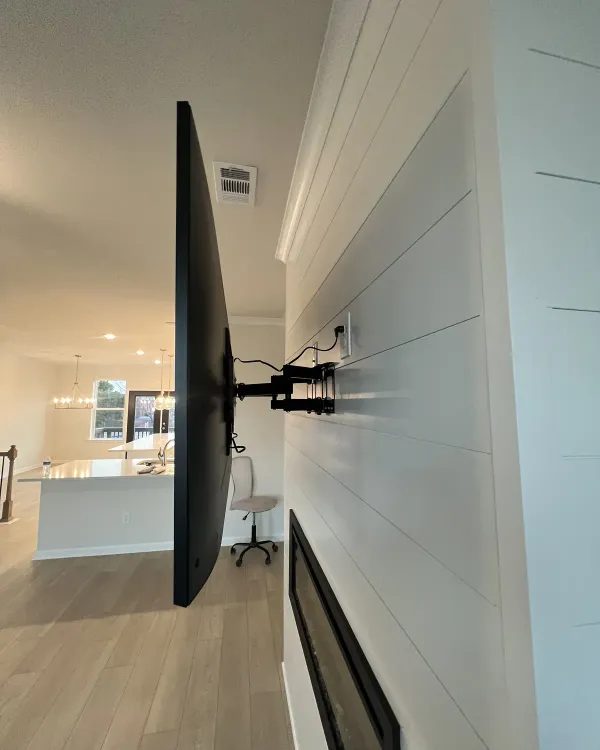
Side view of the same TV on its full-motion arm, showing the shiplap wall and an open kitchen behind

Documented install, March 2025 By the Atlanta crew.

TV Mounting Cost Estimate

Step 1 of 520%
How big is the TV?
One TV.

Rather we call you?

Leave your number, and we call you about your TV, any day from 8:00 AM to 8:00 PM. Add a note on the wall or the TV if you like.

Contact Information

Helps us match you with the installer closest to you.

West Town is the Chicago community area west of the river's North Branch, and outside Wicker Park it is Ukrainian Village, East Village, Noble Square, Pulaski Park and River West. The housing went up from the 1880s into the 1920s: brick workers cottages that William D. Kerfoot began in 1886, then blocks of brick two-flats and three-flats. Inside, that usually means plaster over common brick on the outside walls and plaster-and-lath over wood stud between rooms, and the installer tests which. Your Express Mounting installer brings a hammer drill, 3/16-inch carbide bits and 1/4-inch Tapcons for brick, 5/16-inch lag bolts for framing, SnapToggles for drywall, and a magnet to sort one from the other. Same-day West Town service when booked before noon.

What Express Mounting Customers Say

Google reviews of our Atlanta installs

They installed my TV on my deck in less than 30 minutes. Very professional and neat.

Alexandru Surugiu

Google review

AS
Very knowledgeable and sharp. They installed my TVs on the walls and configured my home network. Highly recommend!

George

Google review

G
Great service done by true experts. Fast and accurate, serviced next day. They also provided some nice heavy duty brackets. Highly recommend for any TV mounting needs. They also got me a very reasonable price.

Anastasia Ceclu

Google review

AC

Look us up before you book

Express Mounting has one Google Business Profile, at our Alpharetta, GA headquarters. Customer reviews for every metro we serve live there.

Chicago installs are done by local installers we dispatch, on the same flat rates and the same warranty.

28 Google reviews, every one on that profile, from customers of the Atlanta crew.

Every booking comes with

  • 3-year workmanship warranty
  • Same-day installation when you book before noon
  • An installer typically arrives within 2-4 hours of confirmation

Kerfoot's 1886 brick cottages near Haddon and Damen: two walls that look alike

The oldest part of Ukrainian Village sits around Haddon, Thomas and Cortez between Damen and Leavitt, and its story starts in 1886. That year William D. Kerfoot, the first real estate developer to reopen after the 1871 fire, began brick workers cottages near Haddon and Damen. The city's landmark listing credits him with nearly one in three buildings in the district. A brick cottage of that age has two kinds of wall, and under paint they look identical. The outside walls are usually common brick with plaster over them, often on thin furring strips. The walls between rooms are usually plaster-and-lath on wood studs. The installer slides a rare-earth magnet across the wall looking for rows of lath nails, then drills one 1/8-inch pilot hole behind where the TV will hang. Wood shavings mean a stud and 5/16-inch lag bolts. Masonry dust means brick: a 3/16-inch carbide bit on the hammer drill, and 1/4-inch Tapcons long enough to pass the furring. Brick is masonry at +$99. A stud wall behind plaster stays at the base rate.

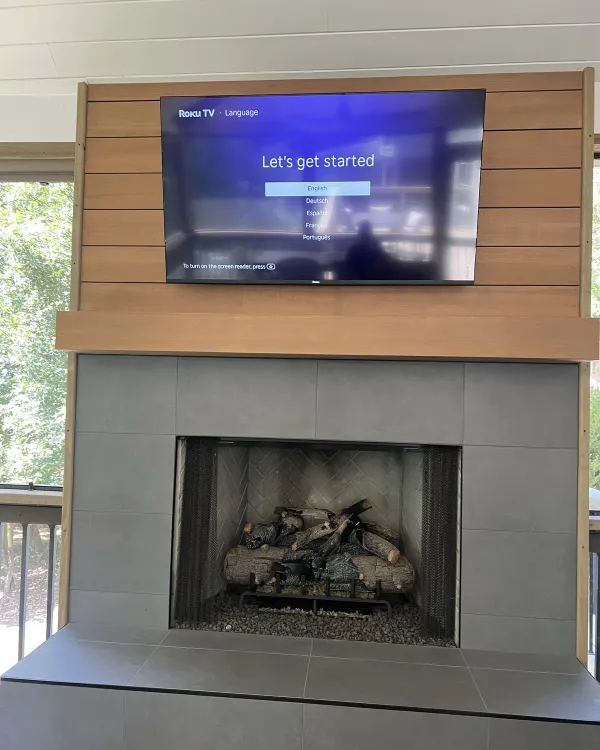
A Roku TV on a horizontal wood-plank chimney breast above a gray tile fireplace on a covered porch

East Village between Chicago Avenue and Division: one block, three kinds of TV wall

East Village runs from Ashland to Damen between Chicago Avenue and Division Street, and in 2006 the city made four sections of it a Chicago Landmark district: stretches of Winchester, Wolcott, Honore and Hermitage. The city calls the housing small-scale and simply detailed, cottages and small flat buildings put up from about 1883 into the 1920s, mostly in brick. Frame cottages and greystone three-flats stand among them. So one East Village block can hold three different TV walls. In a brick two-flat the side walls, whether they face a gangway or meet the building next door, are expected to be solid masonry. A fastener that stops in plaster or furring holds a picture, not a television, so the installer measures with the first hole: where the bit leaves plaster, where it meets brick. That depth sets the Tapcon length. In a frame cottage the same test finds studs, rarely on even 16-inch centers in a house this old, and each one is located on its own. A greystone front room gets the same first hole.

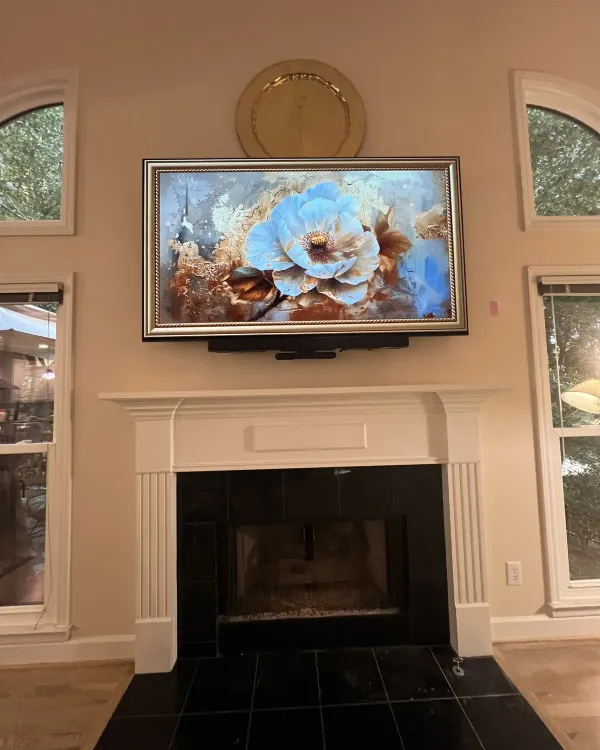
A Samsung Frame TV with an ornate bezel showing a floral artwork, a soundbar beneath it, above a white mantel with a black tile surround

Walton Street to Western Avenue: brick flats from 1910 to 1917 and the third-floor carry

West of Leavitt the cottages give way to flat buildings. Walton Street between Damen and Western filled in from 1890 to 1905. The blocks toward Western Avenue along Cortez, Augusta, Iowa and Rice were subdivided from 1905 and built up between 1910 and 1917, almost entirely as two-story and three-story brick flats. For a TV that raises two practical matters. The first is the carry. A third-floor flat means two full flights, often with a turn at each landing, so the installer measures the box against the stair before lifting, and a screen of 95 inches or more arrives with two technicians as part of its price. The second is whose wall it is. An owner who lives on one floor can book every flat in one visit, each TV priced by its own screen size. A tenant should have the owner's yes first, and can ask for a fixed bracket that leaves four small holes to fill at move-out. Then the wall itself: brick expected at the perimeter, plaster-and-lath between rooms, both confirmed by a test hole.

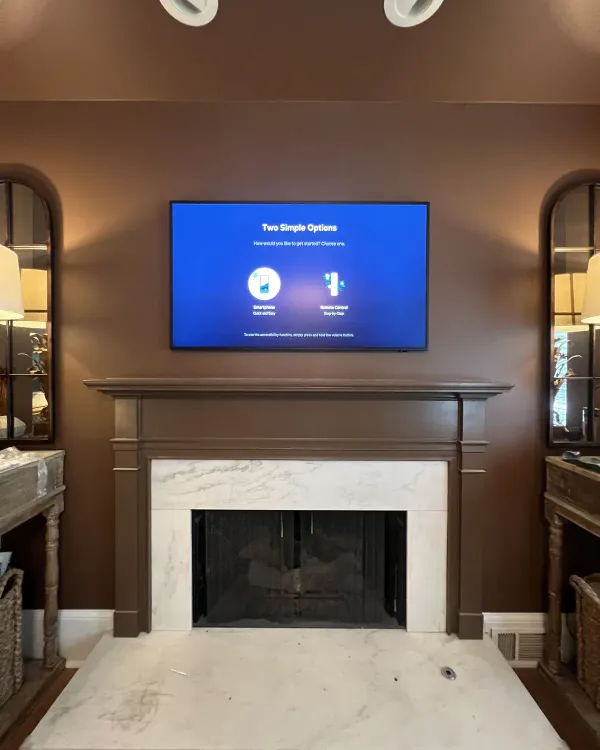
A TV mounted on a brown wall above a dark wood mantel and white marble fireplace, mirrored niches on each side

Two landmark districts in West Town: what we will not guess, and who to ask at the city

West Town has two Chicago Landmark districts outside Wicker Park. The Ukrainian Village District was designated on December 4, 2002 and extended in 2005 and 2007, and the city describes it as roughly bounded by Haddon, Damen, Rice and Western. The East Village District followed on January 11, 2006, and East Village's blocks between Division, Chicago, Hermitage and Damen went on the National Register of Historic Places in 2009. What does any of that mean for a television on an inside wall? We will not guess, and we do not quote landmark rules for your address. The city's landmarks staff can say what a designation covers for your building, and one call before booking settles it. A condo association or a building owner may have a say of their own, so ask there too. What the installer controls is the care an old interior gets. Plaster is drilled at low speed through painter's tape so the finish coat does not chip. Original trim, picture rail and door casings are never used as a fastening point.

River West loft buildings: nothing assumed until the pilot hole

River West is the strip of West Town between the Kennedy Expressway and the North Branch of the river, from Division Street down to Grand Avenue. It has several large loft buildings, most of them turned into housing in the mid-1980s, and it is where the cottage-and-flat pattern of West Town stops. We do not assume what a loft wall is made of, because no two conversions were done alike. The installer tests first. A magnet pass finds steel. A knock separates a hollow partition from a solid wall. One small pilot hole behind the TV position shows wood, steel or concrete on the bit. Each answer has its own hardware: 5/16-inch lag bolts for wood, SnapToggles through a 1/2-inch hole for metal stud, 1/4-inch Tapcons for brick or concrete. Exposed brick has no cavity, so cables ride a paintable surface raceway. Brick and concrete are masonry at +$99. Loft buildings also tend to have a front desk or a manager, so ask about drilling hours and the freight or service elevator before you pick a time.

EMT for power, a plate or a raceway for cable: behind a West Town screen

All of West Town is inside the City of Chicago, and the Chicago Electrical Code requires wiring in metal conduit. The flexible NM cable common elsewhere is not allowed in the city. A new outlet behind the screen is an electrician's job, run in EMT, and it is not part of a mounting visit. Ours is the low-voltage side: HDMI, optical, speaker and network cable. In-wall concealment is $99 per TV, and the route depends on the wall the test hole found. A plaster-and-lath wall on wood studs has an open bay, so cable drops from a plate behind the TV to a plate near the baseboard, with both openings cut slowly by oscillating tool to keep the plaster from cracking past the plate. The magnet is run down the bay first to find any conduit. A brick outside wall offers only the thin gap between furring strips. There the tidy answer is a paintable raceway on the surface for $79, or moving the cable run to the dividing wall beside it.

Noble Square to Pulaski Park: the kit, the bracket, the height and the setup

From Noble Square and the blocks around Eckhart Park to Pulaski Park and the Polish Triangle at Division, Milwaukee and Ashland, a West Town visit runs the same way. The installer we dispatch arrives with the full kit: hammer drill, carbide bits, Tapcons in three lengths, lag bolts, SnapToggles, a rare-earth magnet, a laser level and a vacuum. The bracket is matched to the TV's VESA pattern and weight, and it is its own line on the quote: yours, or one of ours at $49 or $69 flat and $59 or $79 full-motion, by screen size. Height follows the seat. In a living room the screen's center lands near seated eye level, and in a bedroom it goes 42 to 50 inches off the floor. After the hang comes setup: WiFi, inputs, picture mode, a soundbar over HDMI eARC, with soundbar mounting at $79. Samsung including the Frame, Sony, LG OLED, TCL and Hisense are routine. In a Chicago winter a panel that rode in a cold truck warms to room temperature before it is switched on.

Your West Town price, before you book

Pick the TV's size, the wall and the mount, and the estimator shows the labor price, from $129 per TV. Then book a time online, or call from 8:00 AM to 8:00 PM.

Field notes from West Town installs

Take Wicker Park out of West Town and what is left is still most of the community area: Ukrainian Village, East Village, Noble Square, Pulaski Park and River West. Nearly all of it is brick put up between the 1880s and the 1920s. Workers cottages came first, William D. Kerfoot’s from 1886 among them, and two-flats and three-flats followed after the ‘L’ was built along Paulina Street in 1895.

For an installer that history means plaster everywhere and a question behind it. Outside and party walls are usually common brick, sometimes with furring strips between brick and plaster, and they take Tapcons from a hammer drill. Dividing walls are usually plaster-and-lath over wood stud and take lag bolts. A magnet and a pilot hole tell them apart.

Three things hold across the neighborhood. Mortar that has seen a century of freeze-thaw is checked before an anchor goes in. Chicago’s conduit code makes a new outlet an electrician’s job. And two landmark districts mean a question for the city, not for us.

TV mounting prices in West Town

West Town pricing is one number per screen size: $129 up to 54”, $159 for 55-69”, $209 for 70-79”, $299 for 80-94”, $399 for 95” and up. Concealing the cables in the wall is $99 a TV. A paintable raceway on the surface is $79. Brick, stone or concrete carries the published +$99 masonry surcharge. On plaster, drywall or metal stud the labor price stands as it is. In West Town that line can fall inside a single room: the brick outside wall of a cottage or a three-flat is masonry, and the plaster dividing wall six feet away, lagged into wood studs, is the base rate. The bracket is separate, $49 or $69 flat and $59 or $79 full-motion if you want one of ours. Soundbar install is $79, and there is no travel fee anywhere in West Town.

How Express Mounting covers West Town

Alex Crabinsky founded Express Mounting in Atlanta in 2015, and 9,747+ documented installs since then are what the West Town checklist is built on. West Town jobs run through vetted Cook County installers who carry the same hardware, work off the same install checklist, and back every job with the same 3-year workmanship warranty, held by Express Mounting. The installer we dispatch already expects brick behind the plaster of an East Village party wall and studs behind the wall next to it, and tests both before choosing an anchor.
TV mounting and installation in West Town, IL: common questions

How much will I pay to have a TV mounted in West Town?

A flat rate by screen size: $129 up to 54 inches, $159 for 55-69, $209 for 70-79, $299 for 80-94 and $399 for 95 and up. Hiding cables inside the wall is $99 per TV. When the anchors go into brick, as on the outside or party wall of a Ukrainian Village cottage or an East Village flat building, the +$99 masonry surcharge applies. Plaster over wood studs, drywall and metal stud carry no surcharge. The bracket is a separate line, yours or ours.

If I call before noon, can an installer be in West Town today?

Yes. Book before noon, by phone at (470) 777-4077 or online, and an installer from our vetted Cook County network arrives within 2-4 hours of confirming a same-day request. That holds from Ukrainian Village and East Village to Noble Square and River West.

My Ukrainian Village cottage dates from the 1880s. What will the installer find behind the plaster?

Usually two different walls. In a brick cottage of that age the outside walls are typically common brick under plaster, and the walls between rooms are typically plaster-and-lath on wood studs. The installer confirms with a magnet and one small pilot hole. Brick takes 1/4-inch Tapcons and the +$99 masonry surcharge. Studs take 5/16-inch lag bolts at the base rate.

I own a three-flat in the East Village District. Is there anyone at the city I should call about an indoor TV mount?

The city's landmarks staff. The East Village District has been a Chicago Landmark district since 2006, and we do not state what the designation requires for any one building. Ask the city what it covers at your address. Separately, Chicago requires wiring in metal conduit, so a new outlet behind the TV is an electrician's work.

What should I expect from a TV install in a River West loft building?

A test before anything else. River West's large loft buildings were mostly converted to housing in the mid-1980s, and we do not assume what any wall is made of. One pilot hole shows wood, steel or concrete, and the hardware follows: lag bolts, SnapToggles or Tapcons. Brick and concrete add the +$99 masonry surcharge.

Call (470) 777-4077 Text a photo

Text a photo of your wall

Point your phone's camera here to start a text to +14707774077. Add a photo of the wall and your TV's size, and we reply with your price and the first open time.

QR code that starts a text message to +14707774077
Use the quote form instead