Skip to content
Same-Day Service · Free Estimates Book Online

TV mounting services in Mountain's Edge, NV

Mountain's Edge is a master-planned community on the southwest rim of the Las Vegas valley, built from the mid 2000s outward toward the Blue Diamond edge and Exploration Peak. The stock is consistent: stucco over wood frame, 1/2-inch drywall inside, tile roof, no basement, framing at 16-inch centers that a stud finder can read. What changes is the room. Two-story plans along the Buffalo Drive corridor, attached townhomes near Nathaniel Jones Park, newer single-story product toward Mountain's Edge Regional Park. Your Express Mounting installer brings 5/16-inch lag bolts for framing, SnapToggle anchors for the metal-stud walls in attached product, masonry bits for cultured stone, and Seismic Design Category D anchoring. Same-day when booked before noon.

TV mounting services in Mountain's Edge, NV

Mountain's Edge TV mounting is flat-rate: $129 up to 54", $159 for 55-69", $209 for 70-79", $255 for 80-inch and up. Cable concealment is $95 per TV, brick or stone adds $99. Same-day slots when booked before noon.

TV Mounting Cost Estimate

Step 1 of 617%
How many TVs?

Contact Our TV Installers

Ready to schedule your professional TV installation? Contact us for a free quote or book your appointment online. Same-day service available across 13 US metros.

Contact Information

Reading a Mountain's Edge tract wall before the first hole goes in

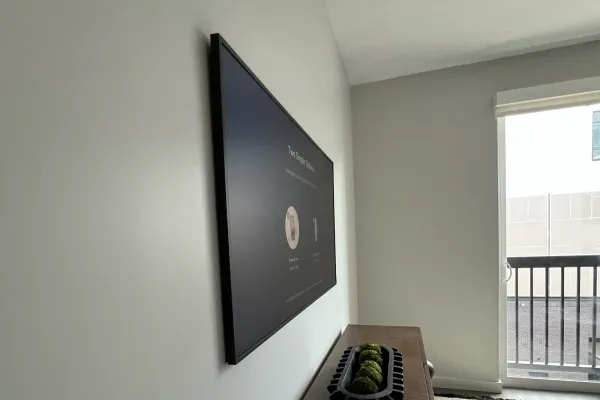
The good part about a community built mostly after 2004 is that the walls are predictable. In Mountain's Edge that means 1/2-inch drywall over wood frame at 16-inch centers, straight studs, and an outlet already sitting in the bay behind the main living-room wall on a lot of plans. Predictable is not the same as guaranteed. We sweep with an electronic stud finder, mark both edges to find the center rather than the first beep, then drill a 1/8-inch pilot and read the shavings. Wood dust means go. Anything gritty means we have found a stucco return, a chase, or blocking, and we move. Then the 5/16-inch by 3-inch lag bolts go in, two into one stud for a 55-inch panel and four across two studs for anything past 65. A 3-inch lag buys about 2 inches of thread in framing, which is what actually carries the TV. Living-room installs in Mountain's Edge run 50 to 70 minutes, including the low-voltage cut and the level check from three feet back.

Reading a Mountain's Edge tract wall before the first hole goes in

Townhomes near Nathaniel Jones Park and the wall you share

Attached product around Nathaniel Jones Park and the newer townhome clusters changes the conversation. Interior partitions are usually the same wood stud as a single-family plan, but the wall you share with a neighbor is built differently: doubled framing, sometimes light-gauge metal stud, often a resilient channel behind the board to keep sound down. Drill blind into that and you can lose the sound rating and hit hardware you cannot see. So we test-hole first. Where the wall reads as metal, we switch to heavy-gauge SnapToggle anchors rated well past 200 lbs apiece, four to a bracket, and skip lag bolts entirely because a lag strips light steel in seconds. Where it reads wood, standard lags go in with shorter thread so nothing pushes through. We also keep the drill off the shared wall before 8 a.m. out of plain courtesy, and mount on an interior wall instead whenever the layout gives us the option. Townhome installs run 60 to 85 minutes, and a certificate of insurance goes to the management office beforehand if yours asks for one.

Townhomes near Nathaniel Jones Park and the wall you share

Two-story family rooms along the Buffalo Drive corridor

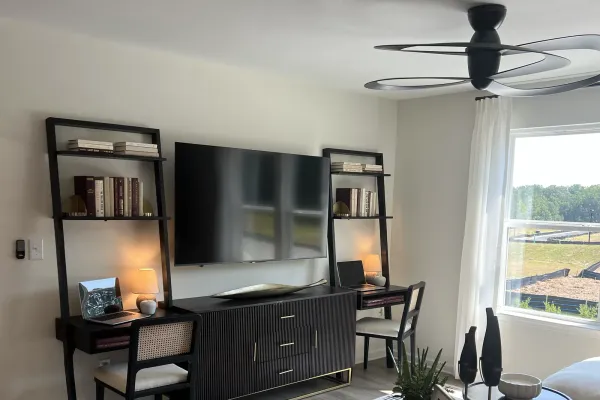
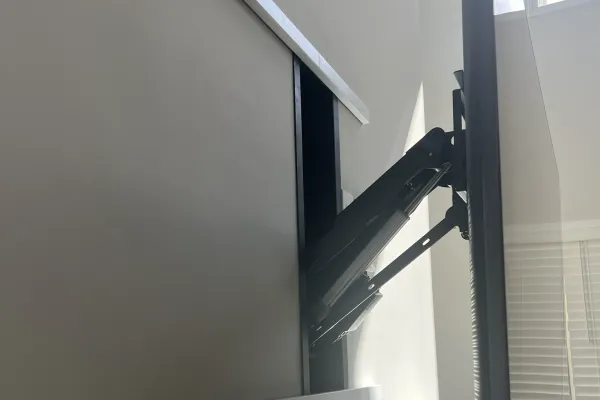
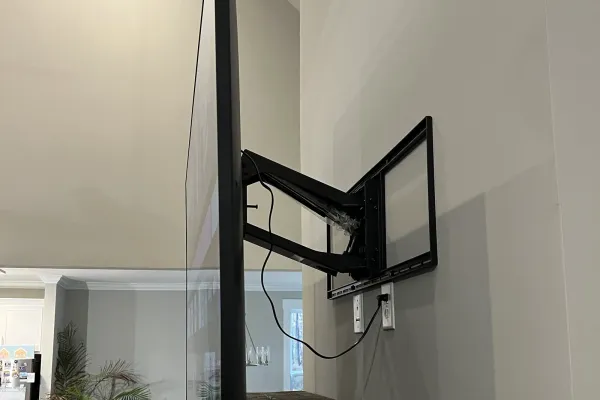
The Buffalo Drive corridor plans favor a two-story family room, and that tall wall pulls people toward mounting the TV up where nobody wants to look at it. A 65-inch panel is comfortable with its center between 42 and 48 inches off the floor. Put the same panel above a raised hearth at 66 inches and you will feel it in your neck by the end of a movie. Where the fireplace forces the issue, we price a pull-down bracket that drops the screen roughly 18 inches and tilts it forward for viewing. Framing behind the drywall is unchanged, but the tall stud bays are the ones carrying fire blocking near the second-floor line, so a fish tape drop can stop at nine feet with no warning. We plan the cable path before the bracket goes up, not after. Full-motion arms on these walls get their pivots locked so nothing can swing loose. Allow 70 to 95 minutes once a 12-foot ladder is part of the job, and count on two people for a panel over 70 inches at that height.

Two-story family rooms along the Buffalo Drive corridor

Cultured stone fireplace surrounds in Mountain's Edge great rooms

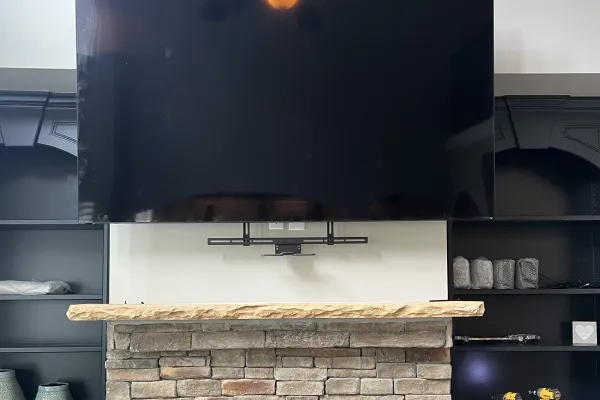
Plenty of Mountain's Edge plans wrap the gas insert in cultured stone, and the fireplace wall is usually the only wall the furniture points at. We take a heat reading before anything else: the insert burns for 20 minutes and a probe goes where the top of the bracket will sit. Gas inserts behind stone commonly settle between 85 and 100 degrees above the mantel, which most panels handle. Read higher and the mount goes up or a pull-down arm goes in. The veneer is 1 to 2 inches thick over lath and scratch coat and holds nothing on its own, so the anchors have to reach wood. A 1/4-inch masonry bit opens a mortar joint, then 5-inch lag bolts thread into the stud behind. Four points per bracket on a 75-inch set. A Tapcon into solid stone covers any corner where the joint misses framing. Stone dulls a bit quickly, so we clear the flutes often and change bits rather than lean harder on a tired one. Stone carries the +$99 masonry surcharge. Figure 95 to 120 minutes.

Cultured stone fireplace surrounds in Mountain's Edge great rooms

Dust, UV and a covered patio out toward Exploration Peak

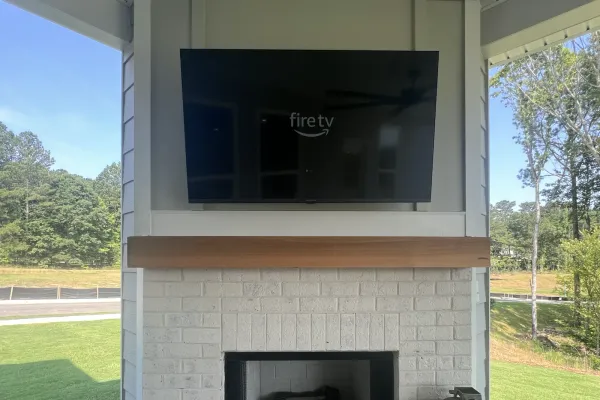
The west side of Mountain's Edge sits against open desert, and the wind that comes off it toward Exploration Peak Park carries fine grit that gets into everything. That changes how a patio TV gets built here. Sealed, heat-rated enclosures go in with their vents facing down so dust is not falling into the fan intake, and we spec a gasketed door rather than an open frame. In full patio shade a standard panel under a UV-rated cover holds up fine; panels are rated to roughly 104 degrees and shade keeps them under it. Direct afternoon sun on the wall means an outdoor-rated set instead. The bracket passes through stucco into framing on 5/16-inch lags, and every penetration gets sealed before we leave, because monsoon rain out here comes in sideways behind wind. Exterior cable stays UV-jacketed and short. Anything the street can see falls under the CC&Rs, so we keep the run tight to the wall and low. Grit also gets into a full-motion arm, which is one more reason a fixed or tilt bracket is the better outdoor choice here. Patio work: 75 to 105 minutes.

Dust, UV and a covered patio out toward Exploration Peak

Concealing cable in a house with no basement to run through

There is no basement anywhere in Mountain's Edge, and that shapes every cable job. Wiring goes in the wall cavity or it goes in a raceway; there is no crawl space underneath to hide a run. The good news is that the standard drop is easy. Cut a low-voltage bracket behind the TV, cut a second one behind the console, run in-wall rated HDMI and power between them, and the wall reads clean in about 25 minutes of the visit. What we avoid is the attic. Under a tile roof in a Mountain's Edge summer an attic gets brutally hot, and cable pulled through it ages faster than cable in a conditioned wall bay, so we route inside the bay whenever geometry allows. Where a fire block or a chase stops the drop, a paint-matched raceway is the honest answer and takes a fraction of the time. Power never rides in the same cavity as an unrated extension cord; if the outlet is in the wrong bay, a licensed electrician moves it and we work around the schedule. Concealment is $95 per TV either way.

Concealing cable in a house with no basement to run through

Category D hardware, HOA limits and what the visit itself covers

Clark County is Seismic Design Category D, so nothing hangs off drywall in Mountain's Edge. Lag bolts thread into framing, panels past 65 inches get four points across two studs, safety screws seat in the bracket, and any full-motion arm leaves locked. HOA design review here governs the exterior, whatever a neighbor can see from the street, so an interior bracket needs no filing; a patio screen, an enclosure or conduit down the stucco does. The visit covers a wall read (wood stud, metal stud in attached product, cultured stone), a mount matched to your TV's VESA pattern and weight, anchoring, cable management, and a test of every input and remote before we go. On the truck: brackets for 32 to 85-inch panels, both kinds of stud finder, carbide and masonry bits, a rotary hammer, laser levels, torque-limited drivers. Same-day for single-TV bookings before noon, multi-room work inside 48 hours. We leave written notes on the TV model, the bracket, and exactly which studs the anchors landed in, which matters the next time somebody wants to move that panel or paint behind it.

Category D hardware, HOA limits and what the visit itself covers

Field notes from Mountain’s Edge installs

Mountain’s Edge is a master-planned community on the southwest edge of the Las Vegas valley, built out from the mid 2000s toward the Blue Diamond edge. For an installer it is one of the easier reads around: stucco over wood frame, drywall inside, tile roof, no basement, framing on 16-inch centers that behaves.

The variety is in product type rather than era. Two-story plans along the Buffalo Drive corridor. Attached townhomes near Nathaniel Jones Park with shared walls built for sound. Newer single-story homes toward Mountain’s Edge Regional Park. Cultured stone around the gas insert in the bigger great rooms.

Hardware follows the wall: 5/16-inch lag bolts into wood stud, heavy-gauge SnapToggles where a shared wall turns out to be metal stud, 5-inch lags through stone veneer into framing on fireplace jobs. Every anchor pattern follows Seismic Design Category D. Outside, dust off the open desert and a tile roof that bakes the attic decide how patio and garage screens get run.

TV mounting prices in Mountain’s Edge

The numbers do not move by neighborhood: $129 up to 54”, $159 for 55-69”, $209 for 70-79”, $255 for 80”+. Cable concealment $95/TV. Cultured stone fireplace walls add the published +$99 masonry surcharge; drywall over wood stud, metal stud in the townhomes and plaster carry NO surcharge. Full-motion arm +$72. Soundbar $79. No travel fee. Most Mountain’s Edge walls are drywall over framing, so the surcharge only appears on stone.

Helpful guides before your Mountain’s Edge install

How Express Mounting covers Mountain’s Edge

Express Mounting has been Alex Crabinsky’s company since 2015. 7,874 documented installs later, the process behind a Mountain’s Edge job is dialed in. Mountain’s Edge jobs run through vetted Clark County installers who carry the same hardware, work off the same checklist, and back every job with the same 100% satisfaction guarantee. The one we dispatch knows a shared townhome wall from a tract living-room wall.
TV mounting in Mountain's Edge, NV: common questions

Is TV mounting in Mountain's Edge priced by the hour?
No, it is flat rate. $129 up to 54 inches, $159 for 55 to 69, $209 for 70 to 79, $255 for 80 and up, quoted before the installer leaves the truck. Cable concealment is $95 per TV, cultured stone adds the +$99 masonry surcharge, and a job that runs long does not cost you more.
Can I get a TV mounted in Mountain's Edge today?
Usually, if you book before noon. Call (470) 777-4077 or book online. An installer from our vetted Clark County network is typically at your door within 2 to 4 hours of a confirmed request. Later bookings land the following morning; multi-TV jobs go inside 48 hours.
I am in a townhome. Can you mount on the wall I share with my neighbor?
Usually, but it gets a test hole first. Shared walls in Mountain's Edge attached product are built for sound: doubled framing, light-gauge metal stud, or board on resilient channel. Metal means heavy-gauge toggles rather than lag bolts. If an interior wall suits the layout, we would rather use that one.
Do I need HOA approval before mounting a TV in Mountain's Edge?
Not for anything inside the house. Design review and the CC&Rs here cover exteriors and street visibility. Put a screen on the covered patio, mount an enclosure, or run conduit down the stucco and those rules apply, so we keep exterior hardware tight to the wall.
Who actually shows up for a Mountain's Edge job, and who is accountable?
A background-checked installer from our vetted Clark County network, not a day-labor sub. Express Mounting is Atlanta-founded and covers this valley through dispatched installers running the same checklist and hardware spec. A certificate of insurance is available on request, your rate is locked at booking, and the guarantee is held by Express Mounting.

What Express Mounting Customers Say

Verified five-star reviews from real Express Mounting customers

They installed my TV on my deck in less than 30 minutes. Very professional and neat.

Alexandru Surugiu

Verified Express Mounting customer

AS
Very knowledgeable and sharp. They installed my TVs on the walls and configured my home network. Highly recommend!

George

Verified Express Mounting customer

G
Great service done by true experts. Fast and accurate, serviced next day. They also provided some nice heavy duty brackets. Highly recommend for any TV mounting needs. They also got me a very reasonable price.

Anastasia Ceclu

Verified Express Mounting customer

AC

Schedule Your TV Installation in Mountain's Edge

Schedule your TV installation in Mountain's Edge today. Your installer arrives ready for the drywall-over-stud tract walls off Buffalo Drive and the shared walls in the townhomes near Nathaniel Jones Park. Upfront pricing, same-day availability.

Call (470) 777-4077 Book Online