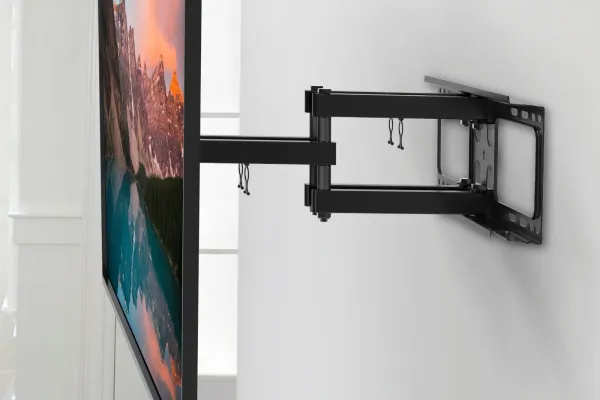
If your lease allows a few small holes, a low-profile fixed mount lag-bolted into two studs is the best apartment mount; the four holes patch with spackle at move-out. If it doesn’t, use a weighted floor stand. In steel-stud high-rises, anchor the bracket with 1/4 inch SnapToggles through the studs. Never use plastic anchors or adhesive mounts.
Quick note: This page contains Amazon affiliate links. We may earn a small commission at no extra cost to you if you buy through them.
Picking a mount for an apartment is a slightly different problem from picking one for a house. You’re solving for two things a homeowner doesn’t worry about: leaving only damage you can repair, and working with whatever wall the building gave you, which in a tower is often steel studs. Below are the mount types that suit renters, specific picks for each, and what to skip. For the install itself, pair this with our apartment mounting guide.
Best mount types for apartments
Before the table decides the style, one check decides whether any of them physically fit. The four threaded holes on the back of your TV follow the VESA Flat Display Mounting Interface standard, and the spacing changes by model and by screen size within the same product line, so a 55 inch and a 65 inch from the same range often take different patterns. Match the pattern first, confirm the bracket is rated above your panel weight second, and only then pick on movement. Our mount finder looks up the pattern and weight by brand, size and model if you’d rather not read it off the back of the set.
| Mount type | Best for | Wall damage | Renter verdict |
|---|---|---|---|
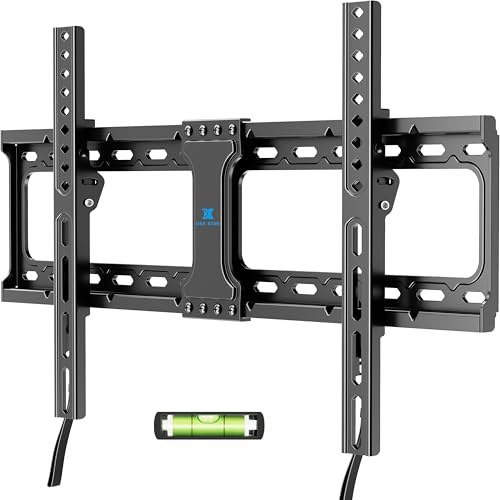
| Low-profile fixed | Small apartments, eye-level seating | 4 small stud holes | Best if you can drill |
| Compact full-motion | Studios, off-center walls, corners | 4 small stud holes | Most flexible |
| Floor-standing stand | No-drill leases | None | Best no-damage option |
| Tension pole | Mid-size TVs, standard ceilings | None | Decent no-drill option |
| Adhesive / suction | Nothing: avoid | None, until it fails | Do not use |
The first two assume you can put four lag bolts into the studs, which most leases allow. The middle two are for leases that forbid drilling. The last row is the trap.
Best mounts if you can drill
If your lease allows small holes, mounting into the studs leaves the least repairable damage and holds any size of TV.
- Low-profile fixed mount: the cleanest look in a smaller apartment, sitting close to the wall. The UL-listed fixed mount for 37-86 inch TVs spans studs 16, 18 or 24 inches apart, so it lines up with most apartment framing.
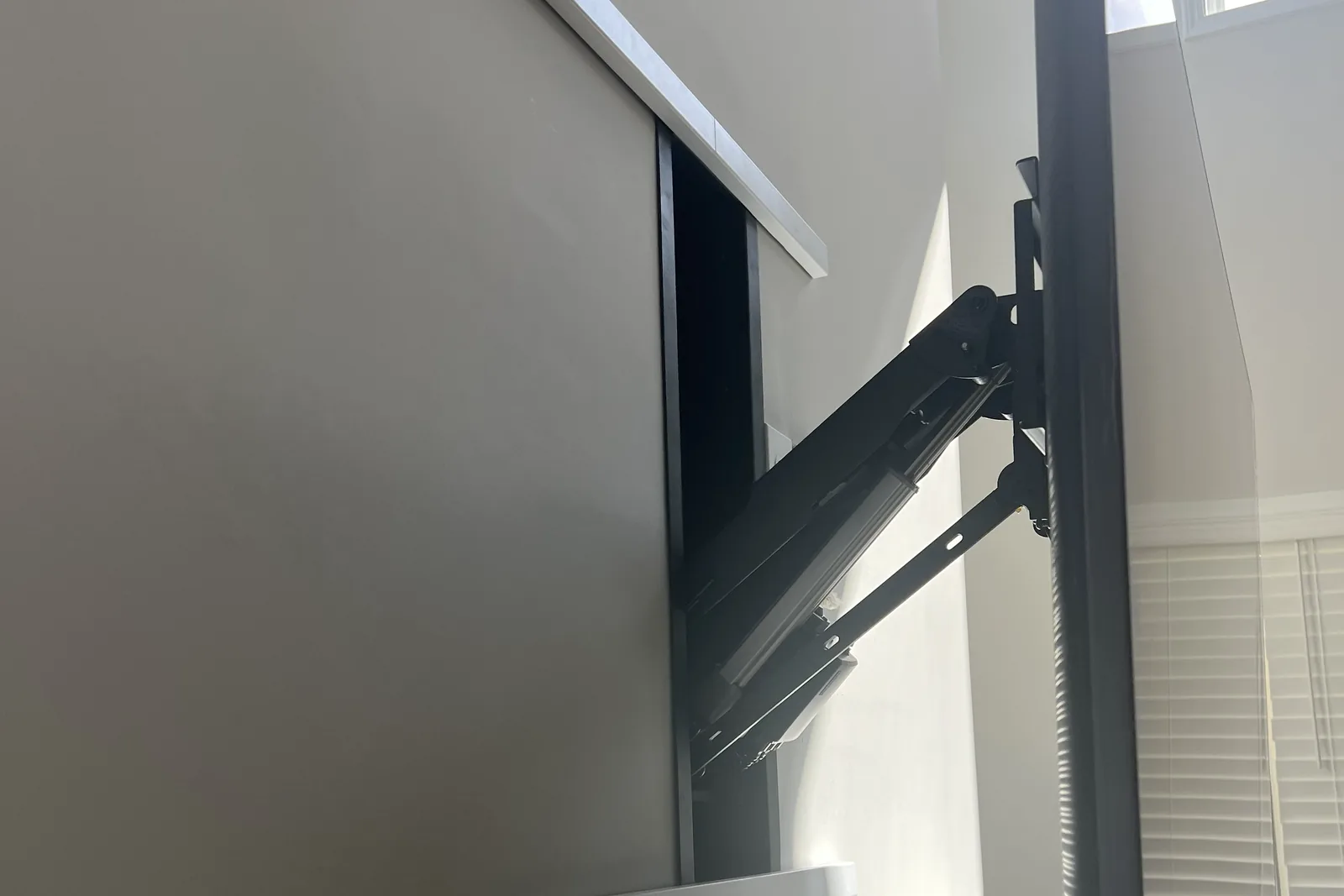
- Compact full-motion mount: better for a studio or an open layout where you watch from the bed and the couch. The USX Mount full-motion arm for 32-70 inch TVs angles the screen and pulls it off the wall, and it’s easier to hang solo because you can seat one side of the bracket at a time. The type-by-type breakdown is in our best TV wall mount guide.
Either way, put lag bolts into the studs, not drywall anchors. Drywall alone only holds a TV up to about 32 inches and 30 pounds, and only on rated toggles; our do you need studs guide explains why. The four small holes patch with spackle at move-out.
Best no-drill options
If drilling is genuinely off the table, you have two real choices:
- Floor-standing TV stand: a weighted base and pole that holds the TV at mount height with zero wall contact. The WALI floor stand takes 32-75 inch TVs up to 110 lb, and the FITUEYES stand covers 50-85 inch sets. It moves with you and damages nothing.
- Tension-pole mount: holds the TV between floor and ceiling with spring tension; it suits mid-size TVs in rooms with a solid ceiling at a standard height.
Our no-drill mounting guide covers which no-drill systems are actually load-rated and which are marketing, and our best floor stands for renters goes deeper on stands alone.
Best mounts for metal-stud high-rises
Most high-rise apartment towers have metal-stud interior walls. Metal studs don’t take lag bolts, so the mount is only as good as the anchor. Pair any quality bracket with 1/4 inch SnapToggles through the steel: four carry a TV up to about 100 lb, six up to about 150 lb. A toggle that misses the stud is only a drywall anchor. The full technique is in our metal stud mounting guide.
Matching the mount to your apartment layout
The right pick also depends on how your apartment is laid out:
- Studio or open plan: you watch from the bed, the desk and the couch, so a compact full-motion mount earns its keep. Swiveling the screen toward whatever you’re doing matters far more in 450 square feet than in a dedicated living room.
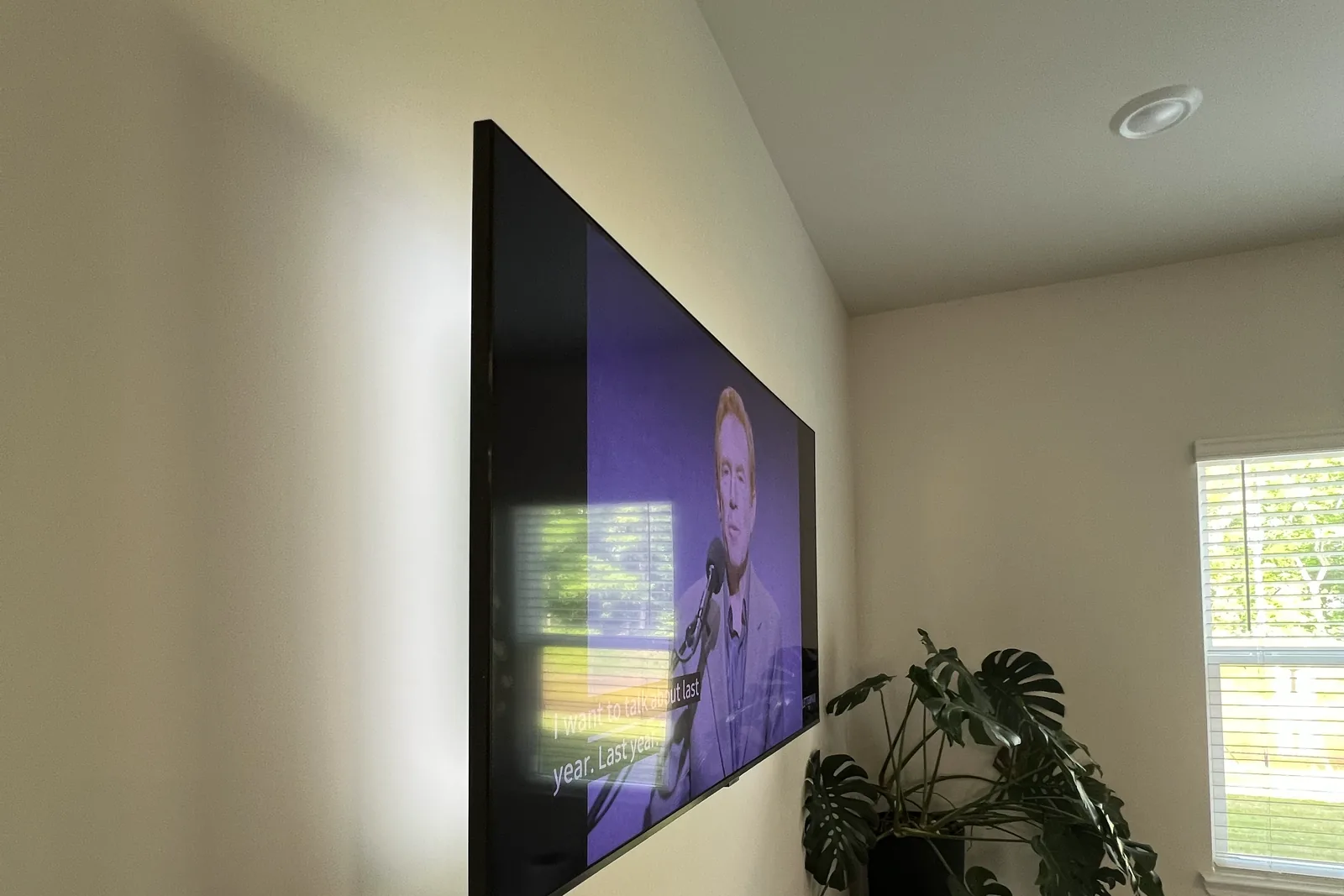
- One-bedroom with a defined living room: if the couch faces the TV wall head-on, a low-profile fixed mount gives the cleanest look and the smallest footprint. Save the full-motion budget unless you have an off-center wall or a second seating area.
- Bedroom TV: center it 42-50 inches from the floor and add a slight tilt so the picture faces the bed. A small tilting mount is plenty for a 32-43 inch bedroom screen, and our TV height chart has the bottom-edge marks.
- High-rise or new-construction tower: assume metal studs until proven otherwise and plan for SnapToggles through the steel.
One space-saver worth knowing: a full-motion mount that folds flat against the wall when retracted gives you the slim look of a fixed mount most of the time, plus the flexibility of an arm when you want it. In a small apartment where the TV doubles as a monitor or a second screen, that flat-when-retracted profile is usually worth the extra cost over a plain fixed mount.
What to skip
- Adhesive or suction “no-drill wall mounts.” They will not safely hold a TV over time. This is the most common renter mistake we see.
- Plastic drywall anchors, for any TV. The load walks them out of the wall, leaving a crater and risking the screen. Even a 32-inch TV on drywall alone needs rated toggles.
- The cheapest full-motion arms. Thin arms sag and loosen as they’re moved. Spend a little more on a UL-listed arm rated above your TV’s weight.
For hiding the cables without cutting drywall, use a paintable surface raceway; see our apartment cable concealment guide.
Frequently asked questions
What’s the best TV mount for an apartment?
If you can drill, a low-profile fixed mount or a compact full-motion mount lag-bolted into the studs; the four small holes patch easily at move-out. If your lease forbids drilling, a weighted floor-standing TV stand is the cleanest no-damage option. Avoid adhesive or suction mounts, which won’t reliably hold a TV.
Can I use a no-drill TV mount in an apartment?
Yes, if it’s a load-rated system. A floor-standing TV stand or a floor-to-ceiling tension pole holds the TV at viewing height with no wall holes. Skip adhesive and suction “no-drill wall mounts,” which are not rated to hold a TV.
What TV mount works on metal studs in a high-rise?
Any quality fixed or full-motion bracket, anchored with 1/4 inch SnapToggles through the steel studs instead of lag bolts: four toggles for a TV up to about 100 lb, six up to about 150 lb. Lag bolts will not hold in steel framing.
Will mounting a TV in my apartment cost me my deposit?
Not if you mount into studs and patch the four small holes with spackle and paint at move-out. Deposits get docked for unrepaired damage, not for the fact that you mounted a TV. The risky case is the large holes plastic drywall anchors leave when they pull out.
Is a fixed or full-motion mount better for a small apartment?
A low-profile fixed mount gives the cleanest look in a small space if you watch the TV head-on. A compact full-motion mount is better for a studio or open layout where you watch from several spots, and it’s easier to hang by yourself because you can seat one side of the bracket at a time.