Skip to content
Same-Day Service · Free Estimates Text a photo

TV mounting services in Albany Park, IL

Albany Park TV mounting is flat-rate: $129 up to 54", $159 for 55-69", $209 for 70-79", $299 for 80-94", $399 for 95-inch and up (2 technicians). Cable concealment is $99 per TV, brick or stone adds $99. Same-day slots when booked before noon, and the installer usually arrives within 2-4 hours of your confirmation.

“Everything looks clean, works perfectly, and was done efficiently.”
Jesse Fife, Google review of an Atlanta install

Updated

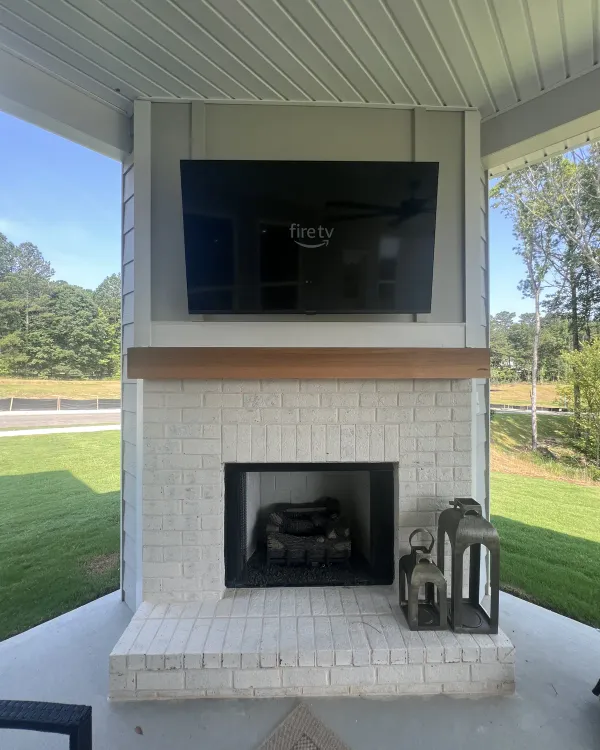
The same porch TV above the painted-brick fireplace, seen straight on

Documented install, June 2025 By the Atlanta crew.

TV Mounting Cost Estimate

Step 1 of 520%
How big is the TV?
One TV.

Rather we call you?

Leave your number, and we call you about your TV, any day from 8:00 AM to 8:00 PM. Add a note on the wall or the TV if you like.

Contact Information

Helps us match you with the installer closest to you.

Albany Park was built in a hurry. The Ravenswood 'L' reached Kimball and Lawrence in 1907, and builders put up bungalows, two-flats and apartment buildings through the 1910s and 1920s. The apartment blocks cluster around the Kimball terminal. Ravenswood Manor, on the river, and North Mayfair, west of Pulaski, are bungalow country. Buildings of those years were finished in plaster, and in the brick ones the installer tests for common brick behind it. Your Express Mounting installer carries a hammer drill, 3/16-inch carbide bits, 1/4-inch Tapcons, 5/16-inch lag bolts, SnapToggles and a rare-earth magnet. Freeze-thaw mortar is checked, river-side basements get a question about water, and Chicago's conduit code applies to any new outlet. Same-day Albany Park service when booked before noon.

What Express Mounting Customers Say

Google reviews of our Atlanta installs

These guys did an awesome job installing 4 TVs on my outdoor patio of full motion mounts side by side, highly recommend them!

Kaleb Bogunskov

Google review

KB
Wonderful communication. Expert installation. On time and competitively priced! I would definitely use them again!

Ferber Buckley

Google review

FB
Absolutely great service - communication, promptness and responsiveness outstanding. Mount I bought didn't work with the TV and Alex left and got another one. Came back to finish the install. Excellent experience!

Jan Noll

Google review

JN

Look us up before you book

Express Mounting has one Google Business Profile, at our Alpharetta, GA headquarters. Customer reviews for every metro we serve live there.

Chicago installs are done by local installers we dispatch, on the same flat rates and the same warranty.

28 Google reviews, every one on that profile, from customers of the Atlanta crew.

Every booking comes with

  • 3-year workmanship warranty
  • Same-day installation when you book before noon
  • An installer typically arrives within 2-4 hours of confirmation

7,000 residents in 1910, more than 55,000 by 1930: Albany Park went up fast, in brick and plaster

Few Chicago neighborhoods were built as quickly as Albany Park. A syndicate of transit investors bought 640 acres in 1893 and named the place for Albany, New York. Streetcars ran on Lawrence Avenue by 1896. Between 1904 and 1907 the North Branch of the river was straightened, which settled the property lines, and in 1907 the Ravenswood 'L' arrived at Kimball and Lawrence. Then the count: 7,000 residents in 1910, 26,676 in 1920, more than 55,000 in 1930. Builders put up bungalows and two-flats at a furious pace, and by the twenties the neighborhood was almost full. Buildings of the 1910s and 1920s were finished in plaster, so the installer expects it in nearly every original room and treats drywall as the sign of a remodel. The open question is what the plaster is fixed to. In a brick building the outside walls are tested for common brick, with furring strips or nothing in between. Room dividers are tested for wood studs. A 1/8-inch hole behind the future screen answers both, and the hardware follows.

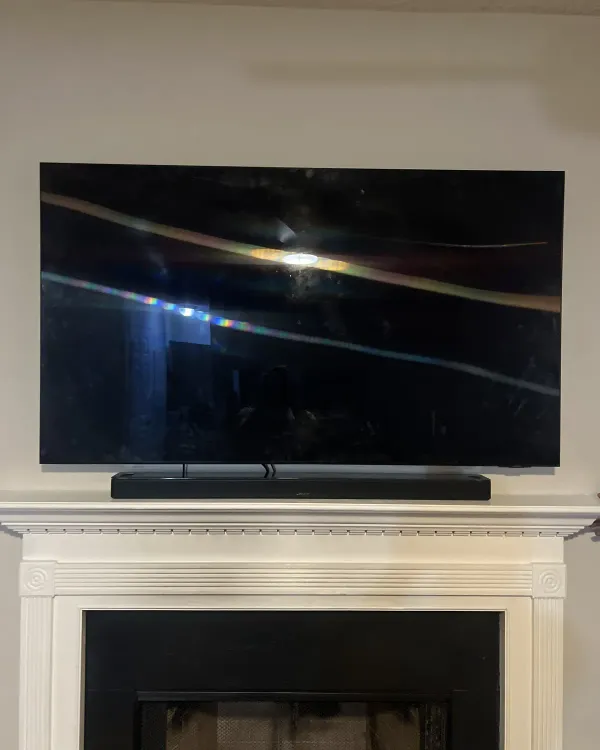
A TV with a soundbar beneath it mounted above a white mantel fireplace

Apartment buildings around the Kimball terminal: plaster, common brick and a neighbor on the other side

When the 'L' terminal opened at Kimball and Lawrence, the blocks around it filled with large apartment buildings, and they thin out the farther you walk from the station. For an installer these are masonry buildings with plaster interiors, and three walls matter. The outside wall is tested for brick behind the plaster. The wall between your unit and the next is tested too. If it is masonry it will hold any TV, but it also carries sound, so a soundbar or subwoofer is better kept off it. The dividers inside the apartment are usually framed, and the test hole shows plaster-and-lath over wood. Brick takes a hammer drill, a 3/16-inch carbide bit and 1/4-inch Tapcons in the brick face or the mortar joint, whichever lines up with the mount holes, at +$99. Wood studs take lag bolts, with no surcharge. Renters need the owner's permission before any drilling. Ask for a fixed bracket if you want the fewest holes to patch later. Upper floors mean stairs, so the box is measured against the landing first.

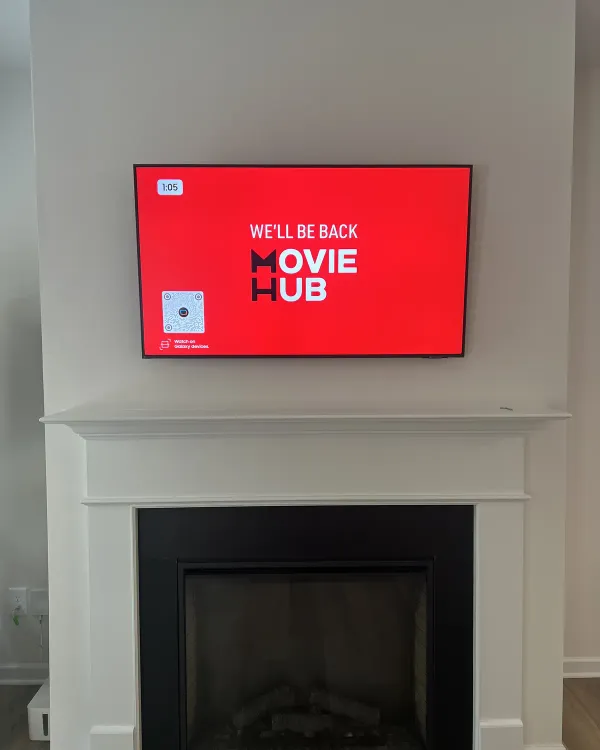
A TV mounted on the drywall above a white mantel with a black firebox

Ravenswood Manor: brick bungalows and Foursquares by the river, and a few frame and stucco houses from before 1915

Ravenswood Manor fills the corner between Lawrence, Montrose, Sacramento and the river. William E. Harmon laid it out in 1909, most of it was built by 1933, and it has been on the National Register of Historic Places since 2008. Its National Register nomination counts 224 bungalows and 110 American Foursquares, with two-flats on a handful of streets and the Francisco 'L' station at ground level inside the district. Most buildings are brick. A few of the earliest houses, built before 1915, combine frame and stucco. That split decides the TV job. In the brick houses the outside walls are tested for masonry behind the plaster, and a mount there means Tapcons and the +$99 surcharge. In a frame and stucco house the same wall should show wood studs behind plaster-and-lath, and 5/16-inch lag bolts do the work at the base rate. Interior walls in both are tested as their own case. A Foursquare's second-floor bedrooms are a common spot for a second TV, centered 42 to 50 inches off the floor for viewing from bed.

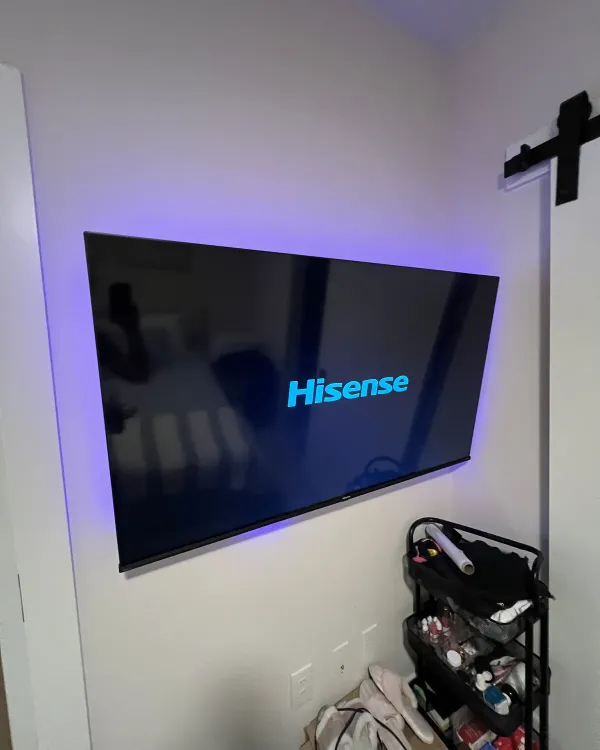
A Hisense TV on a white wall with purple LED bias lighting glowing behind it

North Mayfair's bungalow blocks: brick, frame and stucco built side by side from 1913 to 1930

North Mayfair runs from Lawrence to Foster between Pulaski and Kilbourn, and its streets are bungalow after bungalow. It was built mainly between 1913 and 1930 and joined the National Register in 2006. Of its buildings, 575 are brick bungalows. Frame and stucco bungalows were built alongside them in the same years, a few Tudor Revival cottages followed, and brick two-flats and three-flats stand near Lawrence Avenue. From the sidewalk you can tell brick from stucco. From the living room you cannot, because both are plaster inside. So the installer asks what the outside of the house is made of, then proves it. In a brick bungalow the test hole on an outside wall should pass plaster and reach brick, and the anchor is a 1/4-inch Tapcon sized to cross any furring gap. In a frame or stucco bungalow it should find a stud bay, and lag bolts go into wood. Old brick has a century of freeze-thaw behind it, so the mortar is scraped with an awl before an anchor is trusted to it.

Basements and garden units near the North Branch: the water question comes before the wall

The North Branch of the Chicago River wraps the east and north sides of Albany Park, and it has left its banks here. Heavy rains brought major floods in 2008 and 2013. In 2018 the city and the Metropolitan Water Reclamation District finished a diversion tunnel, 18 feet across and about 150 feet under Foster Avenue, that carries river overflow more than a mile east to the North Shore Channel at River Park. That protects against the river. It is not a promise about any one basement. So for a basement or garden-level TV the installer starts with a question: has this room ever taken water, and how high? The bracket, the plates and every connection go well above that line, and power strips stay off the floor. Then the wall. A basement perimeter wall is usually drywall or paneling on furring strips over the foundation, and the furring holds nothing. Tapcons go through to concrete or block, which is masonry at +$99. A framed partition takes lag bolts at the base rate.

Power in conduit, signal in the wall: outlets and cable concealment in an Albany Park flat

Albany Park is a Chicago neighborhood, so the Chicago Electrical Code covers every building in it. The code requires wiring in metal conduit and does not allow the NM cable used in most other places. The practical result: a new outlet behind your TV is an electrician's work, and the mounting visit does not add one. Plan it before the install if you want the power cord out of sight, and tell us where the box will go so the bracket clears it. Our part is low-voltage. In-wall concealment is $99 per TV and runs HDMI, optical, speaker and network cable between two plates in a framed wall. Old two-flat partitions can hold surprises in the bay, a conduit run or a wood block set crosswise between studs, so the installer probes with a fish tape before cutting the lower opening. On a brick outside wall there is nowhere to hide a cable inside, and a paintable raceway on the surface at $79 is the clean answer. Cords that already reach an outlet need nothing more.

Walk-up stairs, a cold panel and the picture check: how an Albany Park visit runs

An Albany Park visit starts on the stairs as often as at the wall. Two-flats and apartment buildings mean a carry, so tell us the floor and the screen size when you book. At 95 inches and up two technicians come, and that is part of the $399 rate. In winter a TV that has been riding in the cold rests until it reaches room temperature before it is powered on. The bracket is matched to the TV's VESA pattern and weight, and it is a line of its own. Use yours, or ours is $49 or $69 for a flat bracket and $59 or $79 for a full-motion arm, by screen size. A laser sets level before the bracket is fastened, and it is checked again with the panel on. Setup follows: WiFi, inputs, picture mode, and a soundbar on HDMI eARC, with soundbar mounting at $79. Samsung including the Frame, Sony, LG OLED, TCL and Hisense are everyday sets. Last, you sit where you watch and confirm height and level.

Your Albany Park price, before you book

Pick the TV's size, the wall and the mount, and the estimator shows the labor price, from $129 per TV. Then book a time online, or call from 8:00 AM to 8:00 PM.

Field notes from Albany Park installs

Albany Park is close to a single-era neighborhood. The ‘L’ reached Kimball and Lawrence in 1907, and by the end of the 1920s the bungalows, two-flats and apartment buildings were nearly all in place. Large apartment buildings crowd the blocks around the terminal. Ravenswood Manor along the river and North Mayfair west of Pulaski are the bungalow districts.

Outside walls of brick buildings are checked for common brick, and a hammer drill and Tapcons do the anchoring when the bit shows masonry. Room dividers, and the early frame and stucco houses in Ravenswood Manor and North Mayfair, are checked for wood studs behind plaster-and-lath, and those take lag bolts.

Freeze-thaw has worked on this brick for a century, so mortar is probed first. The river flooded in 2008 and 2013, so a basement install begins with the room’s water history. And Chicago’s conduit code leaves a new outlet to an electrician.

TV mounting prices in Albany Park

Measure the screen and you know the Albany Park price: $129 up to 54”, $159 for 55-69”, $209 for 70-79”, $299 for 80-94”, $399 for 95” and up. Cable concealment in the wall runs $99 per TV. A paintable raceway along the wall is $79. A brick, stone or concrete wall brings the published +$99 masonry surcharge. Plaster, drywall and metal stud walls carry none. In Albany Park the surcharge lands on the brick outside wall of an apartment, two-flat or bungalow and on a basement foundation wall. A framed room divider, or any wall in a frame and stucco house, stays at the base rate. The bracket is priced apart: your own, or one of ours at $49 or $69 flat and $59 or $79 full-motion. Soundbar install $79. No travel fee anywhere in Albany Park.

How Express Mounting covers Albany Park

Express Mounting dates to 2015, when Alex Crabinsky founded it in Atlanta, and the 9,747+ documented installs since then shaped the checklist an Albany Park job follows. Albany Park jobs run through vetted Cook County installers who carry the same hardware, work off the same install checklist, and back every job with the same 3-year workmanship warranty, held by Express Mounting. The installer we dispatch already knows to test an apartment’s outside wall for brick and to ask about water before mounting below grade.
TV mounting and installation in Albany Park, IL: common questions

What will I pay to mount a TV in an Albany Park apartment or bungalow?

The same flat rate in either: $129 up to 54 inches, $159 for 55-69, $209 for 70-79, $299 for 80-94 and $399 for 95 and up. Cables hidden in the wall cost $99 per TV. Anchoring into brick, block, stone or concrete adds the +$99 masonry surcharge, common on the outside walls of Albany Park's brick buildings. No surcharge applies to plaster-and-lath over wood studs, drywall or metal stud. The bracket is extra, yours or ours.

Does same-day service cover all of Albany Park, from Ravenswood Manor to North Mayfair?

Yes. Book before noon, by phone at (470) 777-4077 or on the site, and an installer from our vetted Cook County network arrives within 2-4 hours of confirming a same-day request. That goes for Ravenswood Manor, the blocks around Kimball and Lawrence, Mayfair and North Mayfair.

My Albany Park apartment has plaster walls and I cannot find a stud. What will the TV hang on?

It depends on which wall. On an outside wall of a brick building there may be no stud at all, only plaster on furring over common brick, and the TV hangs on 1/4-inch Tapcons set in the brick. On a room divider there are usually wood studs behind the plaster-and-lath, found with a magnet and a pilot hole, and the TV hangs on lag bolts.

Is a garden unit near the North Branch a sensible place for a wall-mounted TV now that the Foster Avenue tunnel is running?

It can be. The tunnel, finished in 2018, diverts river overflow to the North Shore Channel, but it does not speak for any one basement. Tell the installer whether the room has taken water and how high. The TV, the plates and the connections are set above that line, and anchors go through the furring into the foundation wall, which is masonry at +$99.

My landlord owns the Albany Park two-flat I live in. Can I still have a TV mounted?

With the owner's permission, yes, and it is best to have that in writing. Ask for a fixed bracket if you want the fewest holes: four to six small ones to fill when you move out. If the TV lands on a brick outside wall, the +$99 masonry surcharge applies.

Call (470) 777-4077 Text a photo

Text a photo of your wall

Point your phone's camera here to start a text to +14707774077. Add a photo of the wall and your TV's size, and we reply with your price and the first open time.

QR code that starts a text message to +14707774077
Use the quote form instead