Skip to content
Same-Day Service · Free Estimates Text a photo

TV mounting services in Jefferson Park, IL

Jefferson Park TV mounting is flat-rate: $129 up to 54", $159 for 55-69", $209 for 70-79", $299 for 80-94", $399 for 95-inch and up (2 technicians). Cable concealment is $99 per TV, brick or stone adds $99. Same-day slots when booked before noon, and the installer usually arrives within 2-4 hours of your confirmation.

“We called and requested a same day service and they were able to accommodate, even on a Friday.”
Kelly Bell, Google review of an Atlanta install

Updated

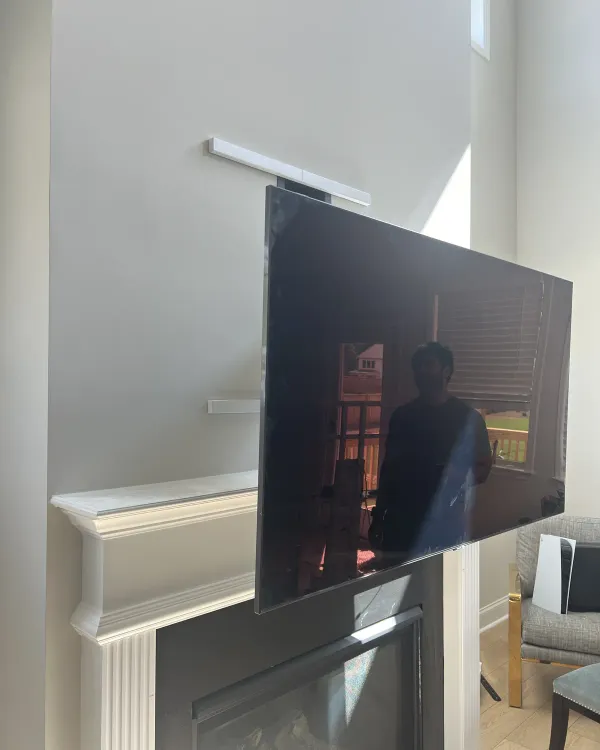
A TV on a full-motion arm swung out from a white wall beside crown molding

Documented install, October 2024 By the Atlanta crew.

TV Mounting Cost Estimate

Step 1 of 520%
How big is the TV?
One TV.

Rather we call you?

Leave your number, and we call you about your TV, any day from 8:00 AM to 8:00 PM. Add a note on the wall or the TV if you like.

Contact Information

Helps us match you with the installer closest to you.

Jefferson Park, nicknamed the Gateway to Chicago, began as a farm village on the Milwaukee Avenue plank road, joined the city in 1889, and filled in with frame cottages and brick bungalows through the 1910s and 1920s. Bungalows and three-flats kept going up into the early 1930s, ranch houses and brick two-flats took the leftover lots from about 1954, and condo buildings and rowhomes arrived in the 2000s. So one street can hold plaster-and-lath over wood studs, plaster over common brick, and new drywall. Your Express Mounting installer sorts them with a rare-earth magnet and a test hole, then reaches for 5/16-inch lag bolts, a hammer drill with 3/16-inch carbide bits and 1/4-inch Tapcons, or SnapToggles. Freeze-thaw mortar is checked first, and Chicago's conduit code covers any new outlet. Same-day Jefferson Park service when booked before noon.

What Express Mounting Customers Say

Google reviews of our Atlanta installs

They did an amazing job. Very quick and professional. Was on time and communicated every step of the way.

Nick

Google review

N
Professional and they do good work. Would recommend.

Alex Black

Google review

AB
They were very professional, neat, and completed my complex job in a timely manner. They also had great communication with setting up the appointment. Would use them again.

Alex B.

Google review

AB

Look us up before you book

Express Mounting has one Google Business Profile, at our Alpharetta, GA headquarters. Customer reviews for every metro we serve live there.

Chicago installs are done by local installers we dispatch, on the same flat rates and the same warranty.

28 Google reviews, every one on that profile, from customers of the Atlanta crew.

Every booking comes with

  • 3-year workmanship warranty
  • Same-day installation when you book before noon
  • An installer typically arrives within 2-4 hours of confirmation

From plank-road village to the Gateway to Chicago: Jefferson Park's building decades, wall by wall

Jefferson Park started as a stop for farmers. After 1849 two plank roads, now Milwaukee and Elston Avenues, carried produce to Chicago, and in 1855 a village was platted near Milwaukee and Higgins. It was incorporated in 1872 and annexed in 1889. Streetcars ran on Lawrence, Milwaukee and Elston by about 1900, and then the houses came: frame cottages and brick bungalows in the 1910s and 1920s, with the fastest growth in the twenties, and three-flats into the early 1930s. Around 1954 ranch houses and brick two-flats filled the lots that were left. Little went up after 1960 until the condo buildings and rowhomes of the 2000s. Each of those waves finished its walls differently, which is why the installer asks roughly when your building went up before asking anything else. A pre-war house is expected to be plaster. A 1950s house can be plaster or early drywall. A 2000s building is drywall, with framing that has to be identified. The age gives the first guess. The test hole gives the answer, and the anchors are chosen from that.

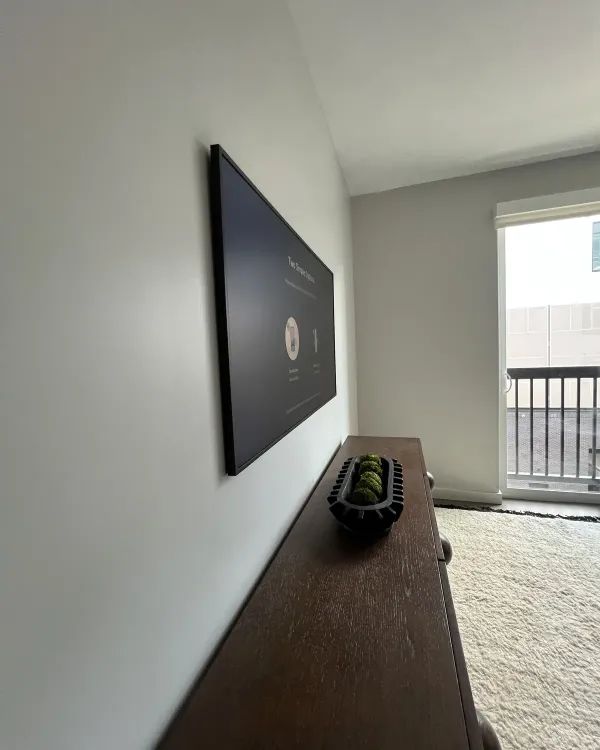
A TV on a flat mount on a white wall beside a dark wood console

Jefferson Park's frame cottages and older frame houses: lath nails, a pilot hole and lag bolts

The frame cottage is one of Jefferson Park's oldest house types. Some have come down for new construction. Those still standing were finished in plaster over wood lath, and many have since been covered again in paneling or a skin of drywall. Under any of those layers the structure is the same: wood studs, and they are what the TV hangs on. An electronic stud finder struggles here, because lath reads as wood from edge to edge. The installer uses a rare-earth magnet instead. It grabs the nails that pin the lath, and the nails line up over each stud. A 1/8-inch pilot hole confirms it, and the depth where the bit meets solid wood tells how long the lag bolt must be to pass every layer and still bite 1-1/2 inches of stud. Bolts are 5/16-inch, two for a mid-size screen and four past 55 inches. Loose plaster is the other check. If the wall gives under thumb pressure near the bracket position, the bracket moves to sound plaster. No surcharge applies to a framed wall.

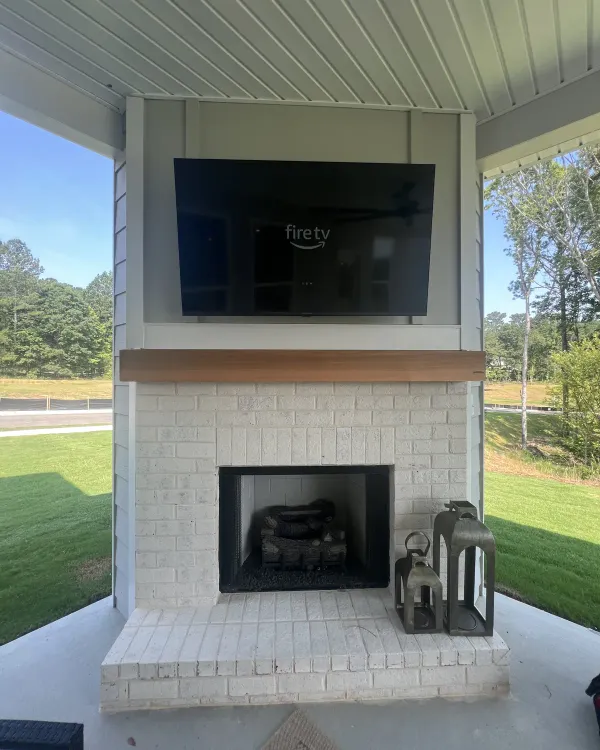
A TV mounted above a wood mantel on a white painted-brick fireplace on a covered porch, lawn and trees behind

1920s brick bungalows and three-flats: brick where you would expect a stud

Brick bungalows line Jefferson Park's side streets, with two-flats and three-flats from the same years among them. In a brick building of the 1920s the plaster often rides on thin furring strips fixed to common brick, and a fastener that stops in the furring has nothing structural around it. So the installer drills one 3/16-inch test hole and reads it on the way in: plaster, a short gap, then brick dust. Tape on the bit marks the depth, and the 1/4-inch Tapcon is picked long enough to cross the plaster and the gap and still seat an inch or more in masonry. A hundred winters of freeze-thaw are the reason for the next step. Mortar that powders under an awl is skipped, and the bracket slides until each anchor sits in sound brick face or a sound mortar joint, whichever lines up with the mount holes. Anchoring into brick carries the +$99 masonry surcharge. A dividing wall inside the same house is usually framed, tests as wood, and stays at the base rate.

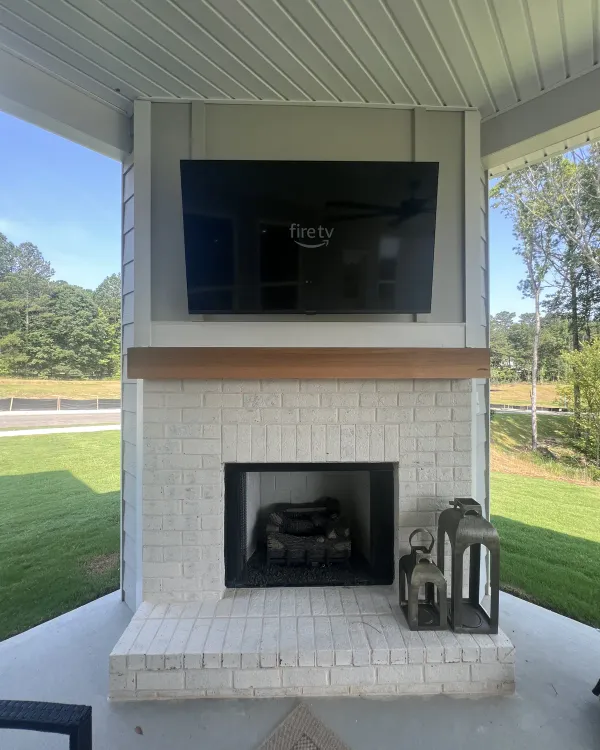
The same porch TV above the painted-brick fireplace, seen straight on

The 1954 infill: ranch houses and brick two-flats on the lots the bungalows left

Not every lot in Jefferson Park was built on before the Depression. Starting around 1954 builders came back and filled the gaps with ranch houses and brick two-flats, and by 1960 the lots were gone. A house from the 1950s may have plaster over gypsum lath, or it may have early drywall, and from the room they look alike. The pilot hole tells them apart by the dust and by how thick the layer is before the bit breaks into the cavity. In both cases the TV hangs on the wood studs, found with a stud finder and confirmed with a magnet, on 5/16-inch lag bolts. Drywall or plaster alone holds only a small set, up to about 32 inches and 30 pounds on rated toggles. A ranch living room often has one long unbroken wall, which suits an 80-inch or larger screen. The brick two-flats of those years get the same outside-wall test as the older brick. If the bit finds masonry, Tapcons and the +$99 line apply. If it finds a stud, neither does.

Condo buildings and rowhomes near Lawrence Avenue and the transit center: framing identified first

Most of what has been built in Jefferson Park since 2000 is condominiums, with some rowhomes: buildings of four to six stories, one of them on Lavergne Avenue near Lawrence, and three-story rowhomes on a former industrial site by the Kennedy. They put residents a short walk from the Blue Line and Metra at the Jefferson Park Transit Center. The surface is drywall. What is behind it is not something we assume for any single building, so the installer tests first. A magnet finds the fastener rows, and a 1/8-inch pilot shows wood shavings, bright steel or gray concrete dust. Wood takes lag bolts. A metal stud takes SnapToggles, four for a fixed mount and six for a full-motion arm, spread across two studs. Concrete takes a hammer drill and Tapcons and adds the +$99 masonry surcharge. The wall shared with the next unit gets its own test hole. Before booking, ask your association or management whether outside installers need to check in, when drilling is allowed, and whether cable may run inside the wall. We schedule around the answers, and the price does not move.

One rule from Gladstone Park to the Copernicus Center: power in conduit, HDMI in the wall

Every Jefferson Park address is inside the City of Chicago, from Gladstone Park at the north end to the blocks around the Copernicus Center on Lawrence. That matters for one part of a TV job. The Chicago Electrical Code requires building wiring in metal conduit, and the NM cable common elsewhere is not allowed in the city. A new outlet behind the screen is therefore an electrician's work, pulled in EMT, and the installer does not add one. What the visit does cover is signal. For $99 per TV, HDMI, optical, speaker and network cable run inside a framed wall between two low-voltage plates, one behind the panel and one near the floor. The installer sweeps the bay with a magnet first, because conduit already in the wall should be found before the saw comes out. A brick outside wall has no bay, so the cables go in a slim paintable raceway on the surface for $79. If the cord already reaches an outlet, a raceway down to it is the whole job.

After the wall is read: bracket, height and setup on a Jefferson Park job

With the wall identified, the rest of a Jefferson Park visit is the same careful routine in any building. The bracket has to suit the TV's VESA pattern and its weight. It is priced apart from the labor: use your own, or ours is $49 up to 54 inches and $69 above for a flat bracket, $59 or $79 for a full-motion arm. A level line is shot with a laser before the bracket is fastened and checked again once the panel is hung. Height comes from where you sit. Living-room screens center near seated eye level. Bedroom screens, watched from the bed, center 42 to 50 inches off the floor. Then the set is powered up: WiFi, inputs, picture mode, and a soundbar on HDMI eARC, with soundbar mounting at $79. The installer sets up Samsung including the Frame, Sony, LG OLED, TCL and Hisense. A panel of 95 inches or more arrives with two technicians at its $399 rate. Floors are covered and dust is vacuumed at the bit. Book before noon for same-day service.

Your Jefferson Park price, before you book

Pick the TV's size, the wall and the mount, and the estimator shows the labor price, from $129 per TV. Then book a time online, or call from 8:00 AM to 8:00 PM.

Field notes from Jefferson Park installs

Four building waves sit side by side in Jefferson Park. Frame cottages and brick bungalows came in the 1910s and 1920s, three-flats into the early 1930s, ranch houses and brick two-flats from about 1954, and condo buildings and rowhomes after 2000.

The cottages are plaster-and-lath over wood studs: magnet, pilot hole, lag bolts. The brick bungalows and flat buildings are tested for common brick behind the plaster on their outside walls, and when the bit shows masonry the job moves to a hammer drill and Tapcons. The 1950s houses are plaster or early drywall over studs. The newer condos and rowhomes are drywall over framing that is identified before anything is hung: wood, metal stud or concrete.

Freeze-thaw is the hazard that comes with old brick, so mortar is probed before it holds an anchor. A new outlet is an electrician’s job in conduit, and our concealment is low-voltage cable only.

TV mounting prices in Jefferson Park

Jefferson Park installs are billed at one flat rate per screen size: $129 up to 54”, $159 for 55-69”, $209 for 70-79”, $299 for 80-94”, $399 for 95” and up. Putting the cables inside the wall is $99 a TV. A paintable surface raceway is $79. The published +$99 masonry surcharge covers brick, stone and concrete, and plaster, drywall and metal stud add nothing. Here the dividing line often runs through a single house: a bungalow’s brick outside wall is a masonry job, and the framed partition six feet away is not. The bracket is billed apart from labor: $49 or $69 flat, $59 or $79 full-motion, if you want one of ours. Soundbar install $79, and no travel fee anywhere in Jefferson Park.

How Express Mounting covers Jefferson Park

Express Mounting was started in Atlanta in 2015 by Alex Crabinsky, and 9,747+ documented installs later the routine is well worn. Jefferson Park jobs run through vetted Cook County installers who carry the same hardware, work off the same install checklist, and back every job with the same 3-year workmanship warranty, held by Express Mounting. The installer we dispatch already knows that a Jefferson Park bungalow and the frame cottage next door need different anchors, and tests both before choosing.
TV mounting and installation in Jefferson Park, IL: common questions

What does TV mounting run in Jefferson Park, and when does the brick surcharge apply?

The flat rate goes by screen size: $129 up to 54 inches, $159 for 55-69, $209 for 70-79, $299 for 80-94 and $399 for 95 and up. In-wall concealment of the cables is $99 for each TV. The +$99 masonry surcharge applies when the anchor goes into brick, block, stone or concrete, which in Jefferson Park usually means the outside wall of a brick bungalow, two-flat or three-flat. Plaster over wood studs in a frame cottage, drywall and metal stud carry no surcharge. Labor does not cover the bracket, so bring yours or add ours.

Is same-day mounting available as far out as Gladstone Park?

Yes. Book before noon by phone at (470) 777-4077 or online, and an installer from our vetted Cook County network arrives within 2-4 hours of confirming a same-day request. Gladstone Park, the blocks off Milwaukee Avenue and the streets around the transit center are all covered.

Our Jefferson Park frame cottage has drywall over the old plaster. What does the installer anchor to?

The wood studs, the same as before the drywall went on. The added layers only change the bolt length. The installer finds the studs with a magnet on the lath nails, drills a 1/8-inch pilot to measure how deep the solid wood sits, and picks 5/16-inch lag bolts long enough to pass the drywall and plaster and still grip the stud.

I own a condo near the Jefferson Park Transit Center. What should I ask the association before booking?

Ask whether an outside installer has to be registered ahead of time, which hours allow drilling, whether a large TV box needs a reserved elevator, and whether cable may run inside the wall. Each building sets its own answers, and we do not know yours. Tell us what you learn and the visit is scheduled to fit.

There is no Express Mounting shop in Jefferson Park. Who does the work, and who do I call afterward?

An installer from our vetted Cook County network, dispatched by Express Mounting and working to the hardware list and install checklist developed in Atlanta. The flat rate you are quoted is locked when you book. The 3-year workmanship warranty is held by Express Mounting, not the individual installer, so the number to call afterward is ours: (470) 777-4077.

Call (470) 777-4077 Text a photo

Text a photo of your wall

Point your phone's camera here to start a text to +14707774077. Add a photo of the wall and your TV's size, and we reply with your price and the first open time.

QR code that starts a text message to +14707774077
Use the quote form instead