Skip to content
Same-Day Service · Free Estimates Text a photo

TV mounting services in Irving Park, IL

Irving Park TV mounting is flat-rate: $129 up to 54", $159 for 55-69", $209 for 70-79", $299 for 80-94", $399 for 95-inch and up (2 technicians). Cable concealment is $99 per TV, brick or stone adds $99. Same-day slots when booked before noon, and the installer usually arrives within 2-4 hours of your confirmation.

“Wonderful communication. Expert installation. On time and competitively priced!”
Ferber Buckley, Google review of an Atlanta install

Updated

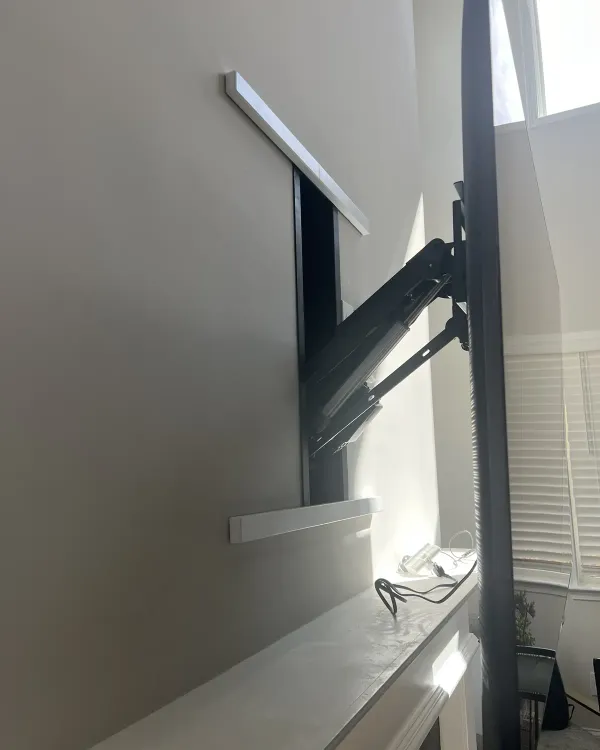
Side view of a TV on a full-motion arm, extended off a white wall

Documented install, October 2024 By the Atlanta crew.

TV Mounting Cost Estimate

Step 1 of 520%
How big is the TV?
One TV.

Rather we call you?

Leave your number, and we call you about your TV, any day from 8:00 AM to 8:00 PM. Add a note on the wall or the TV if you like.

Contact Information

Helps us match you with the installer closest to you.

Irving Park began as a commuter suburb. Charles T. Race bought farmland here in 1869 and paid for a depot so the trains would stop. A boom between 1895 and 1914 added more than 5,000 buildings. What stands now: Queen Anne and Italianate houses and farmhouses in Old Irving Park, Craftsman bungalows and Foursquares in The Villa, turn-of-the-century houses in Independence Park and West Walker, brick apartment buildings north of Irving Park Road. Houses of those years were plastered, so the installer expects plaster-and-lath over wood studs in the frame houses and tests for common brick in the masonry ones. Your Express Mounting installer arrives with 5/16-inch lag bolts, a rare-earth magnet, a hammer drill, 3/16-inch carbide bits, 1/4-inch Tapcons and SnapToggles. Same-day Irving Park service when booked before noon.

What Express Mounting Customers Say

Google reviews of our Atlanta installs

These guys did an outstanding job installing 2 TVs for us. Highly recommend them for your TV mounting needs.

Angelina Pascar

Google review

AP
We called and requested a same day service and they were able to accommodate, even on a Friday. When our technician got here, he assessed our mounting ask in seconds and immediately got to work.

Kelly Bell

Google review

KB
Great service, thank you Alex

Aleksey Khusanov

Google review

AK

Look us up before you book

Express Mounting has one Google Business Profile, at our Alpharetta, GA headquarters. Customer reviews for every metro we serve live there.

Chicago installs are done by local installers we dispatch, on the same flat rates and the same warranty.

28 Google reviews, every one on that profile, from customers of the Atlanta crew.

Every booking comes with

  • 3-year workmanship warranty
  • Same-day installation when you book before noon
  • An installer typically arrives within 2-4 hours of confirmation

A commuter suburb since the 1870s: how Irving Park's building years sort its walls

Irving Park was sold as a suburb before it was a Chicago neighborhood. Charles T. Race bought the land in 1869 and paid for a depot so the Chicago & North Western would stop, and the first houses followed the station. More than 200 stood in the original subdivision within twenty years. Chicago annexed the area in 1889, and between 1895 and 1914 a boom added more than 5,000 buildings, about 1,200 of them multifamily. For a TV installer that timeline works like a wall chart. Anything from those decades was finished in plaster, so drywall in an Irving Park house usually marks a later remodel. What sits behind the plaster depends on the shell. A frame house has wood studs. A brick building may carry its plaster on furring strips over common brick, with no stud at the outside wall. Neither a knock nor an electronic finder settles which one you have. A 1/8-inch test hole behind the future screen does, and the bit comes back with wood shavings or brick dust.

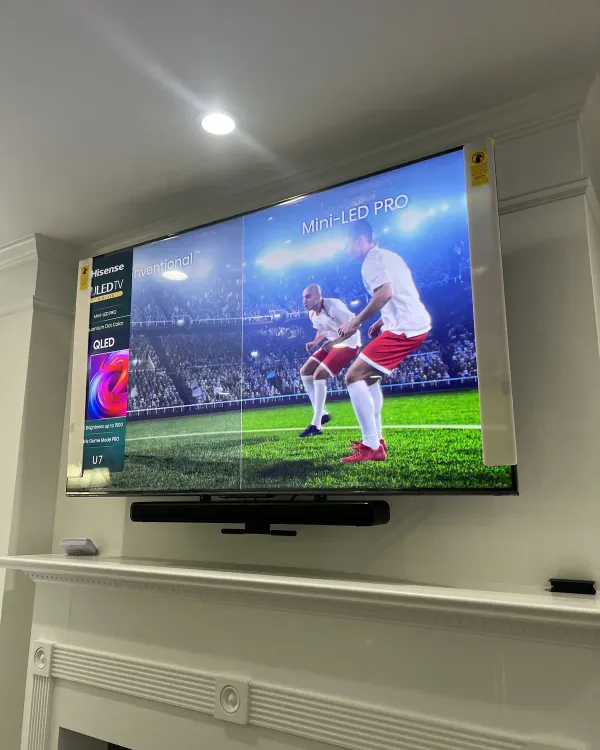
A Hisense mini-LED TV mounted inside a white paneled alcove, showing a soccer broadcast

Old Irving Park's Victorians, Italianates and farmhouses: framing that follows no 16-inch rule

Old Irving Park runs from Montrose to Addison between Pulaski and Cicero, and it holds the oldest houses in the neighborhood: Queen Anne, Victorian and Italianate houses and a few farmhouses. A volunteer survey by the Irving Park Historical Society documented several hundred buildings that predate 1894, many from the 1870s. A frame house of that age was plastered over wood lath, and the studs behind the lath do not always sit on 16-inch centers. So the installer finds each stud separately. A rare-earth magnet dragged across the wall sticks where lath nails run in a vertical line. A 1/8-inch pilot hole then answers the question: wood shavings and steady resistance mean a stud, a sudden drop means the bay beside it. Blue tape goes over the mark and the drill turns slowly, so the finish coat stays whole around the hole. Two 5/16-inch lag bolts carry a 55-inch screen, four carry anything larger, and a full-motion arm gets a plate wide enough to reach two studs. Plaster adds no surcharge. Plan on 60 to 90 minutes.

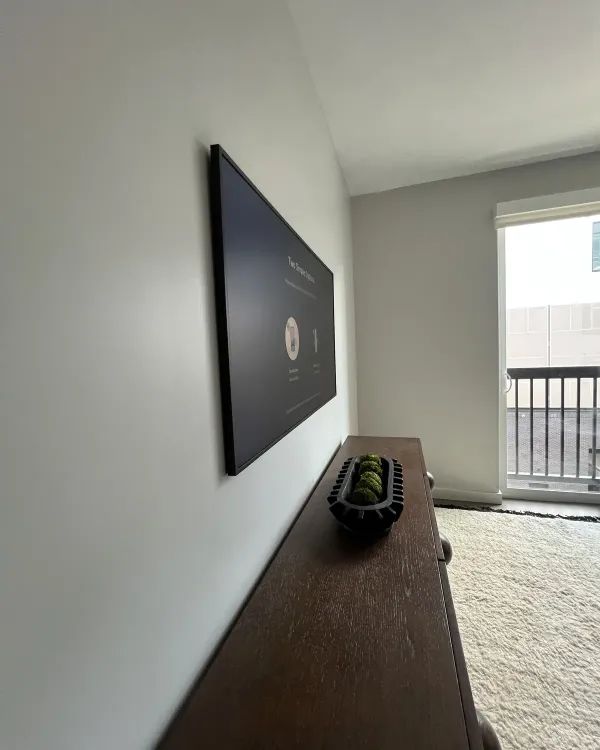
A TV on a flat mount on a white wall beside a dark wood console

The Villa: bungalows and Foursquares in clapboard, brick, shingle and stucco, each one tested

The Villa sits east of Pulaski between Addison and Avondale, on the 3600 to 3800 blocks of Avers, Hamlin, Harding and Springfield. Most of its houses went up between 1907 and 1922, after Albert Haentze and Charles M. Wheeler bought the land: bungalows and American Foursquares with Craftsman and Prairie influence, set behind landscaped parkways and the rock planters the improvement league put on the corners in 1923. The builders mixed clapboard, brick, shingles and stucco on the outside. The installer has to read that mix from indoors. A clapboard, shingle or stucco house is normally wood frame, and the test hole should show plaster-and-lath over a stud bay. A brick house can have plaster on furring over the brick at its outside walls, and there a 1/4-inch Tapcon passes the furring and seats in the masonry: +$99 for the brick, nothing for the plaster. Villa rooms tend to run long and narrow, so the TV wall is usually a side wall, and it pays to tape the outline and sit down before a hole is drilled.

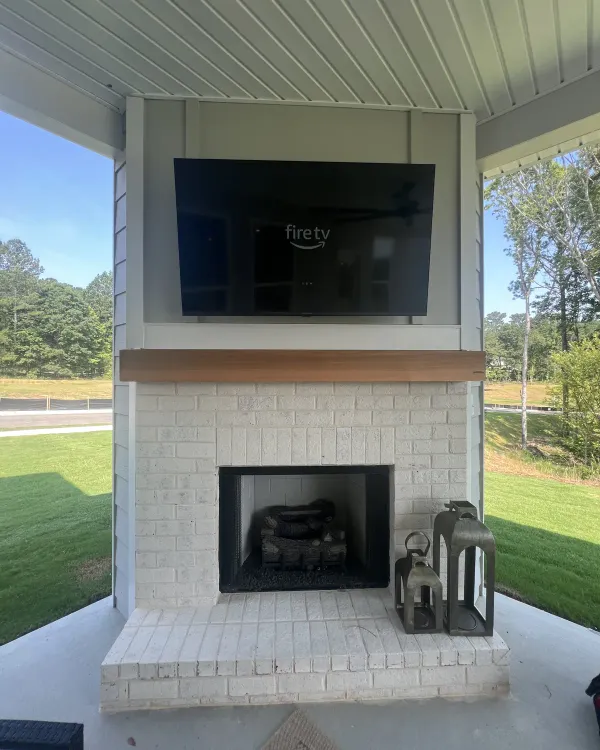
A TV mounted above a wood mantel on a white painted-brick fireplace on a covered porch, lawn and trees behind

Independence Park, West Walker and the apartment buildings north of Irving Park Road

East of Pulaski the houses get a little younger. Independence Park is known for turn-of-the-century houses and multifamily buildings, and West Walker for large late Victorian, Foursquare and Revival houses. North of Irving Park Road stand big apartment buildings trimmed with terra cotta, iron fencing and fountains. About 1,200 multifamily buildings went up in Irving Park between 1895 and 1914, so apartment walls are an everyday question here. In a masonry apartment building the outside walls and the walls between units are the ones to test for brick. If the bit slows and brings out brick dust, the anchor becomes a 1/4-inch Tapcon set with a hammer drill in the brick face or the mortar joint, whichever lines up with the mount holes. Room dividers inside the unit are usually framed, and there lag bolts go into wood. Renters should have the owner's yes before any hole. A fixed bracket means only four small holes to fill when the lease ends. Walk-up stairs matter too: the installer measures the box against the landing before carrying it up.

Along the Kennedy: 1960s buildings on Keystone, Kedvale and Keeler, where nothing is assumed

The Kennedy Expressway came through Irving Park around 1960 and took houses and businesses with it. In the decade that followed, apartment and condominium buildings replaced several of the larger old homes along Keystone, Kedvale and Keeler north of the expressway. We have no record of how any one of them is built. So the wall is tested first. The installer runs a magnet for fasteners, knocks, and drills one 1/8-inch pilot behind the screen position. If the bit brings out wood, there is a stud, and 5/16-inch lag bolts go in. Bright metal curls mean steel framing, where SnapToggles spread the load behind the metal stud. Gray dust and a hard stop mean concrete or block: a hammer drill, a Tapcon and the +$99 masonry line. Drywall alone holds a small set, up to about 32 inches and 30 pounds on rated toggles. A condominium building may also have its own rules for outside contractors, drilling hours or cable in the walls. Put that question to your association or management before you pick a time.

No Romex in Irving Park: the outlet is an electrician's job, the HDMI is ours

Irving Park is inside the City of Chicago, and the Chicago Electrical Code requires wiring in metal conduit. The plastic-sheathed NM cable used in most of the country is not allowed in the city. A new outlet behind the screen belongs to an electrician, who runs it in EMT, and a mounting visit does not cover it. The low-voltage side is ours. In-wall concealment at $99 per TV carries HDMI, optical and speaker cable from an opening behind the panel to one near the baseboard. In a frame house that is a drop through the stud bay. Old bays can hide a horizontal block or a run of conduit, so the installer checks with a magnet and a fish tape before cutting the second opening. A brick outside wall has no bay to drop through. There a paintable raceway on the surface at $79 does the job, or the cable takes a route through a framed partition beside it. Where the house already has an outlet at TV height, nothing electrical changes.

Brackets, viewing height and setup for long, narrow Irving Park rooms

The bracket is a separate line on an Irving Park quote. Bring your own, or take one of ours: $49 for a flat bracket up to 54 inches and $69 above, $59 or $79 for a full-motion arm. In a long, narrow front room a fixed or tilt bracket keeps the panel close to the wall and out of the walking path. Height follows the seat. In a living room the middle of the screen lands near seated eye level, and in a bedroom, watched from the bed, the center goes 42 to 50 inches off the floor. A pull-down mount you supply for a spot over a mantel is a $99 assembly add-on. Then setup: WiFi, inputs, picture mode, a soundbar over HDMI eARC, with soundbar mounting at $79. Samsung sets including the Frame, Sony, LG OLED, TCL and Hisense all get the same setup. A panel of 95 inches or more comes with two technicians as part of its $399 rate. You judge height and level from your own chair before the tools are packed.

Your Irving Park price, before you book

Pick the TV's size, the wall and the mount, and the estimator shows the labor price, from $129 per TV. Then book a time online, or call from 8:00 AM to 8:00 PM.

Field notes from Irving Park installs

Irving Park has been building houses since the 1870s. Old Irving Park holds the oldest stock: Queen Anne, Victorian and Italianate houses and a few farmhouses. The Villa came next, bungalows and Foursquares built mostly between 1907 and 1922. Independence Park, West Walker and the apartment blocks north of Irving Park Road filled in during the 1895 to 1914 boom.

Nearly all of it was plastered. In a frame house the job is finding wood studs behind plaster-and-lath with a magnet and a pilot hole, then lag bolts. In a brick bungalow or apartment building the outside wall is tested for common brick behind the plaster, and a hammer drill and Tapcons take over when the bit shows masonry. The 1960s buildings near the Kennedy get no assumptions: the pilot hole says wood, metal stud or concrete.

Brick here has been through a century of freeze-thaw, so old mortar is probed before an anchor goes near it. And Chicago’s conduit rule makes a new outlet an electrician’s job, so our concealment is low-voltage only.

TV mounting prices in Irving Park

A TV install in Irving Park is priced by the screen, never by the hour: $129 up to 54”, $159 for 55-69”, $209 for 70-79”, $299 for 80-94”, $399 for 95” and up. Routing the cables through the wall is $99 per TV. A paintable raceway mounted on the surface is $79. Anchoring into brick, stone or concrete carries the published +$99 masonry surcharge. Plaster, drywall and metal stud are never surcharged. In Irving Park that keeps a Victorian or farmhouse wall of plaster-and-lath over studs at the base rate, and puts the surcharge where the anchor has to reach brick: a brick bungalow’s outside wall, a brick apartment wall, a chimney breast. The bracket is a separate line: your own, or ours at $49 or $69 for a flat one and $59 or $79 for full-motion. Soundbar install $79. No travel fee anywhere in Irving Park.

How Express Mounting covers Irving Park

Alex Crabinsky founded Express Mounting in Atlanta in 2015, and the 9,747+ documented installs since then are what the Irving Park checklist is built on. Irving Park jobs run through vetted Cook County installers who carry the same hardware, work off the same install checklist, and back every job with the same 3-year workmanship warranty, held by Express Mounting. The installer we dispatch already knows that an Old Irving Park farmhouse hides its studs behind lath and that a Villa bungalow may have brick behind its plaster.
TV mounting and installation in Irving Park, IL: common questions

What does an Irving Park TV install cost, and does old plaster add to it?

Plaster adds nothing. The rate is flat by screen size: $129 up to 54 inches, $159 for 55-69, $209 for 70-79, $299 for 80-94 and $399 for 95 and up. Concealing the cables in the wall adds $99 per TV. The +$99 masonry surcharge applies only when the anchor goes into brick, block, stone or concrete, as on the outside wall of a brick Villa bungalow. Plaster-and-lath on wood studs, drywall and metal stud stay at the base rate. The bracket is separate, so bring yours or add ours.

Can I call in the morning and have a TV on the wall in Irving Park by evening?

Yes, when you book before noon. Phone (470) 777-4077 or book online. An installer from our vetted Cook County network arrives within 2-4 hours of confirming a same-day request. That covers Old Irving Park, The Villa, Independence Park, West Walker, California Park and Kilbourn Park alike.

Where are the studs in an 1880s Old Irving Park house, and can they take a 75-inch TV?

Behind the plaster-and-lath, and yes. The studs carry the TV, not the plaster. In a house that old the studs are not always on 16-inch centers, so the installer finds each one with a magnet on the lath nails and a 1/8-inch pilot hole, then sets four 5/16-inch lag bolts into two studs.

Does living in The Villa change how a TV gets mounted or wired?

The mounting is the same as anywhere in Irving Park: a test hole, then lag bolts in wood or Tapcons in brick. The Villa District is a Chicago Landmark district, and we do not interpret landmark rules. If you are unsure what the designation covers at your address, ask the city. A new outlet is an electrician's work in conduit, here as anywhere in Chicago.

Will an 85-inch TV work in the long, narrow front room of a Villa bungalow?

Often. An 85-inch install is $299, and the installer tapes the outline on the side wall so you can judge it from the sofa first. Four anchors go into two studs, or into brick if the wall tests as masonry, which adds $99.

Call (470) 777-4077 Text a photo

Text a photo of your wall

Point your phone's camera here to start a text to +14707774077. Add a photo of the wall and your TV's size, and we reply with your price and the first open time.

QR code that starts a text message to +14707774077
Use the quote form instead