Skip to content
Same-Day Service · Free Estimates Text a photo

TV mounting services in Bronzeville, IL

Bronzeville TV mounting is flat-rate: $129 up to 54", $159 for 55-69", $209 for 70-79", $299 for 80-94", $399 for 95-inch and up (2 technicians). Cable concealment is $99 per TV, brick or stone adds $99. Same-day slots when booked before noon, and the installer usually arrives within 2-4 hours of your confirmation.

“Wonderful communication. Expert installation. On time and competitively priced!”
Ferber Buckley, Google review of an Atlanta install

Updated

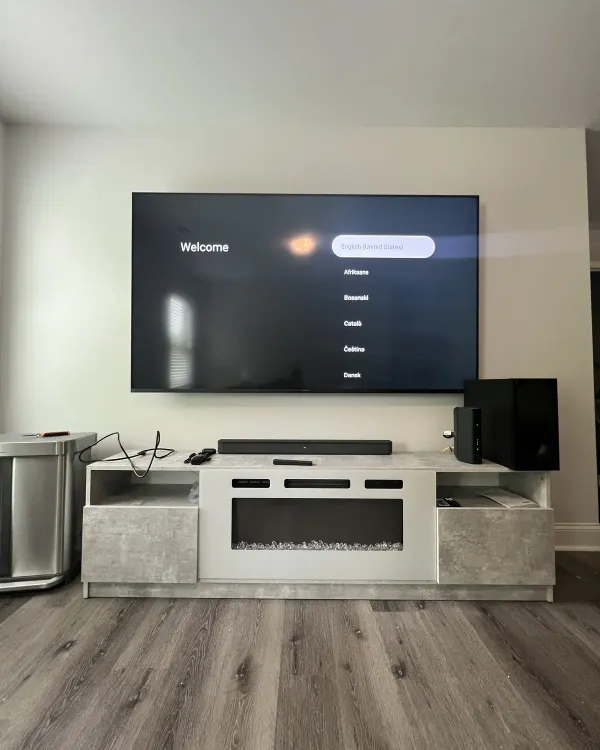
A TV on a white wall above a white console holding a sound system, showing its welcome screen

Documented install, April 2025 By the Atlanta crew.

TV Mounting Cost Estimate

Step 1 of 520%
How big is the TV?
One TV.

Rather we call you?

Leave your number, and we call you about your TV, any day from 8:00 AM to 8:00 PM. Add a note on the wall or the TV if you like.

Contact Information

Helps us match you with the installer closest to you.

Bronzeville took shape between 1870 and 1930 as a district of rowhouses, greystones and boulevard mansions, and from 1916 the Great Migration made it Chicago's Black Metropolis. Those houses still line King Drive, the Gap on Calumet, Giles and Prairie avenues, and the Giles-Calumet District. Houses of that age mean plaster, and on outside and party walls the installer's test hole usually finds brick behind it. Around them stand the mid-century towers of Lake Meadows and Prairie Shores and new houses and townhomes on rebuilt blocks. Your Express Mounting installer brings a rare-earth magnet, 5/16-inch lag bolts for wood studs, a hammer drill, 3/16-inch carbide bits and 1/4-inch Tapcons for brick, and SnapToggles for steel framing. Chicago's conduit electrical code applies. Same-day Bronzeville service when booked before noon.

What Express Mounting Customers Say

Google reviews of our Atlanta installs

These guys did an outstanding job installing 2 TVs for us. Highly recommend them for your TV mounting needs.

Angelina Pascar

Google review

AP
We called and requested a same day service and they were able to accommodate, even on a Friday. When our technician got here, he assessed our mounting ask in seconds and immediately got to work.

Kelly Bell

Google review

KB
Great service, thank you Alex

Aleksey Khusanov

Google review

AK

Look us up before you book

Express Mounting has one Google Business Profile, at our Alpharetta, GA headquarters. Customer reviews for every metro we serve live there.

Chicago installs are done by local installers we dispatch, on the same flat rates and the same warranty.

28 Google reviews, every one on that profile, from customers of the Atlanta crew.

Every booking comes with

  • 3-year workmanship warranty
  • Same-day installation when you book before noon
  • An installer typically arrives within 2-4 hours of confirmation

Greystones on King Drive: a carved stone front and what the test hole finds behind the plaster

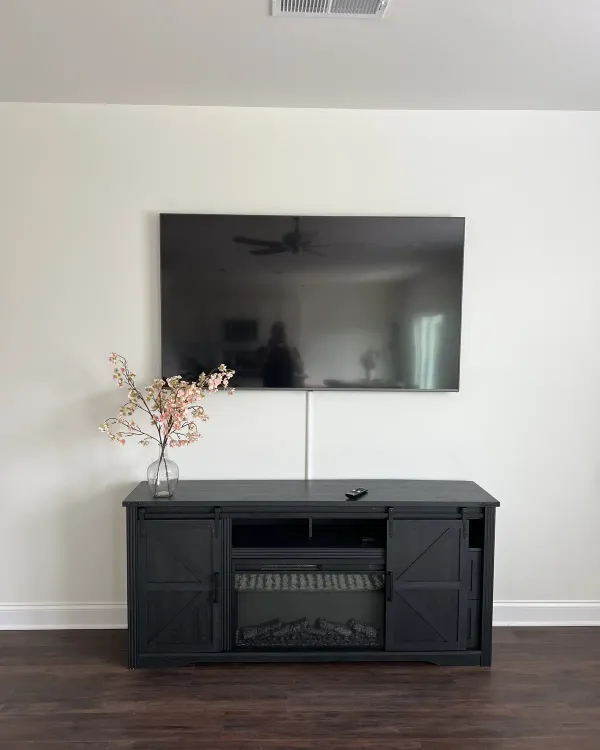
The greystone is the house people picture when they think of Bronzeville. They were built between about 1890 and 1930, two or three stories tall, with a front of light gray stone, wide steps, carved detail and sometimes a turret. Many hold two or three flats. King Drive, the old Grand Boulevard, still has a stretch of attached greystones that looks much as it did a century ago. Inside, a house of that age was finished in plaster, and the installer treats what is behind the plaster as a question. On a partition between rooms the usual answer is wood stud under lath: a magnet finds the nail rows, a 1/8-inch pilot confirms it, and 5/16-inch lag bolts go in. On an outside wall the test hole often passes plaster and a thin gap and then meets brick. That wall has no studs. The anchor has to reach the brick, so a 1/4-inch Tapcon is sized to cross the gap and bite an inch or more. Brick is masonry at +$99. Plaster over wood adds nothing.

A TV on a flat mount on a white wall next to a black media cabinet

The Gap: rowhouses on Calumet, Giles and Prairie, and the wall between you and next door

North of 35th Street, the 3100 to 3500 blocks of Calumet, Giles and Prairie avenues hold one of the few groups of rowhouses left on the South Side. They were built between 1870 and 1910 and include four by Frank Lloyd Wright, the Roloson Houses of 1894. Neighbors call the area the Gap, because it survived when the blocks around it were cleared in the 1960s. A rowhouse shares a wall with the house on each side, and in a narrow house one of them is usually the TV wall. Expect the test hole to find brick there, under plaster or under the drywall of a later rehab. A 3/16-inch carbide bit on a hammer drill, hammer action off for the first quarter inch so the finish does not chip, then 1/4-inch Tapcons in the brick face or the mortar joint, whichever lines up with the mount holes. Old mortar is scraped with an awl first. If it powders, the bracket shifts along its slots to sound material. Four anchors hold a 65-inch panel. Masonry adds +$99.

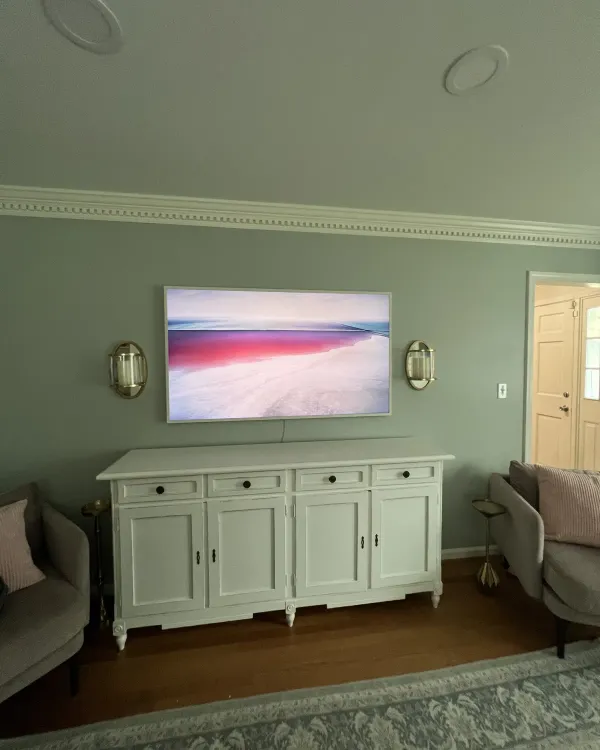
A TV on a flat mount centered above a white dresser on a sage-green bedroom wall

Divided into kitchenettes, restored since: plaster and drywall inside one Bronzeville house

Bronzeville's houses have been rearranged more than most. The Great Migration began in 1916, the district between 22nd and 55th streets doubled in population between 1910 and 1920, and apartments were subdivided into kitchenettes to hold the newcomers. Since the 1990s the movement has run the other way, with owners restoring greystones and rowhouses. A house that has lived both lives can have walls of more than one age. An original partition is plaster on wood lath. A wall added later, or one rebuilt in a gut rehab, is drywall on studs, and those studs may be wood or steel. Under paint they look alike. The installer tells them apart by knocking, by running a magnet for the fastener pattern, and by the dust on a 1/8-inch bit: gritty and hard for plaster, soft and chalky for drywall. Then wood gets lag bolts and steel gets SnapToggles. Drywall alone, between studs, carries only a small set, up to about 32 inches and 30 pounds. Neither plaster nor drywall adds a surcharge. A partition install takes 45 to 70 minutes.

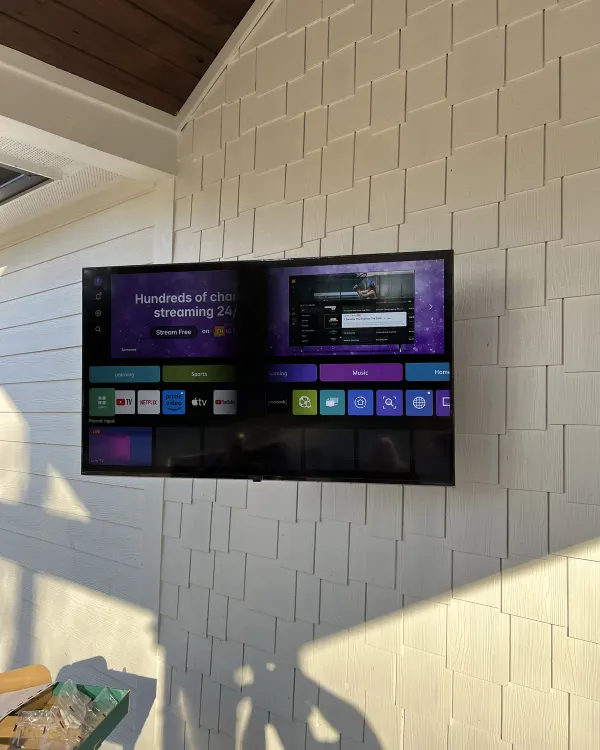
A TV mounted on a white shake-shingle wall under a vaulted wood porch ceiling

Lake Meadows and Prairie Shores: mid-century apartment towers where the pilot hole goes first

East of King Drive, between 31st and 35th streets, Lake Meadows was the city's first urban renewal project: residential towers designed by Skidmore, Owings & Merrill and set on wide lawns in the 1950s. Prairie Shores followed next door between 1958 and 1962, five towers of 19 stories. Together they are Bronzeville's high-rise addresses, and they are a different job from a greystone. We do not state what a given tower wall is made of. The installer tests it: a magnet across the surface, then a 1/8-inch pilot hole behind the TV spot. Bright metal on the bit is steel stud, and SnapToggles go through 1/2-inch holes, four for a fixed bracket and six for a full-motion arm. Gray dust and hard going is concrete, which takes a hammer drill, a 3/16-inch carbide bit and 1/4-inch Tapcons, with the +$99 masonry surcharge. Before booking, ask your building's management about drilling hours, visitor sign-in and elevator use for a large box. If you rent, get the owner's yes in writing. A fixed bracket leaves four small holes to fill at move-out.

New houses on rebuilt blocks: Legends South, Park Boulevard, Oakwood Shores and the infill between greystones

Some of Bronzeville's housing is brand new. The Robert Taylor Homes, 28 towers along State Street finished in 1962, came down between 1998 and 2007, and Stateway Gardens just north was gone by 2007 as well. Low-rise, mixed-income housing has been going up in their place under the names Legends South and Park Boulevard, and Oakwood Shores has replaced the Ida B. Wells Homes. On the side streets, new single-family houses and townhouses have filled vacant lots between the old greystones. Buildings this recent are the quickest walls in the neighborhood, and they are still confirmed before drilling. The stud finder marks the framing, a magnet picks up the row of drywall fasteners, and a 1/8-inch pilot shows wood shavings or bright steel. Wood takes 5/16-inch lag bolts, two in one stud for a 55-inch panel and four across two studs past 65 inches. In a townhouse the wall shared with the neighbor gets its own test hole. Open stud bays also make in-wall cable concealment simple at $99 per TV. No masonry, no surcharge.

Three walls, three cable routes: concealment under Chicago's conduit code

Bronzeville is inside the City of Chicago, where the electrical code requires wiring in metal conduit and does not allow flexible NM cable. A new outlet behind the screen is therefore an electrician's job, run in EMT, in a greystone and a new townhome alike. The mounting visit covers low-voltage cable: HDMI, optical, speaker and network. In-wall concealment is $99 per TV, and the route depends on which of three walls the TV is on. A drywall stud wall is the easy one, a fish-tape drop between two plates. A plaster-and-lath partition also has open bays, but the two openings are cut slowly with an oscillating tool so the plaster does not crack past the plate, and the tape is kept clear of any conduit the magnet finds. A brick outside wall or party wall has no bay, only the thin gap behind the plaster, and that is too tight to count on. There the cable runs in a paintable raceway on the surface for $79, or the TV moves to a partition.

Landmark blocks, the kit and the last look: a Bronzeville visit from door to picture

Parts of Bronzeville are Chicago Landmark districts: the Gap since 1988, the Giles-Calumet District on the 3700 and 3800 blocks since 2009, and the Black Metropolis-Bronzeville District, whose nine structures include the Victory Monument at 35th Street and King Drive. What a designation means for work at your address is a question for the city, and we do not answer it for them. The installer we dispatch arrives with the whole kit, because the wall is not known until it is tested: hammer drill, carbide bits, Tapcons in three lengths, lag bolts, SnapToggles, a rare-earth magnet, a laser level and a vacuum. The bracket is its own line: yours, or one of ours at $49 or $69 flat and $59 or $79 full-motion, by screen size. Plaster dust travels, so a drop cloth goes down and the vacuum runs at the bit. Then WiFi, inputs and a soundbar over HDMI eARC. Samsung including the Frame, Sony, LG OLED, TCL and Hisense are routine. You sit down and judge height and level before the tools are packed.

Your Bronzeville price, before you book

Pick the TV's size, the wall and the mount, and the estimator shows the labor price, from $129 per TV. Then book a time online, or call from 8:00 AM to 8:00 PM.

Field notes from Bronzeville installs

Bronzeville’s walls come from three building periods. The first ran from 1870 to about 1930 and left the rowhouses of the Gap, the greystones along King Drive and the row houses and two-flats of the Giles-Calumet District. A partition normally tests as wood stud under lath and takes lag bolts. An outside or party wall normally tests as brick behind the plaster and takes a hammer drill and Tapcons.

The second period is the 1950s and early 1960s, when Lake Meadows and Prairie Shores went up as apartment towers. Tower walls are tested first, and the pilot hole shows steel stud or concrete. The third is now: low-rise housing at Legends South, Park Boulevard and Oakwood Shores and infill houses on the side streets, where the usual finding is drywall over stud.

Freeze-thaw is the hazard in the old brick, so mortar is checked before an anchor goes in. Chicago’s conduit code makes a new outlet an electrician’s work. And on a landmark block, questions about the rules go to the city.

TV mounting prices in Bronzeville

Bronzeville pays by screen size, the same flat rate on every block: $129 up to 54”, $159 for 55-69”, $209 for 70-79”, $299 for 80-94”, $399 for 95” and up. Cable hidden inside the wall is $99 per TV. A paintable raceway on the surface is $79. Brick, stone or concrete adds the published +$99 masonry surcharge. Plaster, drywall and metal stud add nothing. Here that means plaster is never the cost and the brick behind it sometimes is: a TV lagged into the studs of a greystone partition stays at the base rate, and one anchored into the party wall of a rowhouse is masonry. The bracket is a separate line, $49 or $69 flat and $59 or $79 full-motion if you want one of ours. Soundbar install $79, and no travel fee anywhere in Bronzeville.

How Express Mounting covers Bronzeville

The company behind the visit is Express Mounting, started in Atlanta in 2015 by Alex Crabinsky, with 9,747+ documented installs behind its checklist. Bronzeville jobs run through vetted Cook County installers who carry the same hardware, work off the same install checklist, and back every job with the same 3-year workmanship warranty, held by Express Mounting. The installer we dispatch already knows that a greystone can have wood behind one wall and brick behind the next, and that old mortar gets checked before it is trusted.
TV mounting and installation in Bronzeville, IL: common questions

Is there one price for a Bronzeville TV install, or does a brick wall change it?

The labor rate is flat by screen size: $129 up to 54 inches, $159 for 55-69, $209 for 70-79, $299 for 80-94 and $399 for 95 and up. In-wall cable concealment is $99 per TV. Brick does change it. When the anchors go into masonry, as on the outside or party wall of a greystone or rowhouse, the +$99 masonry surcharge applies. Plaster-and-lath over wood studs, drywall and metal stud carry no surcharge. The bracket is its own line, yours or ours.

If I call before lunch, can my TV be up in Bronzeville by evening?

In most cases, yes. Book before noon at (470) 777-4077 or online, and an installer from our vetted Cook County network arrives within 2-4 hours of confirming a same-day request. That covers the neighborhood from the Gap and Lake Meadows on down King Drive.

What does the installer do differently on a rowhouse wall in the Gap?

Tests it before trusting it. One small hole shows whether the wall shared with the next house is brick, and whether the mortar is sound after more than a century of freeze-thaw. If it is, 1/4-inch Tapcons go in the brick face or the mortar joint, whichever lines up with the mount holes, and the +$99 masonry surcharge applies. If a spot is soft, the bracket shifts or the TV moves to another wall.

Calumet, Giles and Prairie are landmark blocks. Does that affect a TV on an inside wall?

That is the city's call, not ours, and we will not guess at its rules. The Calumet-Giles-Prairie and Giles-Calumet districts are Chicago Landmark districts, so if you are unsure, ask the city before booking. A new outlet is separate and is an electrician's work.

My Bronzeville greystone has a mantel in the front room. Is the wall above it a good place for the TV?

It can be, once it is tested. A chimney breast is usually brick behind the plaster, so it takes Tapcons and the +$99 masonry surcharge. The screen sits high there, so a tilt bracket helps, and a pull-down mount you supply is a $99 assembly add-on. If the fireplace still works, the installer checks the heat at that wall first.

Call (470) 777-4077 Text a photo

Text a photo of your wall

Point your phone's camera here to start a text to +14707774077. Add a photo of the wall and your TV's size, and we reply with your price and the first open time.

QR code that starts a text message to +14707774077
Use the quote form instead