Skip to content
Same-Day Service · Free Estimates Text a photo

TV mounting services in Pilsen, IL

Pilsen TV mounting is flat-rate: $129 up to 54", $159 for 55-69", $209 for 70-79", $299 for 80-94", $399 for 95-inch and up (2 technicians). Cable concealment is $99 per TV, brick or stone adds $99. Same-day slots when booked before noon, and the installer usually arrives within 2-4 hours of your confirmation.

“Very happy with the work. Polite, cleaned up after, and paid close attention to detail to make sure it was the ideal spot.”
John Leahy, Google review of an Atlanta install

Updated

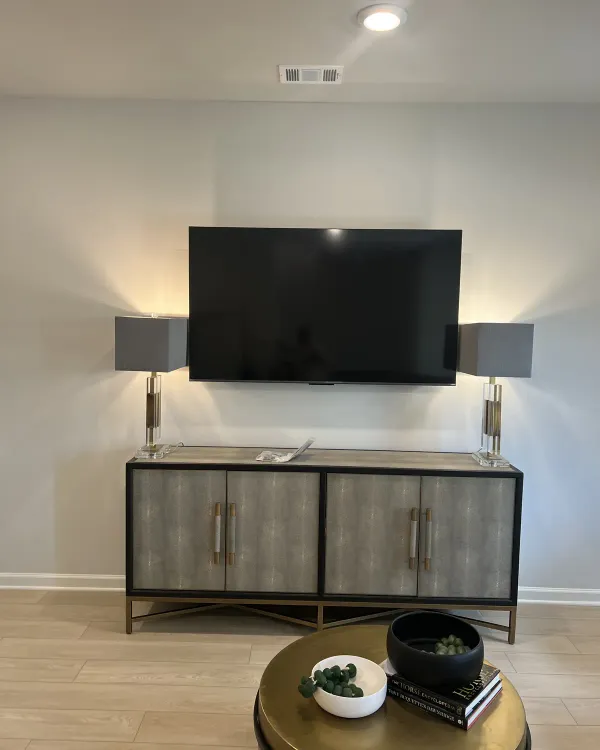
A TV on a flat mount on a white wall above a gray console and a round gold table

Documented install, June 2025 By the Atlanta crew.

TV Mounting Cost Estimate

Step 1 of 520%
How big is the TV?
One TV.

Rather we call you?

Leave your number, and we call you about your TV, any day from 8:00 AM to 8:00 PM. Add a note on the wall or the TV if you like.

Contact Information

Helps us match you with the installer closest to you.

Pilsen was built after the Great Chicago Fire of 1871, when Bohemian families settled the blocks around 18th Street and named them for the city of Plzen. Most of what stands dates from the 1880s and 1890s: brick cottages, rear houses at the back of the lot, two-flats and three-flats, and store-and-flats buildings. The city raised its streets, and some Pilsen lots still sit below the sidewalk. Walls are plaster, with common brick or wood stud behind, and the first hole says which. Your Express Mounting installer brings a hammer drill, 3/16-inch carbide bits and 1/4-inch Tapcons for brick, 5/16-inch lag bolts for studs, a magnet to tell them apart, and a moisture meter for a below-grade wall. Same-day Pilsen service when booked before noon.

What Express Mounting Customers Say

Google reviews of our Atlanta installs

Alex from Express Mounting did an outstanding job! He helped me take down my old 82-inch TV and professionally mount my new 82-inch setup with ease. He also went above and beyond by organizing and connecting all my peripherals, including my Xbox, PlayStation, and sound system. Everything looks clean, works perfectly, and was done efficiently. Highly recommend!

Jesse Fife

Google review

JF
Alex was experienced and knowledgeable about my 2 TV, outside install. Very pleased with the service. I have already recommended to my friends and neighbors.

Mark Gupton

Google review

MG
Excellent service! Installed my TV in less than an hour.

John De Lago

Google review

JD

Look us up before you book

Express Mounting has one Google Business Profile, at our Alpharetta, GA headquarters. Customer reviews for every metro we serve live there.

Chicago installs are done by local installers we dispatch, on the same flat rates and the same warranty.

28 Google reviews, every one on that profile, from customers of the Atlanta crew.

Every booking comes with

  • 3-year workmanship warranty
  • Same-day installation when you book before noon
  • An installer typically arrives within 2-4 hours of confirmation

Below the sidewalk: Pilsen's sunken lots and the wall that gets a damp check first

Pilsen keeps a trace of old Chicago that is easy to miss. When the city raised its street grades to build sewers, a job that took about two decades, the smaller buildings here were not always lifted to match. Several of them, and their lots, still sit below the street and sidewalk. Families planted gardens down in those front yards, which is how Pilsen came to be called the Garden City. For a TV it means the lowest floor of some buildings is partly below today's ground. An outside wall on that level is treated as a foundation wall until the test says otherwise. The installer checks it for damp with a moisture meter and looks along the base of the wall for staining before any hole. A dry wall takes 1/4-inch Tapcons in holes made with a 3/16-inch carbide bit, masonry work at +$99. A wall that reads damp does not get a bracket. The TV moves to a dividing wall, where plaster-and-lath over wood studs takes lag bolts at the base rate.

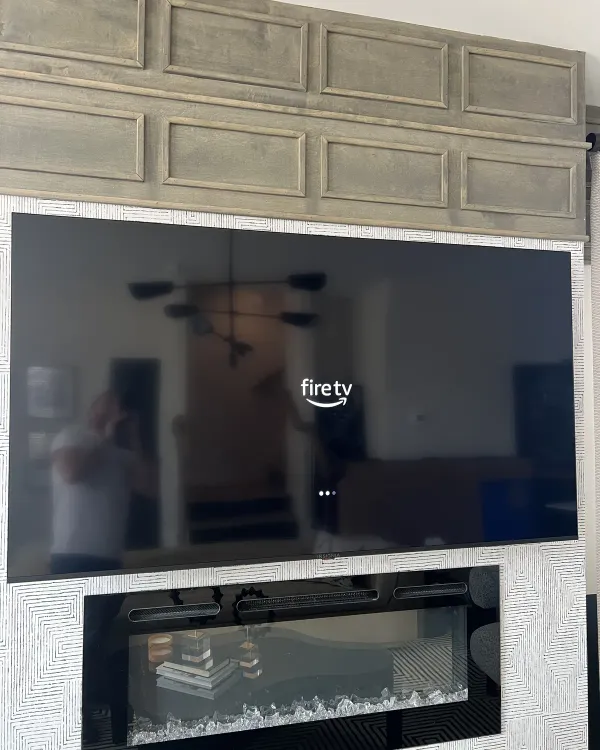
A TV mounted on a textured accent wall above a linear electric fireplace, under gray coffered paneling

Store and flats on 18th Street: apartments over a shop, three flights up

The National Register text for the Pilsen Historic District calls 18th Street the spine of the neighborhood. Its buildings went up between the late 1870s and 1910, most are three or four stories, and the pattern is the one old Chicago called store and flats: a shop at the sidewalk, apartments above. Living over a storefront shapes a TV install in three ways. The climb comes first. A fourth-floor flat is three flights up, so the installer measures the box against the stair and each landing before lifting, and a 95-inch or larger screen comes with two technicians as part of its price. Timing is second. Hammer drilling is kept to daytime hours and to the few minutes it needs, since a shop below and neighbors on either side all hear it. The wall is third. These are brick buildings, so the walls shared with the buildings next door are expected to be masonry under their plaster, and the walls between rooms are expected to be plaster-and-lath on wood studs. A magnet pass and one pilot hole settle it.

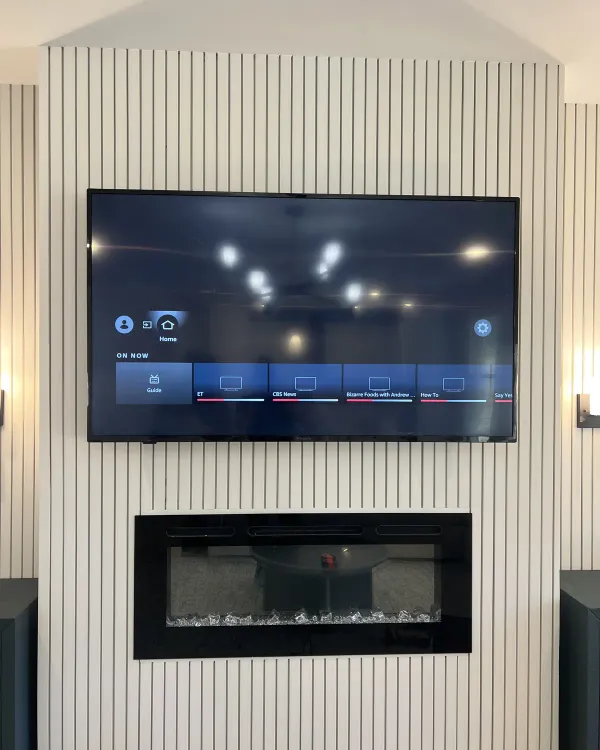
A TV mounted on a vertical slat accent wall above a linear electric fireplace

Brick cottages from the 1880s and 1890s: small rooms and outside walls with no stud

Builders did not start on Pilsen until after the 1871 fire, and many of its houses date from the 1880s and 1890s. Brick was the preferred material, and the modest brick cottage is one of the building types the historic district is known for. Two things define a TV job in one. The rooms are small, so screen size is worth a minute of thought. The installer tapes the outline of the panel on the wall, and you look at it from the seat before anything is drilled. The other thing is the wall. On the outside wall of a brick cottage the plaster usually sits on the brick or on thin furring strips, with no stud to find, and the mount goes on 1/4-inch Tapcons in the brick face or the mortar joint, whichever lines up with the mount holes. Mortar from the 1880s has been through a great many freeze-thaw winters, so it is scraped with an awl first. If it powders, the bracket slides along its slots to sound material. Brick adds the +$99 masonry surcharge.

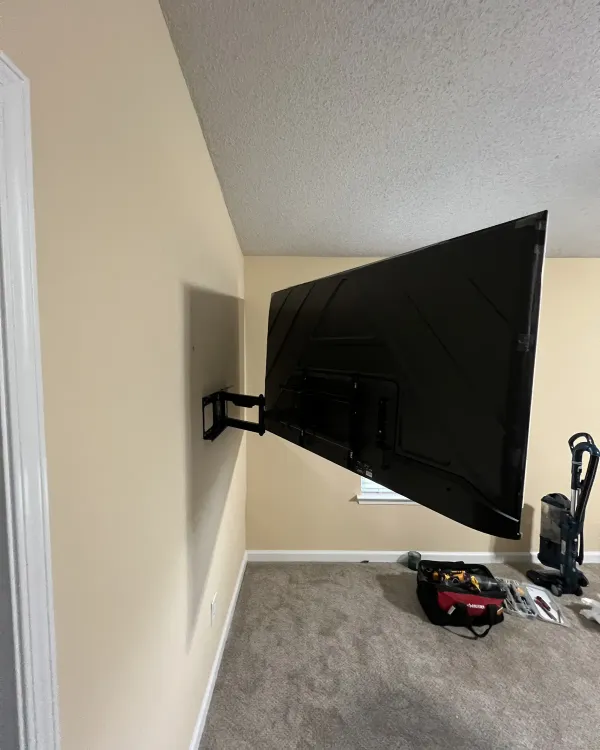
A TV on a full-motion arm swung out from a beige garage wall

Rear houses at the back of the lot: the narrow walk in and the wall you find there

One Pilsen habit doubled up the lots. An owner would build a first house at the rear of the lot, then a larger one toward the street later, and keep or rent the one behind. The National Register listing counts these back-lot houses among the district's building types, and an 1894 newspaper account describes frame dwellings standing behind the street-facing houses on Allport Street. If your home is the one in back, say so when you book. It changes two things. One is the carry: the way in is usually a narrow walk beside the front building, so the installer measures the TV box against that passage before bringing it through. The other is the wall. A frame rear house means wood studs behind plaster-and-lath, found with a magnet on the lath nails and confirmed with a 1/8-inch pilot hole, then 5/16-inch lag bolts and no surcharge. A brick one means Tapcons, a hammer drill and masonry pricing. The test decides, not the building in front. A rear-house install takes 60 to 90 minutes.

East Pilsen lofts and studios along Halsted: wood, steel or concrete, found by drilling

The east side of Pilsen, along Halsted Street, is one of Chicago's largest art districts: blocks of adjoining artists' lofts and studio spaces between 16th Street and Cermak Road. They are the least predictable walls in the neighborhood. No one should tell you what a loft building is made of without drilling it, and the installer we dispatch does not try. The test comes first. A magnet finds steel studs or conduit. A knock separates a hollow partition from a solid wall. A pilot hole behind the TV position shows wood, steel or concrete on the bit. Wood gets 5/16-inch lag bolts. Metal stud gets SnapToggles, set through 1/2-inch holes so the steel channel spreads the load behind the stud. Brick or concrete gets Tapcons and the +$99 masonry surcharge. Exposed brick has no cavity for cable, so wires run in a paintable raceway on the surface. In a live-work space the TV often shares a wall with shelving, tools or hung work, and the bracket position is taped out and agreed before a hole is made.

Pilsen two-flats and three-flats, brick or frame: conduit for power, a route for the cable

Two-flats and three-flats are the other Pilsen standard, in brick and, as the Chicago Architecture Center notes, in wood frame too. Whatever the wall, the wiring rule is the same, because Pilsen is a Chicago neighborhood and the Chicago Electrical Code requires wiring in metal conduit. Flexible NM cable is not allowed in the city. So a new outlet behind the TV is an electrician's job, run in EMT, and the mounting visit does not cover it. The cable side is ours. In-wall concealment at $99 per TV carries HDMI, optical, speaker and network cable from a plate behind the screen to a plate near the console. In a framed wall that is a drop through the open stud bay, with the magnet run down it first to locate any conduit and the plaster cut slowly with an oscillating tool. A brick wall has no bay. Its cables go in a paintable raceway on the surface for $79, or the TV moves a few feet to a wall that can take a drop.

Halsted to Western, 16th to Cermak: the order of a Pilsen visit

The Pilsen Historic District runs from Halsted Street west to Western Avenue and from the viaduct near 16th Street south to Cermak Road, and a visit anywhere in it follows one order. Wall first: magnet, knock, pilot hole. Then the bracket, matched to the TV's VESA pattern and weight. It is a separate line on the quote, yours or one of ours at $49 or $69 flat and $59 or $79 full-motion, and a pull-down mount you supply is a $99 assembly add-on. Height follows the seat: near seated eye level in a living room, center at 42 to 50 inches in a bedroom. The bracket is leveled with a laser line before it is fastened and again with the panel hanging. A drop cloth covers the floor, and a vacuum runs at the bit. Setup follows: WiFi, inputs, picture mode, and a soundbar over HDMI eARC, with soundbar mounting at $79. Samsung including the Frame, Sony, LG OLED, TCL and Hisense are routine. In a Chicago winter a cold panel warms to room temperature before it is powered on.

Your Pilsen price, before you book

Pick the TV's size, the wall and the mount, and the estimator shows the labor price, from $129 per TV. Then book a time online, or call from 8:00 AM to 8:00 PM.

Field notes from Pilsen installs

Almost nothing in Pilsen was built before 1871, and a great deal of it was finished by 1900. Bohemian families settled here after the Great Fire, built in brick, and left the neighborhood its cottages, rear houses, two-flats and three-flats, and the store-and-flats buildings that line 18th Street and Blue Island Avenue. Thalia Hall, at 18th and Allport, went up in 1892.

Behind the paint that means plaster. On outside and party walls the installer expects common brick under it and drills with a hammer drill and carbide bit for Tapcons. On dividing walls, and throughout the frame buildings, the expectation is plaster-and-lath over wood stud and lag bolts.

Two local conditions shape the rest. Streets were raised here and some lots were not, so a floor below the sidewalk gets a moisture check before any anchor. And 1880s mortar has had a long run of freeze-thaw, so it is tested before it is trusted. Power is conduit work under Chicago’s code, an electrician’s job.

TV mounting prices in Pilsen

A Pilsen quote starts with the size of the screen: $129 up to 54”, $159 for 55-69”, $209 for 70-79”, $299 for 80-94”, $399 for 95” and up. Concealing cables in the wall is $99 per TV. A paintable raceway on the wall surface is $79. Brick, stone or concrete adds the published +$99 masonry surcharge, and plaster, drywall and metal stud add nothing. Because brick is the main building material in Pilsen, the surcharge comes up often: on the outside wall of a brick cottage, a shared wall in a store-and-flats building, a below-grade foundation wall. A dividing wall or a frame rear house, lagged into wood studs, stays at the base rate. The bracket is separate, yours or ours at $49 or $69 flat and $59 or $79 full-motion. Soundbar install is $79, and there is no travel fee anywhere in Pilsen.

How Express Mounting covers Pilsen

Since Alex Crabinsky started Express Mounting in Atlanta in 2015, the company has documented 9,747+ installs, and that record is where the Pilsen routine comes from. Pilsen jobs run through vetted Cook County installers who carry the same hardware, work off the same install checklist, and back every job with the same 3-year workmanship warranty, held by Express Mounting. The installer we dispatch already knows a Pilsen wall is more likely brick than stud, and that a floor below the sidewalk is checked for damp before it is drilled.
TV mounting and installation in Pilsen, IL: common questions

Does Pilsen TV mounting have a set price by screen size?

Yes. $129 up to 54 inches, $159 for 55-69, $209 for 70-79, $299 for 80-94 and $399 for 95 and up. Hiding the cables inside the wall costs $99 per TV. Pilsen is mostly brick, and when the anchors go into brick, stone or concrete the +$99 masonry surcharge applies. A plaster-and-lath wall on wood studs, drywall and metal stud carry no surcharge. The bracket is a separate line, yours or ours.

Do installers get to Pilsen on the same day?

When you book before noon, yes. Call (470) 777-4077 or book online. An installer from our vetted Cook County network arrives within 2-4 hours of confirming a same-day request, on 18th Street, along Blue Island Avenue, near Harrison Park or in East Pilsen.

My Pilsen apartment's lowest floor is below the sidewalk. Can a TV go on that wall?

Often, after a check. Some Pilsen buildings sit below the street because the city raised the grade around them, so an outside wall on that level is treated as a foundation wall. The installer checks it for damp first. A dry wall takes Tapcons, with the +$99 masonry surcharge. A damp one does not get a bracket, and the TV goes on a dividing wall.

Is there a rule about TV mounts for buildings in the Pilsen Historic District?

Not one we can quote. The district has been on the National Register of Historic Places since 2006, and what that means for your building is a question for the city, and for the owner or management if you rent. The rule we can state is electrical: Chicago requires wiring in metal conduit, so a new outlet behind the TV is an electrician's work.

I live in a rear house behind another building in Pilsen. Can the installer get a large TV back there?

Yes. Tell us when you book that the address is a rear house and how wide the walk beside the front building is. The installer measures the box against that passage before carrying it in, and a screen of 95 inches or more comes with two technicians as part of its price.

Call (470) 777-4077 Text a photo

Text a photo of your wall

Point your phone's camera here to start a text to +14707774077. Add a photo of the wall and your TV's size, and we reply with your price and the first open time.

QR code that starts a text message to +14707774077
Use the quote form instead