Skip to content
Same-Day Service · Free Estimates Text a photo

TV mounting services in Rogers Park, IL

Rogers Park TV mounting is flat-rate: $129 up to 54", $159 for 55-69", $209 for 70-79", $299 for 80-94", $399 for 95-inch and up (2 technicians). Cable concealment is $99 per TV, brick or stone adds $99. Same-day slots when booked before noon, and the installer usually arrives within 2-4 hours of your confirmation.

“Very happy with the work. Polite, cleaned up after, and paid close attention to detail to make sure it was the ideal spot.”
John Leahy, Google review of an Atlanta install

Updated

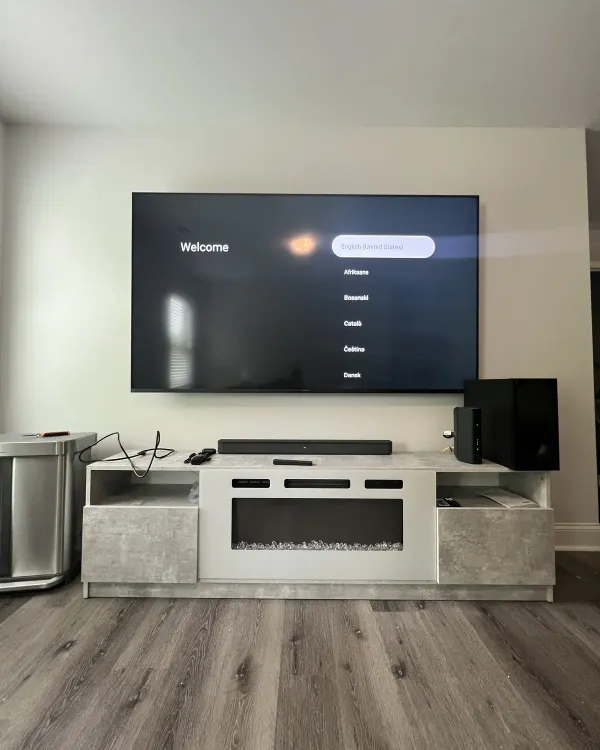
A TV on a white wall above a white console holding a sound system, showing its welcome screen

Documented install, April 2025 By the Atlanta crew.

TV Mounting Cost Estimate

Step 1 of 520%
How big is the TV?
One TV.

Rather we call you?

Leave your number, and we call you about your TV, any day from 8:00 AM to 8:00 PM. Add a note on the wall or the TV if you like.

Contact Information

Helps us match you with the installer closest to you.

Rogers Park is Chicago's far north lakefront neighborhood, a village annexed in 1893 that filled with apartments after the 'L' opened its Howard station in 1908. From Loyola and Sheridan Road through Morse Avenue, the Glenwood Avenue Arts District, Jarvis Square and the blocks north of Howard, the housing is courtyard buildings, two-flats, three-flats, large apartment blocks and some Victorian frame houses. The installer expects plaster, then tests what is behind it: common brick on furring strips, or wood stud under plaster-and-lath. Your Express Mounting installer brings a hammer drill, 3/16-inch carbide bits, 1/4-inch Tapcons, 5/16-inch lag bolts, SnapToggles and a rare-earth magnet. Lake-effect winters and the Chicago conduit code shape the rest. Same-day Rogers Park service when booked before noon.

What Express Mounting Customers Say

Google reviews of our Atlanta installs

They installed my TV on my deck in less than 30 minutes. Very professional and neat.

Alexandru Surugiu

Google review

AS
Very knowledgeable and sharp. They installed my TVs on the walls and configured my home network. Highly recommend!

George

Google review

G
Great service done by true experts. Fast and accurate, serviced next day. They also provided some nice heavy duty brackets. Highly recommend for any TV mounting needs. They also got me a very reasonable price.

Anastasia Ceclu

Google review

AC

Look us up before you book

Express Mounting has one Google Business Profile, at our Alpharetta, GA headquarters. Customer reviews for every metro we serve live there.

Chicago installs are done by local installers we dispatch, on the same flat rates and the same warranty.

28 Google reviews, every one on that profile, from customers of the Atlanta crew.

Every booking comes with

  • 3-year workmanship warranty
  • Same-day installation when you book before noon
  • An installer typically arrives within 2-4 hours of confirmation

From village to apartment district: the 1908 'L' and the plaster it left in Rogers Park

Rogers Park was incorporated as a village in 1878 and annexed to Chicago in 1893, when about 3,500 people lived here. Then the 'L' arrived. The Howard station opened in 1908, Loyola moved to the lakefront in 1912, and two-flats and large apartment blocks went up near the tracks. The population went from 6,700 in 1910 to more than 57,000 twenty years later. That one building rush explains most Rogers Park walls. Homes finished in those decades were finished in plaster, not drywall, and the installer arrives expecting it. What sits behind the plaster is the open question, and knocking never answers it. In a brick apartment building the installer tests the outside walls for masonry with the plaster carried on thin furring strips, and the walls between rooms for wood stud under plaster-and-lath. So every Rogers Park visit starts the same way: a magnet pass, then one 1/8-inch pilot hole behind where the TV will hang. The dust on the bit picks the hardware. Red dust means brick and Tapcons. Wood shavings mean lag bolts.

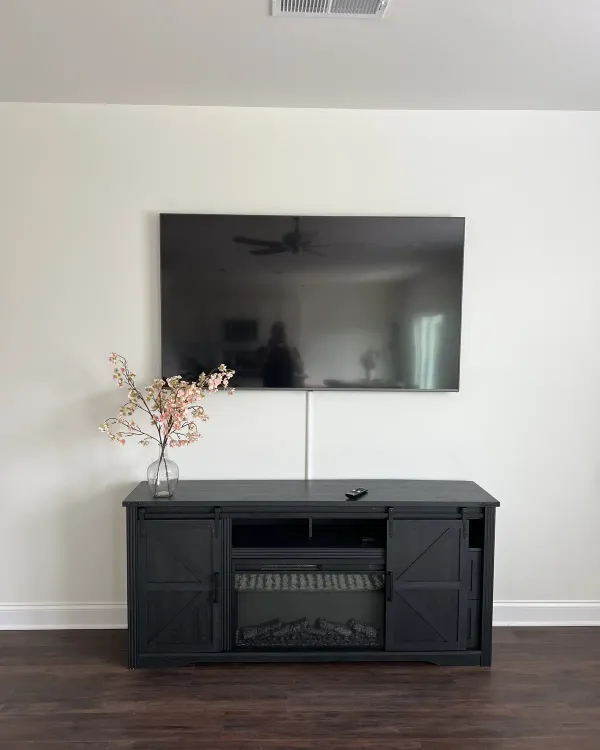
A TV on a flat mount on a white wall next to a black media cabinet

Rogers Park courtyard buildings: one pilot hole sorts the brick wall from the partition

The courtyard building is the Rogers Park address people picture: three or four stories wrapped around a landscaped court. Chicago has thousands of them, built from the 1880s on, and this neighborhood is one of the places they are found. For a TV, the question in a courtyard apartment is which kind of wall the screen is going on. Outside walls and the walls shared with the next stair are where the installer looks for brick. If the pilot hole passes plaster, crosses a thin gap and then meets brick, the plaster is on furring strips and the anchor has to reach past them. That calls for a 3/16-inch carbide bit on a hammer drill and a 1/4-inch Tapcon, set in the brick face or the mortar joint, whichever lines up with the mount holes. Brick is masonry, so the +$99 surcharge applies. If the hole brings out wood, it is a stud partition, and 5/16-inch lag bolts go in with no surcharge. Through the plaster the drill runs slowly, hammer action off.

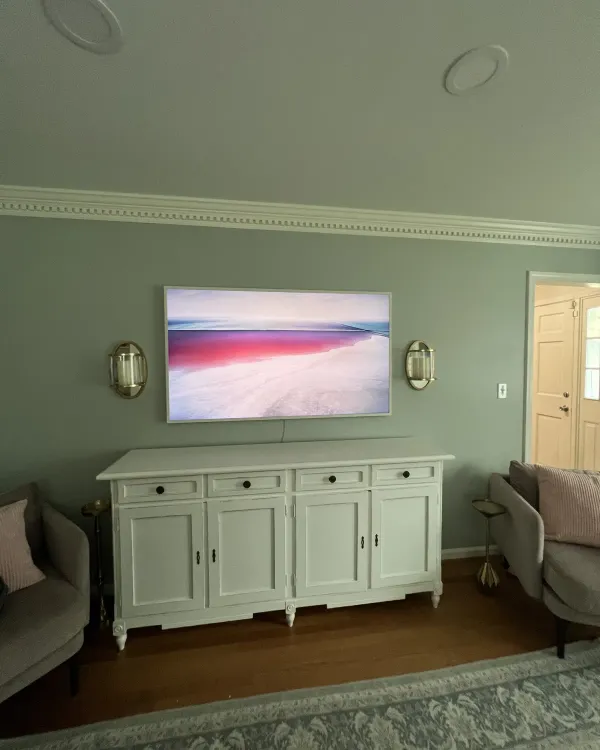
A TV on a flat mount centered above a white dresser on a sage-green bedroom wall

North of Howard: three-story apartment buildings, narrow streets and the carry upstairs

East of the 'L', Rogers Park jumps north of Howard Street for a few blocks, up to Calvary Cemetery. The area came into Chicago in 1915, and it was built tight: narrow streets lined with three-story apartment buildings. It is also where the neighborhood's apartment construction ran heaviest, along with the strip beside the 'L' tracks. Two practical things follow for a TV install. First, the carry. Courtyard and apartment buildings of that era seldom had elevators, so tell us the floor when you book. The installer measures the box against the stair and the landing before lifting, and a panel of 95 inches or more comes with two technicians as part of its $399 price. Second, the neighbors. A third-floor unit has people below and beside it, so hammer drilling is kept short: mark every hole, drill them in one pass, vacuum at the bit. If your building posts quiet hours, give them to us with the booking and the visit is set inside them. The walls get the same pilot-hole test as anywhere in Rogers Park.

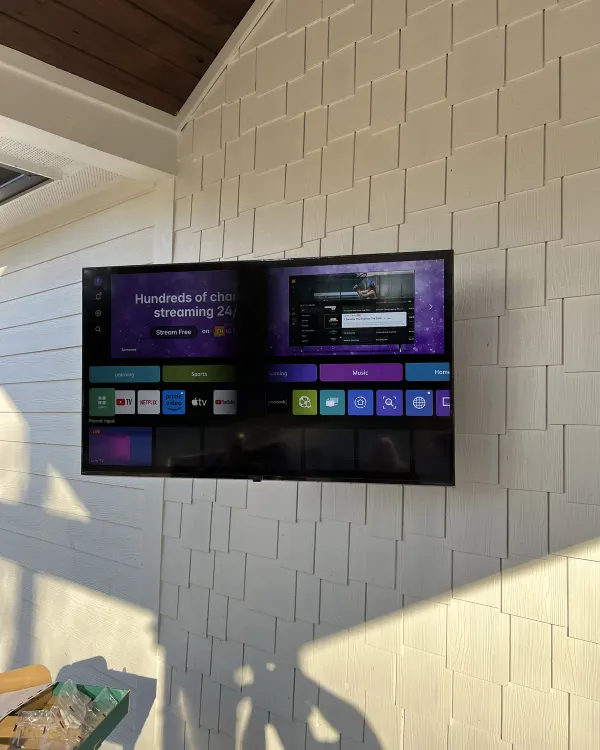
A TV mounted on a white shake-shingle wall under a vaulted wood porch ceiling

Victorian frame houses between the Metra line and Ridge: studs under plaster-and-lath

Before the apartments, Rogers Park was a railroad suburb. The Chicago and North Western line arrived in 1873, and large Victorian homes went up on the blocks between those tracks, now the Metra line, and the ridge to the west. Some of that 19th-century wood-frame housing still stands among the bigger buildings. A frame house is the one Rogers Park wall where the installer expects a stud, and the work is locating it. Plaster-and-lath defeats an electronic stud finder, which reads the lath as one continuous stud. A rare-earth magnet is the better tool. Dragged slowly over the wall, it sticks wherever a lath nail sits, and the nails line up over the studs. A 1/8-inch pilot hole then settles it. If the bit keeps pulling wood, that is a stud. If it breaks through into a hollow, the hole is between studs. Spacing in a house this old can wander, so no stud is assumed from the one beside it. Then 5/16-inch lag bolts go in, four for a screen past 55 inches. Plaster carries no surcharge.

Sheridan Road and the lakefront: high-rises and later apartment buildings are tested first

Sheridan Road was the showpiece street of old Rogers Park, with large houses on big lots by the end of the 1800s. Frank Lloyd Wright's Emil Bach House, completed in 1915 at 7415 North Sheridan, survives from that period. Many of its neighbors were later replaced by four-plus-one apartment buildings, and close to the lake there are a few high-rises from the 1910s and 1920s. These are the Rogers Park buildings where the installer assumes least. A taller or later building can have wood stud, steel stud or concrete behind the finish. So the pilot hole comes first. Wood shavings call for lag bolts. Bright metal curls mean steel framing, and SnapToggles go through 1/2-inch holes so the load is spread behind the stud. Gray powder means concrete: hammer drill, carbide bit, 1/4-inch Tapcons, and the +$99 masonry surcharge. Lake-effect weather adds one caution on this side of the neighborhood. A wall that faces the water runs cold in January, so where the room allows a choice, an inside wall is the better home for the screen.

Leases, condo associations and Chicago's conduit rule: what to settle before a Rogers Park booking

A great many Rogers Park homes are apartments, so the first step is often a phone call that is not to us. If you rent, ask the owner or the management office whether a wall mount is allowed, and get the yes in writing. A fixed bracket leaves four small holes to fill at move-out. If you own in a vintage condo building, ask the association about drilling hours and about any wall shared with a neighbor. We do not know your building's rules, and we do not guess at them. Power is the other thing to settle. Rogers Park is inside the City of Chicago, where the electrical code requires wiring in metal conduit and the flexible NM cable common elsewhere is not allowed. A new outlet behind the screen is an electrician's work. Our part is low-voltage: HDMI, optical and network cable. In a stud partition, hiding those cables inside the wall is $99 per TV. On a brick wall with no usable cavity, a paintable raceway on the surface is $79.

What comes up the stairs with the installer, and how a Rogers Park visit ends

The installer we dispatch to Rogers Park carries the whole kit to your door, because the wall is not known until it is tested: hammer drill, 3/16-inch carbide bits, Tapcons in three lengths, 5/16-inch lag bolts, SnapToggles, a rare-earth magnet, a laser level, painter's tape and a vacuum. A drop cloth goes down and the vacuum runs at the bit. The bracket is matched to the TV's VESA pattern and weight, and it is its own line on the quote: yours, or one of ours at $49 or $69 for a flat bracket and $59 or $79 for full-motion, by screen size. Before any hole, the screen's outline is taped on the wall for you to judge from your seat. In a bedroom the center lands 42 to 50 inches off the floor. In winter, a panel that has been in a cold car warms to room temperature before it is switched on. Then setup: WiFi, inputs, and a soundbar over HDMI eARC, with soundbar mounting at $79. Samsung including the Frame, Sony, LG OLED, TCL and Hisense are routine.

Your Rogers Park price, before you book

Pick the TV's size, the wall and the mount, and the estimator shows the labor price, from $129 per TV. Then book a time online, or call from 8:00 AM to 8:00 PM.

Field notes from Rogers Park installs

The ‘L’ made Rogers Park. Before the Howard station opened in 1908 this was a former village of frame houses. By 1930 it was one of the most densely populated parts of Chicago, and most of what stands between Devon Avenue and the Evanston line dates from that stretch: courtyard buildings, two-flats and three-flats, large apartment blocks.

Nearly every wall is plaster with a test behind it. Brick outside walls take a hammer drill and Tapcons. Wood stud partitions and the old frame houses west of the ‘L’ take lag bolts, with the studs found by magnet. On Sheridan Road and near the lake, high-rises and later apartment buildings are tested with no assumptions, since the pilot hole can show wood, steel or concrete.

Rogers Park sits on Lake Michigan, so lake-effect cold and freeze-thaw are part of every winter, and a cold panel warms up before it is powered on. And this is the City of Chicago: wiring runs in conduit, so a new outlet is an electrician’s job.

TV mounting prices in Rogers Park

A Rogers Park quote starts from the screen: $129 up to 54”, $159 for 55-69”, $209 for 70-79”, $299 for 80-94”, $399 for 95” and up. Running the cables inside the wall is $99 per TV. A paintable raceway on the surface is $79. Brick, stone or concrete adds the published +$99 masonry surcharge. Plaster, drywall and metal stud add nothing. In Rogers Park that means an anchor into the brick outside wall of a courtyard building or a two-flat is masonry work, and a mount lagged into a stud partition or a frame house wall stays at the base rate. The bracket is a separate line: your own, or ours at $49 or $69 flat and $59 or $79 full-motion. Soundbar install $79. No travel fee anywhere in Rogers Park.

How Express Mounting covers Rogers Park

Express Mounting was started in Atlanta in 2015 by Alex Crabinsky, and the 9,747+ documented installs since then are what the Rogers Park checklist is built on. Rogers Park jobs run through vetted Cook County installers who carry the same hardware, work off the same install checklist, and back every job with the same 3-year workmanship warranty, held by Express Mounting. The installer we dispatch already knows that a courtyard building wall can be brick on one side of the room and wood stud on the other, and drills one small hole to find out which.
TV mounting and installation in Rogers Park, IL: common questions

What is TV mounting going to cost me in Rogers Park?

The price follows the screen: $129 up to 54 inches, $159 for 55-69, $209 for 70-79, $299 for 80-94 and $399 for 95 and up. Hiding cables inside the wall is $99 per TV. When the anchor goes into brick or concrete, as it can on the outside wall of a Rogers Park courtyard building, the +$99 masonry surcharge applies. Plaster, drywall and metal stud add nothing. The bracket is extra, yours or one of ours.

I'm up by Howard Street. Is a same-day TV install possible in Rogers Park?

Yes, when you book before noon, online or at (470) 777-4077. An installer from our vetted Cook County network arrives within 2-4 hours of confirming a same-day request. That holds from the blocks north of Howard down past Jarvis Square and Morse Avenue to Loyola.

Which wall in a Rogers Park courtyard apartment should carry the TV?

Whichever one tests best for where you sit. The installer drills one small pilot hole in each candidate wall. A wood stud partition takes 5/16-inch lag bolts at the base rate. A brick outside wall takes 1/4-inch Tapcons in the brick face or the mortar joint, whichever lines up with the mount holes, and adds the +$99 masonry surcharge.

My Rogers Park lease says nothing about wall mounts. Who do I ask before booking?

The owner or the management office, and get the answer in writing. It helps to say that a fixed bracket leaves four small holes to fill at move-out and that cables can run in a paintable surface raceway with no opening cut in the wall. Condo owners should put the same question to their association.

Can the TV go on a lake-facing outside wall in Rogers Park?

It can, once the wall is tested. An outside wall in an older brick building may be masonry behind the plaster, which counts as masonry work at +$99. One caution comes with lake-effect winters. That wall runs colder than an inside one, so an inside wall is the better pick when the room gives a choice.

Call (470) 777-4077 Text a photo

Text a photo of your wall

Point your phone's camera here to start a text to +14707774077. Add a photo of the wall and your TV's size, and we reply with your price and the first open time.

QR code that starts a text message to +14707774077
Use the quote form instead