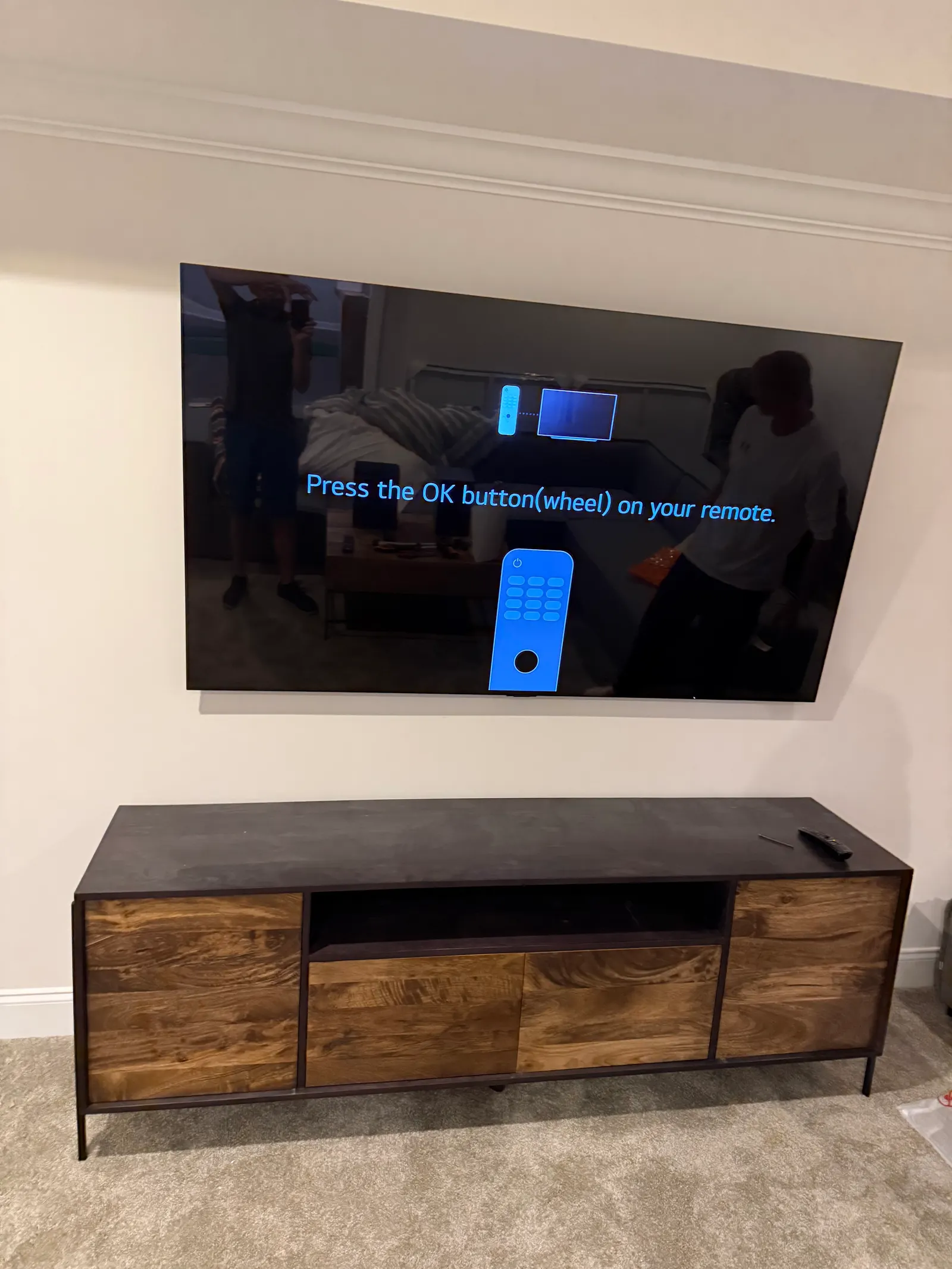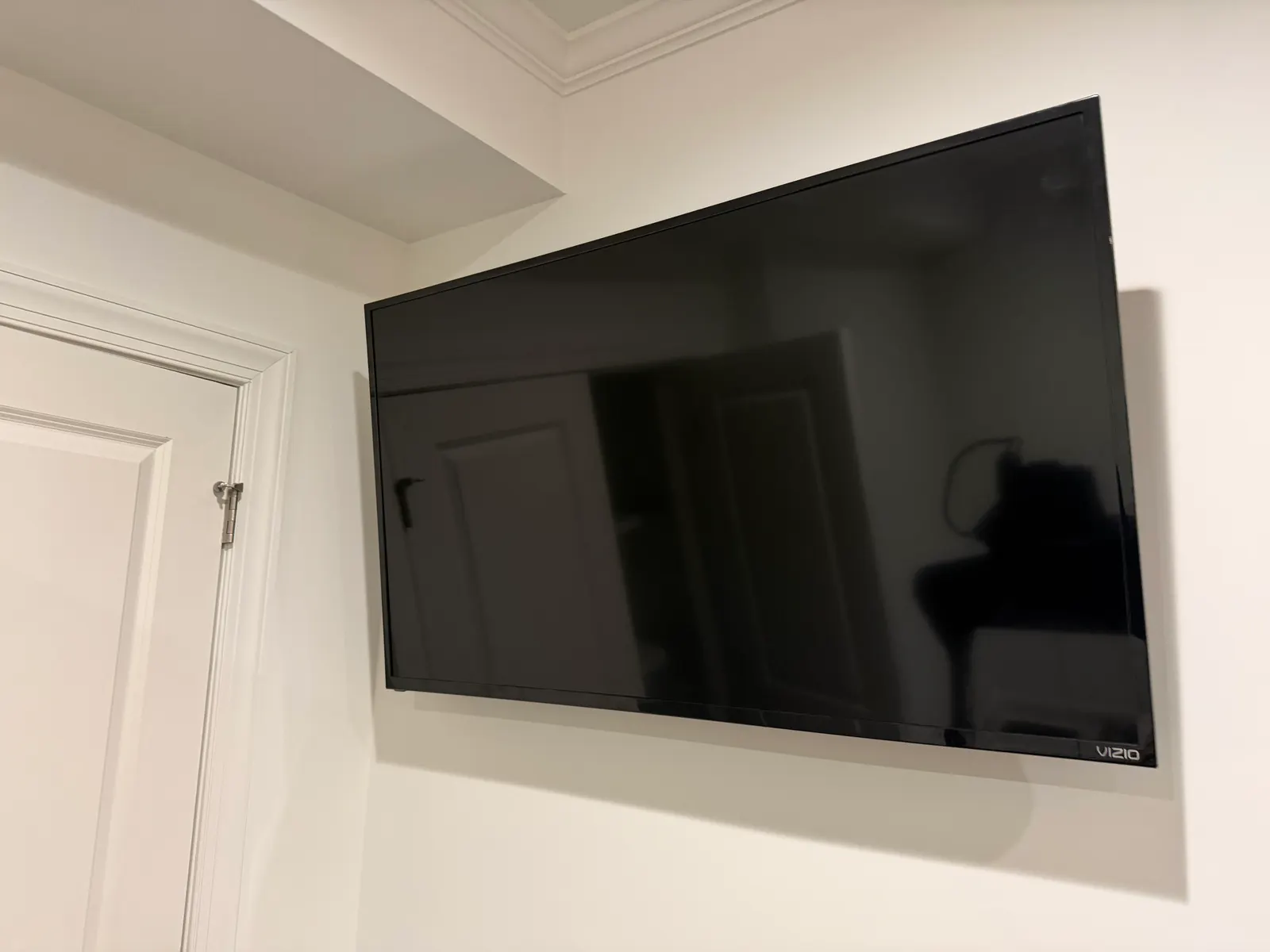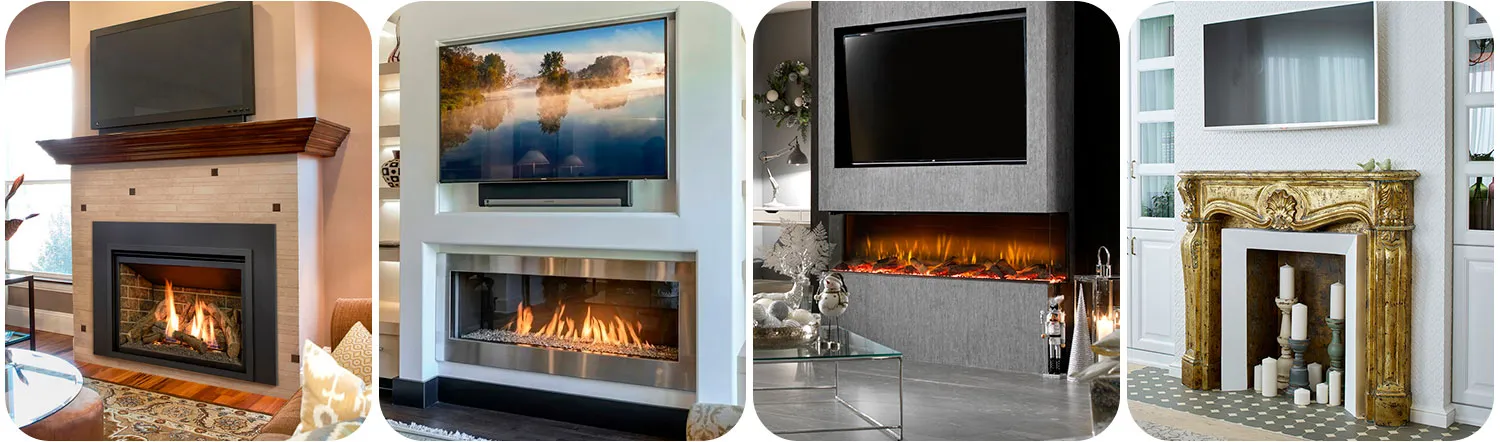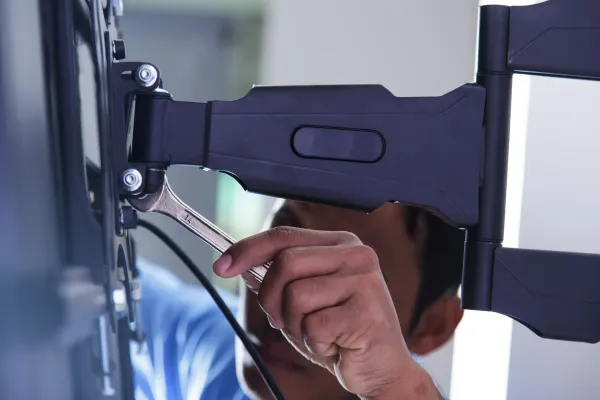
Mounting a TV on drywall is safe only when the install respects strict weight and anchor rules. After 7,874 documented TV installs since 2015, the rule is simple: TVs over 32 inches require at least one wall stud (drywall anchors alone will not hold long-term); TVs under 32 inches and under 30 lbs can mount in drywall using 4+ heavy-duty toggle anchors rated 100 lbs each. Full-motion mounts must always anchor into studs regardless of TV size, because cantilever torque exceeds any drywall-only anchor system.
Quick note: This page contains Amazon affiliate links. We may earn a small commission at no extra cost to you if you buy through them. Recommendations come from products I’ve personally hung on real customer walls over 10 years and 7,874 installs - not spec-sheet guessing.
Wall-mounted TVs are sleek, space-saving, and a great way to modernize your living room - but is it safe to mount a TV on drywall? Drawing on 7,874+ documented TV installs since 2015, our team at Express Mounting has seen every drywall scenario, from new construction to 1950s plaster-over-lath, and the rules below come straight from those field installs.
Short answer: Yes, but only if it’s done right.
Mounting a TV is more than just finding a place that looks good - it’s about making sure that place is structurally sound and safe. If you’re considering a wall mount, especially in a rental, older home, or drywall-heavy room, there are some crucial things to know before you pick up a drill.
Let’s walk through what works, what to avoid, and how to safely mount your TV on drywall - whether you do it yourself or call in the pros.
Why people love mounting TVs on drywall
Drywall is one of the most common wall types in homes and apartments across the U.S., and for good reason - it’s inexpensive, easy to paint, and relatively simple to work with. Because it’s so widespread, it’s also where most people first attempt a DIY TV mount.
“Can I mount my TV directly onto drywall without studs?”
That’s a question we hear all the time - and unfortunately, many people attempt it without understanding the risks. What seems like a quick 30-minute job can easily turn into a costly repair or, worse, a damaged TV.
When done right, wall mounting your TV to drywall looks incredibly clean and helps free up floor space. It can also keep cords out of reach of kids and pets, making it a safer option overall.
The truth: drywall alone can’t hold a TV (and why that matters)
Here’s the key thing most people don’t realize:
- ➡️ Drywall by itself is not designed to hold heavy loads like a flat-screen TV.
- ➡️ A typical 55-inch TV weighs around 30-50 pounds - and drywall won’t hold that weight long-term without proper support.
Even if it seems stable at first, a TV mounted without studs or anchors can pull out over time, especially if you tilt or swivel it often. And if the mount fails, you’re looking at damage to your wall, the mount, and possibly your expensive TV.
Field note from an Inman Park job: A homeowner on Elizabeth Street called us in last fall thinking she had standard drywall - she’d already drilled three pilot holes and snapped two SnapToggles. The wall was actually 1920s plaster-on-lath with a 1990s drywall skim coat. We swapped to 4-inch Grade 5 lag bolts hitting the original studs and the 65-inch Sony hung perfectly. Identifying the wall correctly saved a $400 patch job.
The best way to avoid all of this? Anchor into the wall studs - solid vertical beams behind the drywall that are designed to bear weight. If you live in an older home with plaster surfaces, see our guide on how to find studs behind plaster and lath walls before drilling. If those aren’t accessible, specialized anchors may work in certain cases, but they must be carefully selected based on your TV’s weight and mount type. Our complete walkthrough on how to mount a TV covers the full step-by-step process.
Is it ever safe to mount a TV without studs?
Yes, but only under specific conditions, and only if you’re using professional-grade drywall anchors or toggle bolts designed for heavier loads. For a deeper dive into when no-stud mounting is actually safe (and when the “no-stud” marketing is a myth), read our breakdown of the no-stud TV mounting myth. If you’re deciding between hardware options, our toggle bolts vs lag bolts guide explains which fastener belongs in which wall.
These anchors expand behind the drywall, creating more surface area to hold the mount in place. However, this solution is typically only safe for smaller TVs - usually under 30-40 lbs - and fixed mounts that won’t be adjusted regularly.
Two numbers decide whether that math works, and people routinely check the wrong one. The bracket’s screen size range tells you nothing about load. What holds the television is the stated weight rating, and it has to sit above your panel’s weight without its stand, since that is the figure every rating refers to. The second number is the hole spacing on the back of the panel, which follows the VESA Flat Display Mounting Interface standard and varies by model and by screen size within the same model. A bracket can satisfy the size range on the box, miss the weight rating, and still bolt on perfectly, which is precisely how a mount ends up on the floor with the drywall still attached to it.
That said, we always recommend using studs where possible. If your wall doesn’t line up perfectly with your layout, here are a few smart alternatives:
- Use a mounting plate that spreads the load across multiple anchors and/or studs
- Consider adding a plywood support panel behind the wall for added reinforcement
- Select a mount that spans multiple studs and provides flexibility
- Hire a professional to assess the wall and provide the safest install option
If you’re mounting a large TV (85 inches or larger), drywall anchors are off the table entirely - see our heavy-duty 85”+ TV mounting guide for Atlanta for the structural reinforcement these jobs require.
Common TV mounting mistakes on drywall
Here at Express Mounting, we’ve fixed a lot of “DIY gone wrong” situations. The most common mistakes we see when people try to mount a TV into drywall include:
- ❌ Using plastic drywall anchors not rated for weight (these often fail over time)
- ❌ Mounting into hollow drywall with no stud support
- ❌ Eyeballing the stud location instead of using a reliable stud finder
- ❌ Skipping a level, leading to a crooked TV
- ❌ Ignoring hidden pipes or wires behind the wall
- ❌ Over-tightening bolts, damaging the drywall or causing anchor failure
Every one of these errors can lead to an unstable TV setup - or worse, a dangerous one.
So, is it safe to mount a TV on drywall?
✅ Yes - but only when installed correctly, with proper support and tools.
Here’s a simplified safety checklist:
| Requirement | Safe for TV Mounting? |
|---|---|
| Mounted directly into wall studs | ✅ Yes |
| Heavy-duty toggle anchors (with caution) | ✅ Sometimes |
| Mounted into drywall only (no anchors/studs) | ❌ No |
| Used level and stud finder | ✅ Strongly recommended |
| Checked wall for wires/pipes | ✅ Absolutely |
If you’re ever unsure, your safest option is to consult with a professional. A one-time expert install is far more affordable than replacing a damaged TV - and gives you confidence every time you hit that power button.
Express Mounting service pricing for drywall installs
If you’d rather skip the DIY guesswork: Express Mounting flat-rates drywall TV installs across Metro Atlanta - basic mount $129 (up to 54”), $159 (55-69”), $209 (70-79”), $255 (80”+). Cable concealment $95 per TV. Masonry surcharge +$99 for brick or stone walls. Call (470) 777-4077 to book.
Need help? We’ve got you covered.
At Express Mounting, we’ve mounted TVs on every wall surface you can imagine - and yes, drywall is one of our specialties.
Whether you need help choosing the right bracket, determining if your wall can hold a larger screen, or just want someone to handle the whole process from start to finish - we’re ready.
✅ Fast, safe, and clean installation
✅ Full cable management & outlet solutions
✅ Brick, drywall, and fireplace walls
✅ Local install team with 7,874+ Atlanta jobs
Don’t risk it. Mount it right.
Mounting a TV may look simple on YouTube - but when drywall is involved, even small mistakes can lead to expensive problems. If you’re thinking about mounting your TV on drywall, take a moment to make sure it’s being done the right way.
Your TV deserves to be secure. Your wall deserves to be protected. And you deserve the confidence knowing it was done professionally.
👉 Request a quote or call (470) 777-4077 - flat-rate installs from $129 across 13 metros nationwide, studs found and wires hidden.
Let us take care of everything - so you can sit back, relax, and enjoy your perfectly mounted screen.
Frequently Asked Questions
Can I mount a 55-inch TV on drywall without studs?
We do not recommend it. A typical 55-inch TV weighs 30-50 lbs, and even a fixed mount creates leverage that pulls outward on the wall. Without at least one stud (or a plywood backer panel installed behind the drywall), the anchors will eventually loosen, especially with seasonal humidity cycles. If you cannot hit a stud, use heavy-duty snap-toggles rated 100+ lbs each in a 4-anchor pattern, and choose a fixed (non-tilting, non-articulating) mount only.
How much weight can drywall hold?
Standard 1/2-inch drywall on its own holds roughly 5-10 lbs per anchor point with plastic anchors, and up to 100 lbs per anchor point with heavy-duty snap-toggles or strap toggles. However, “holds” means static load. TV mounts apply dynamic and leveraged load, so the practical safe weight is about 30-40 lbs total for a drywall-only install using 4 quality toggles.
What’s the safest anchor for drywall mounting?
The safest drywall-only anchor for TV mounting is a heavy-duty steel SnapToggle drywall anchor (sometimes branded SnapSkru or Toggler) rated 100+ lbs per anchor.
For loads approaching the upper limit, heavy-duty toggle bolts rated 200 lb give an extra safety margin. Plastic expansion anchors and self-drilling plastic anchors are not suitable for TV mounts.
For anything over 40 lbs or any full-motion mount, skip anchors and hit at least one stud (a Franklin ProSensor 710 stud finder is what we use on every install to locate studs reliably).
Do snap-toggles really hold a TV?
Yes, when used correctly and within their rating. Snap-toggles distribute load across a metal channel that sits flat behind the drywall, dramatically increasing pull-out resistance compared to plastic anchors. They work best for small to mid-sized fixed mounts (under 40 lbs TV weight) where stud access is impossible. They do not solve the cantilever problem on full-motion mounts.
Does a full-motion mount need studs?
Always. Full-motion (articulating) mounts amplify torque as the arm extends, sometimes by 3-5x the TV’s weight at full extension. No drywall anchor system, regardless of rating, is designed for this cyclical leveraged load. Full-motion mounts require at least one stud, ideally two, or a properly installed plywood backer panel anchored to studs.
Can I mount a 75-inch TV on drywall?
Not on drywall alone, full stop. A 75-inch TV typically weighs 70-100 lbs depending on model, and the bracket spans wide enough that even with toggles in all four corners, the cantilever pulls anchors out within months. Always anchor a 75-inch into at least two wood studs using 3/8” x 3” Grade 5 lag bolts. If the studs do not align with your bracket, install a 3/4” plywood backer panel (24” x 16”) anchored across two studs, then mount the bracket to the plywood. We did this exact reinforcement on a Roswell client’s Samsung Q90 last month.
What if my drywall is older or softer?
Pre-1980s drywall is typically thinner (3/8” instead of standard 1/2”) and made with weaker gypsum binders that crumble under toggle pressure. If your home was built before 1980 and you cannot get to a stud, do not use snap-toggles - they pulverize the drywall when set. Instead, use Molly bolts (sleeve-style anchors) which compress against the back of the wall without crushing the gypsum, or step up to a plywood backer panel screwed into studs. Newer thick drywall (5/8” fire-rated, common in condos) handles toggles fine.
How do I tell if my wall is plaster or drywall?
Three quick tests: (1) tap it - drywall sounds hollow and dull, plaster rings sharper and harder; (2) look at an outlet box - if you see crumbly white dust around the edges, it’s drywall; if you see hardened gray-white material with embedded fibers or wood lath strips, it’s plaster; (3) push a thumbtack into a hidden corner - drywall accepts it easily, plaster resists or chips. If the wall is plaster-on-lath, your install rules change completely - see our plaster-and-lath stud-finding guide before drilling.
Written by Alex Crabinsky, founder of Express Mounting and lead installer behind 7,874+ TV installs across Metro Atlanta.